
Installing fiber overhead remains one of the fastest, most economical ways to deliver broadband across neighborhoods, campuses and long rural stretches — but it’s not the same as pulling indoor cable. Aerial work mixes mechanical engineering (span, sag, tension), careful selection of cable types (ADSS, figure-8, lashed) and a disciplined safety-first attitude. This article explains the common aerial cable types, the hardware you’ll actually use on poles and span ends, and the safety practices that keep crews and the network safe — nothing more, nothing less.
What aerial installation means and why choice matters
Aerial fiber installation places optical cable on poles or other supports rather than underground or in conduit. That makes it quicker to deploy and easier to inspect, but the cable must withstand wind, ice, UV exposure, vibration and occasional mechanical abuse. Choosing the correct cable construction and support hardware up front reduces failures and lowers lifetime cost. Industry design guides (Telcordia GR-20 and manufacturer installation manuals) are the reference points for performance and environmental tests for outside-plant cables.
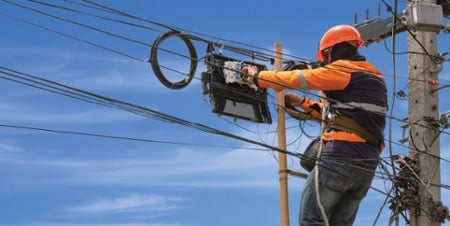
Common aerial cable types
ADSS (All-Dielectric Self-Supporting) — a standalone, nonconductive jacketed cable that carries its own weight between poles without a supporting steel strand. ADSS is used where electrical isolation is needed (near power lines) because it has no metallic messenger. Installation requires attention to tensioning and creep behavior.
Figure-8 / Self-supporting (steel messenger integrated) — these cables have an integrated steel messenger in a figure-eight cross-section; they are simple to hang and often rated for specific maximum span lengths. They combine messenger and fiber in one jacket for fast, single-pass installation.
Lashed (lashing to a separate messenger strand) — a fiber cable is lashed to a pre-installed suspension strand. This method is flexible for adding fibers to existing aerial plant and is widely used on distribution networks. Lash installation hardware and proper spacing are critical to avoid damage while lashing.
Overlashing / bundle and micro-duct solutions — used to add capacity to existing lines with minimal new hardware; overlashing practices require reduced span lengths or stronger suspension strands.
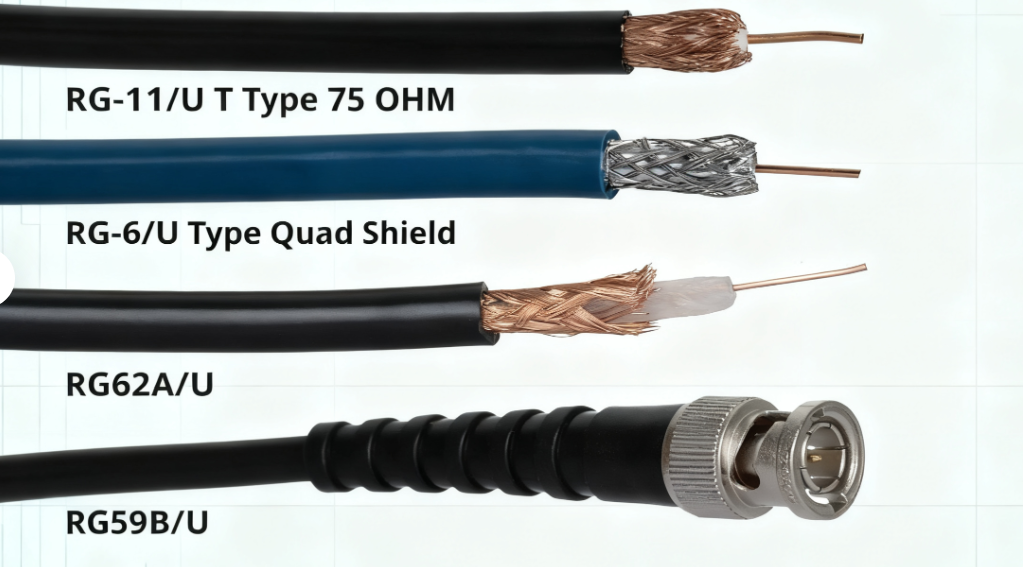
Essential aerial hardware
Messenger strand / suspension strand — galvanized steel strand sized by span and loading; it’s the backbone for lashed systems. Design tables (for example RUS/NESC-based) give maximum span lengths by strand size and wind/ice loading.
Spacers and straps — used to keep cable centered beneath messenger and prevent chafing during wind. Proper spacing avoids concentrated wear.
Lashing wire and lasher machine — lashing wire (galvanized) and a powered lasher install the cable to the strand; estimate extra wire (5–20%) for turns and joints per manufacturer tables.
Dead-end / anchor assemblies and suspension clamps — at span ends, dead-end clips or anchors secure the cable or messenger; choose rated hardware for expected tension and environmental class.
Pole hardware — eyebolts, insulators, boards and crossarms — selection depends on whether the plant shares poles with utilities; follow pole-loading practices and utility agreements.
Field procedures that actually matter
Survey and notification. Always verify pole ownership, check existing attachments, and notify utilities where required. Mark the route and plan attachment points and guying if poles are near load limits.
Span and sag planning. Cable manufacturer tables (and RUS/NESC tables) tell you allowable span lengths and installation sag at a chosen temperature/tension. Typical practice: keep spans within manufacturer and local-regulation limits and control installation tension to avoid overstressing fibers. For lashed systems, adhere to recommended maximum spans for given strand sizes and loading districts.
Proper lashing and attachment sequence. Lash from the far end toward the reel end, maintain specified spacing for straps and spacers, form drip loops at handholes and building entries, and allow adequate slack for splice access.
Testing before leave-site. Perform OTDR traces and insertion-loss testing immediately after placement and before final attachment closure so that any faults are accessible. Record splice loss and OTDR events in the as-built package.
Safety rules you cannot skip
Assume all nearby conductors are energized. Work near power lines must follow OSHA approach-distance rules and training requirements; de-energize only with utility confirmation or maintain required minimum distances and safeguards. OSHA rules also mandate qualified-person procedures when working within regulated approach distances.
Use fall protection and pole-climbing PPE. Line-clearance and pole-work require harnesses, lanyards, helmets and effective rescue planning. Only qualified crew members should handle live-line proximity scenarios.
Control tension and use rated equipment. Over-tensioning ADSS or lashed cable risks fiber strain and premature failure; dead-end hardware must match worst-case calculated tension including wind and ice loads.

Common mistakes and how to avoid them
Skipping manufacturer installation limits (span, tension, bend radius) — always follow the cable and hardware manual.
Poor documentation — lacking accurate as-built drawings and splice logs makes future work slower and riskier.
Neglecting clearance and utility coordination — this raises safety and legal exposure.
Quick aerial installation checklist
-
Route survey and utility coordination completed.
-
Cable type selected (ADSS / figure-8 / lashed) per environment.
-
Messenger, lash wire and dead-end hardware sized to spans and load.
-
Tension, sag and bend-radius limits set and crew briefed.
-
OTDR and loss tests completed and as-built records archived.
-
Safety plan (electrical approach, fall protection, rescue) signed by supervisor.
WOLON product note

For reliable overhead networks, WOLON’s aerial fiber series offers ADSS, figure-8 and rugged lashed cables designed to the GR-20 and RUS specifications, plus matched aerial hardware kits (spacers, dead-ends, lasher-grade wire) to simplify field work. WOLON outdoor cables are factory-tested for tensile, crush and environmental performance so installers spend less time reworking spans and more time delivering service.
