Deciding between 400G vs 800G vs 1.6T for a future-ready data room comes down to three practical variables: traffic profile (AI/GPU vs general compute), available budget, and the site’s power/cooling envelope. This article compares real technical trade-offs—power, port density, breakout flexibility, and ecosystem maturity—and gives clear recommendations for different data-room types.
Quick recommendation
-
Small-to-medium enterprise or standard colocation: 400G today; design cabling and patching to scale.
-
Most enterprise data rooms planning 3–5 year upgrades: 800G is the pragmatic sweet spot.
-
Hyperscale AI back-ends, dense GPU clusters, or green-field high-density aggregation: plan for 1.6T readiness (cooling, footprints) and migrate when switch/CPO modules and budgets align.
How the three speeds differ in practice
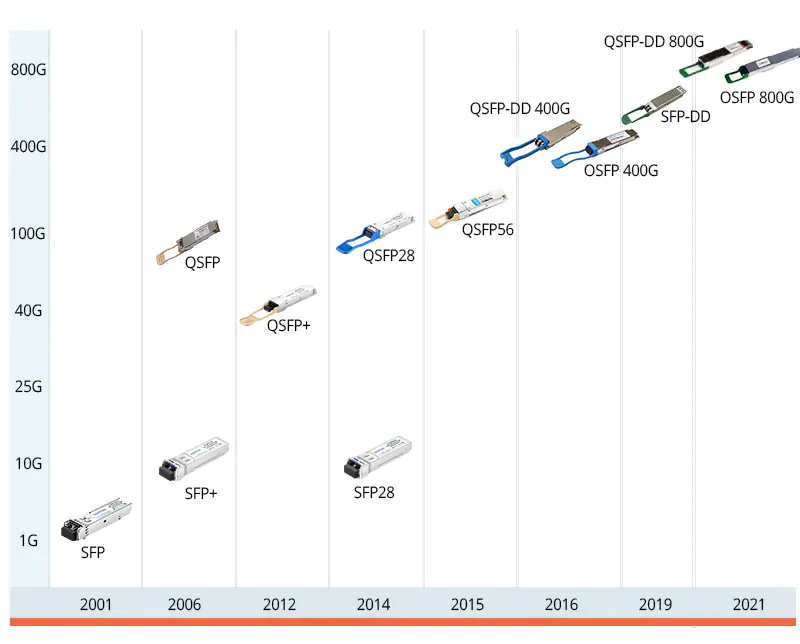
When comparing 400G vs 800G vs 1.6T you must evaluate: (A) module power per port; (B) breakout and flexibility; (C) ecosystem maturity (switch silicon and pluggable/module options); and (D) operational cost-per-bit.
-
Power per module: modern 400G QSFP-DD pluggables typically draw in the single-digit to low-teens of watts (commonly ~7–12 W for many 400G pluggables).
800G pluggables are available today with power in the mid-teens (commercial examples near ~13–16 W) and some implementations as low as the low teens for SR variants.
Early 1.6T pluggables and OSFP-XD/CPO approaches are targeting ~20–30 W today (with expectations of improvements as silicon and DSP process nodes shrink). Plan your racks and PDUs accordingly. -
Breakout and operational flexibility: 800G modules are commonly used to provide 2×400G breakout or 4×200G/8×100G breakouts, which preserves operational flexibility while increasing port density. That breakout capability is a major reason many operators adopt 800G first.
-
Ecosystem & standards: 400G is mature across QSFP-DD/OSFP; 800G has broad vendor support today (OSFP, QSFP-DD800) and is being adopted rapidly; 1.6T is now emerging (OSFP-XD, CPO roadmaps) and is best considered a near-term target rather than a universally mature choice.
Cost, density and power—real tradeoffs
-
CapEx per port: 400G optic modules and NICs are the least expensive per port today because of volume and maturity. 800G adds higher per-module cost but lowers system TCO by increasing effective throughput per line-card. 1.6T optic modules are still premium; their total cost makes sense only in very high-density, high-traffic fabrics.
-
Power per bit: moving to higher line rates reduces power per bit but increases power per module—so per-rack cooling and PDU provisioning must be paid attention to. In other words, higher speeds are more efficient on a per-Gbps basis but concentrate more heat into fewer slots.
Use-case based decision (practical)
-
Small enterprise or cost-sensitive colo (“data room”): pick 400G ports for aggregation and spine where volumes are moderate. 400G is proven, lower cost, and fairly power-efficient; it’s the lowest risk for a budgeted upgrade cycle. (If you can’t fully populate with 400G today, use 100G/200G where necessary and reserve QSFP-DD slots.)
-
Enterprise planning to scale for AI, big data, or heavy east-west traffic: choose 800G as the primary upgrade target. It balances maturity, breakout flexibility (2×400G), and improved efficiency per bit; it’s the most pragmatic future-proof choice for the next 3–5 years. Many operators expect 800G to dominate AI back-end ports in the mid-2020s.
-
Hyperscale, AI training farms, or green-field aggregation fabric: plan for 1.6T readiness—physically (OSFP-XD or CPO footprint), thermally, and in cable plant—but deploy 800G initially. For pure high-density GPU interconnects where absolute lowest latency and highest aggregate throughput matters, 1.6T or co-packaged optics (CPO) will rapidly become compelling as the tech matures.
Operational checklist before choosing
-
Measure your typical port utilization and expected growth over 36 months.
-
Run a thermal audit of racks—can your cooling handle concentrated 20–30 W pluggables? If not, favor 400G/800G and upgrade cooling.
-
Confirm switch ASIC and vendor roadmap (does your switch vendor support 800G/1.6T in the needed form factor?).
-
Evaluate breakout needs: do you need many logical 100G/200G endpoints per physical port? If yes, 800G (with breakouts) is attractive.
Final verdict
If you must pick one growth path for a typical “future data room” today, 800G represents the best compromise of maturity, density, efficiency, and flexible operational models—so 800G is the answer for most enterprise and colo data rooms aiming to be future-ready. For strictly budget-constrained builds or where upgrades are gradual, 400G is still the safe, cost-effective choice. For hyperscale AI or the densest aggregation fabrics, 1.6T is the final target—design your facility to accept it, but expect to populate with 800G first and migrate to 1.6T as module power, cost, and CPO ecosystems fully mature.