Introduction
If you’re shopping for small-network upgrades or wiring a modern home lab, you’re likely to encounter two very similar-looking parts: SFP modules and SFP+ modules. They share the same small, hot-pluggable “stick” form factor, but under the hood the two serve different performance and use-case needs. This guide explains what’s the difference between SFP and SFP+ modules, covers speeds, reach, compatibility, typical use cases (including DACs/AOCs), and gives practical buying tips — so you can pick the right transceiver and the right supplier.
What are SFP and SFP+ modules?
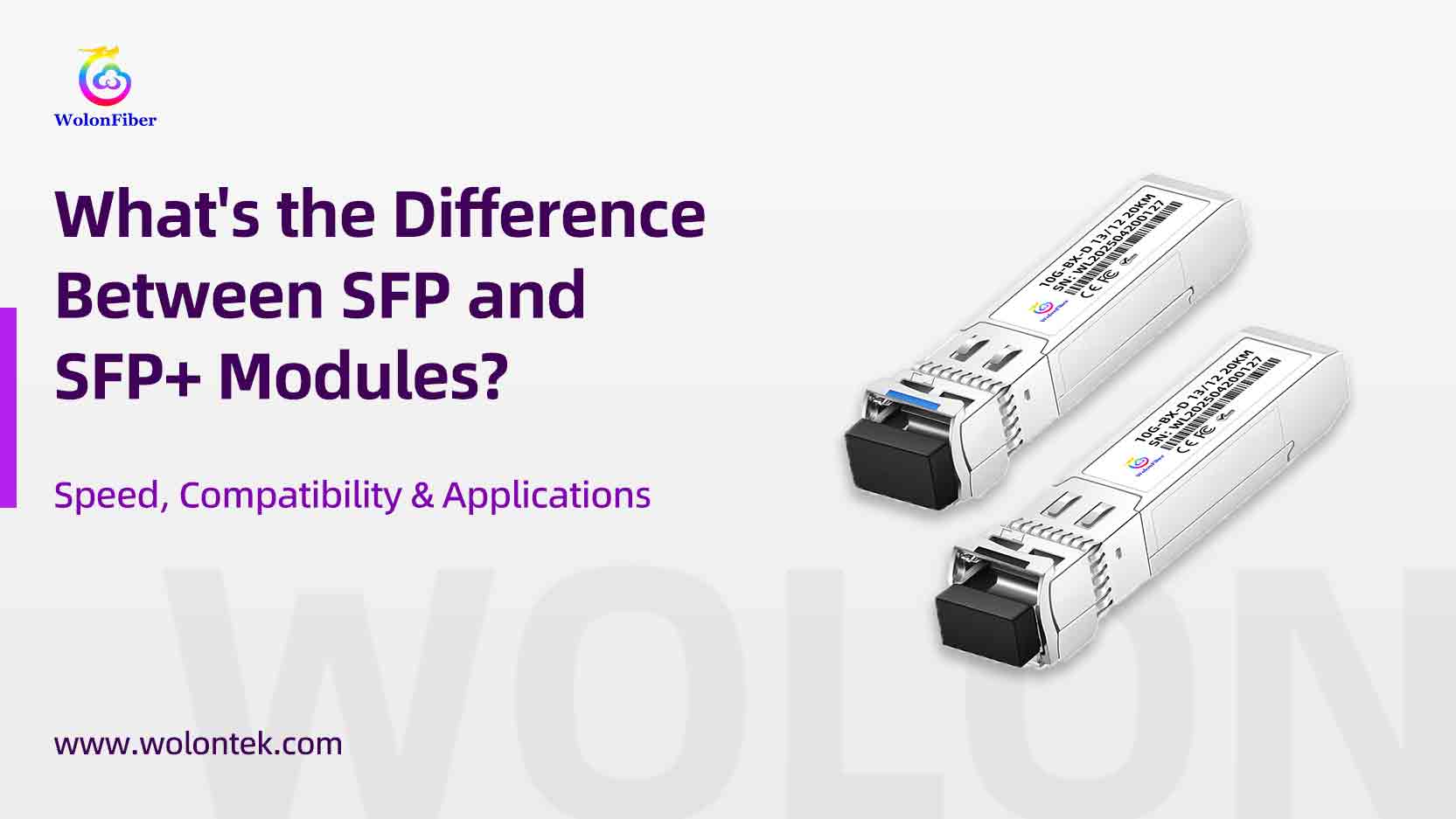
SFP (Small Form-factor Pluggable) is a multi-rate, hot-swappable optical or copper transceiver used to convert network ports to fiber or copper links. The common 1G SFP types (1000BASE-SX/LX/T) are ubiquitously used for switches, routers, and media converters. Cisco、Wolon and other vendors ship many 1G SFP modules designed for enterprise and SMB use.
SFP+ (Enhanced SFP) uses the same mechanical package but is engineered for higher-speed serial interfaces — most commonly 10 Gigabit Ethernet. The SFP+ electrical spec is formalized under the SFF-8431 spec and supports 10Gb/s line rates and related protocols. In practice, SFP+ is the go-to for 10GbE links inside racks and between adjacent racks in data centers.
The easiest takeaway
-
SFP = small, flexible transceiver used most often for 1G.
-
SFP+ = same form factor, engineered for 10G and higher-performance links.
-
Compatibility is common but not guaranteed — vendor docs matter.
|
Feature |
SFP Modules |
SFP+ Modules |
|
Data Rates |
Typically up to 1 Gbps |
Up to 16 Gbps (with some models reaching 32 Gbps) |
|
Distance |
100m to 100km |
Up to 120km |
|
Wavelength Options |
1310nm, 1490nm, 1550nm, 1625nm |
|
|
Form Factor |
Similar to SFP+ but designed for lower data rates |
Similar to SFP, but designed for higher speeds |
|
Power Consumption |
Higher power consumption |
Lower power consumption, more energy-efficient |
|
Backward Compatibility |
/ |
SFP+ modules can be used in SFP slots (with reduced speed) |
|
Key Applications |
– Ethernet Connectivity (Fast Ethernet, Gigabit Ethernet) |
– 10 Gigabit Ethernet (10GbE) |
|
– Fiber Channel for SANs (Storage Area Networks) |
– Fiber Channel over Ethernet (FCoE) |
|
|
– High-Performance Computing (HPC) |
||
Speed and protocol differences
SFP (typical): Commonly used for 1 Gbps Ethernet (1000BASE-X, 1000BASE-T). But the SFP family is broader — there exist SFPs for Fibre Channel, SDH/SONET, and other lower-rate serial links.
SFP+: Primarily designed for 10 Gbps Ethernet (10GBASE) and related protocols (10G Fibre Channel, OTU2, etc.). SFP+ supports DACs/AOCs and optical 10G transceivers.
In short: if you need 10 Gbps, choose SFP+. For 1 Gbps and legacy links, SFP is the standard.
Reach and optical types
Both SFP and SFP+ come in multiple flavors (SR, LR, ER, CWDM/DWDM, BiDi) that determine wavelength and maximum distance:
1G SFP (1000BASE-SX): typical reach up to 550 m on multimode fiber (varies by fiber grade OM1/OM2/OM3).
10G SFP+ (10GBASE-SR): typical reach ~300 m on OM3, ~400 m on OM4 multimode fiber; single-mode LR variants reach kilometers depending on the grade. These distances are module- and fiber-dependent — always check the datasheet.
Compatibility — the tricky but important part
Because the mechanical size is identical, people often assume SFP and SFP+ are drop-in compatible. Reality:
Many SFP+ ports are backward compatible with SFP modules and the switch can run the port at 1G when an SFP is inserted. However, this behavior is vendor- and platform-dependent; the SFP+ cage and the port’s PHY must support 1G operation. Cisco’s installation notes document how some 1G SFPs will operate in 10G-capable ports (but not in 1G-only hardware).
Conversely, you cannot run a 10G SFP+ transceiver in a pure 1G SFP-only port; the host must support the electrical signaling for 10G. Community experience confirms that while “most” vendors support SFP-in-SFP+ backward operation, it’s not an absolute guarantee — check your hardware’s compatibility matrix before buying.
Practical rule: when in doubt, consult the switch/router vendor compatibility sheet. If you need guaranteed multi-rate support, choose transceivers listed in the vendor’s compatibility matrix.
Power, heat and cost: what changes with speed
Power: SFP+ transceivers often use slightly more power than a typical 1G SFP, but well-designed 10G optics (and especially DACs/AOCs) can be energy-efficient — typical SFP+ optics and DACs can run under ~1W per port for many SR/AOC/DAC scenarios, although 10GBase-T (RJ45) modules historically consumed more power. Expect real-world power to vary by module type and vendor.
Cost: SFP+ (10G) modules and AOCs/DACs are typically more expensive than commodity 1G SFP module, but prices have fallen steadily — particularly for multi-source (third-party) modules.
How to choose — real-world recommendations for consumers
-
Match speed to need: For home or small-business Internet/desktop links (typical <1 Gbps), 1G SFP is sufficient. For fast NAS-to-switch links, virtualization hosts, or future-proofing with 10Gb uplinks, choose SFP+.
-
Check port support: Confirm whether your switch supports SFP+ and whether SFP modules are supported in that SFP+ slot (or vice-versa) — check vendor docs.
-
Choose medium by distance: Short intra-rack — use DAC/AOC; short-to-medium MMF runs — use 10GBASE-SR (SFP+ SR); long single-mode runs — LR/ER optics.
-
Buy from reputable suppliers: For mission-critical or warranty-sensitive hardware, buy OEM or MSA-compliant modules from trusted vendors. If you need cost savings, validated third-party suppliers that publish compatibility lists are common in the market.
Want help picking the right transceivers, DACs or AOCs for your network? If you’re in manufacturing, cloud, or building a high-speed home lab, I can:
-
recommend exact models that match your switch model,
-
prepare a low-cost 1G vs 10G ROI estimate,
-
or help write product pages and comparison tables for your store.
Wuhan Wolon Communication (Wolon) produces MSA-compliant SFP and SFP+ modules and offers sampling and compatibility testing — tell me your switch model and link distance and I’ll recommend two SKU options (cost-conscious and performance-first) and ready-to-publish product copy.