
The Cisco SFP-10G-SR and SFP-10G-SR-S are functionally very similar for basic 10G Ethernet over multimode fiber (MMF): both operate at 850 nm and reach ~300 m on OM3 and ~400 m on OM4. The key differences are in supported protocols and enabled features: the “-S” (S-class) variant is typically a cost-optimized, Ethernet-focused SKU that may omit some protocol support (e.g., FCoE/OTN/WAN-PHY) and enterprise features, and in some cases is targeted at narrower temperature or compliance ranges. For most enterprise LAN and data-center short-reach use-cases, the S-class delivers the same Ethernet performance at a lower cost.
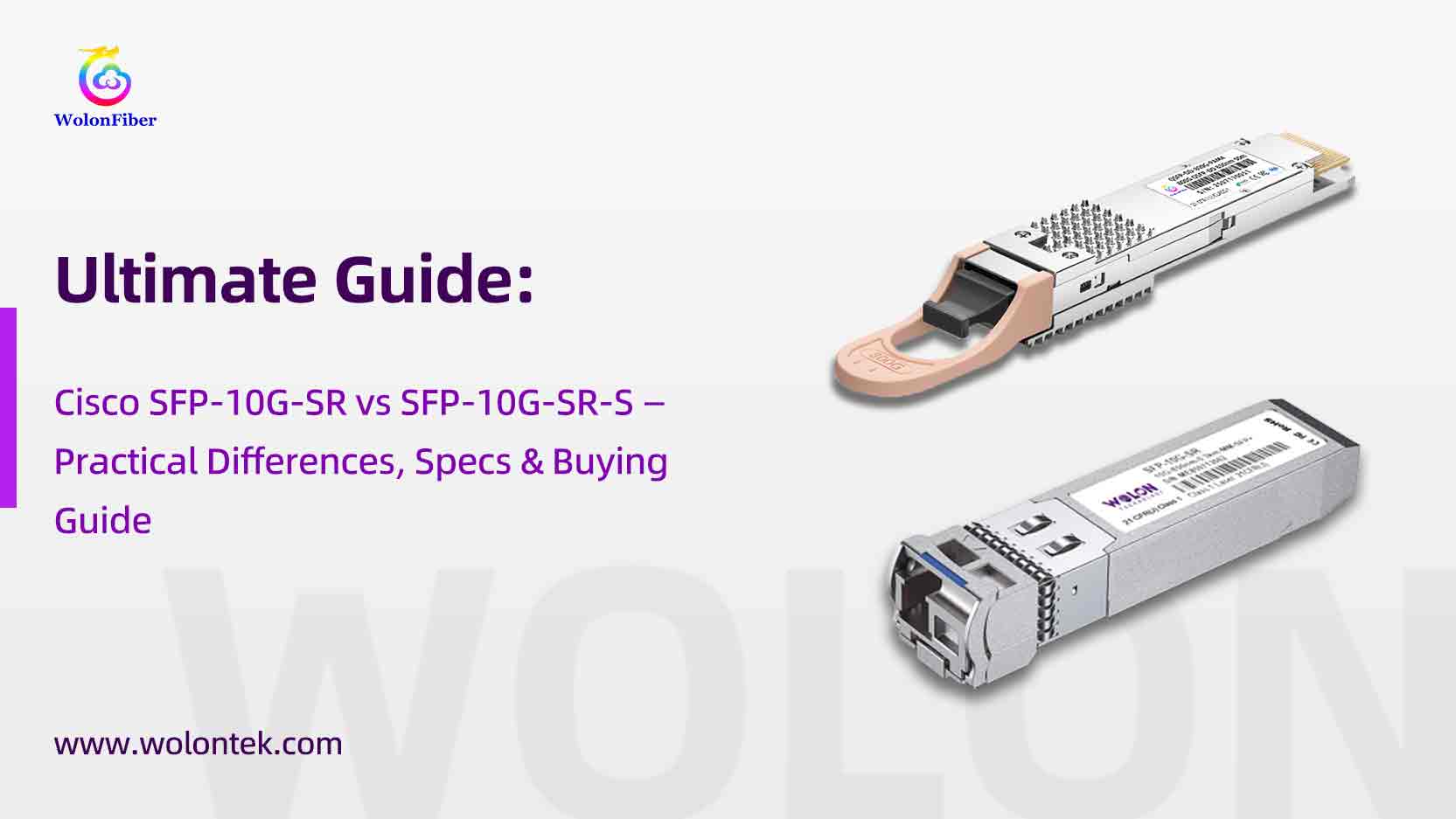
What both modules share
-
Standard: 10GBASE-SR (SFP+) — 10 Gbps Ethernet over multimode fiber.
-
Wavelength: 850 nm (VCSEL).
-
Connector: Duplex LC.
-
Typical reach: up to 300 m over OM3; up to 400 m over OM4/OM5 when using certified MMF. (Actual reach depends on fiber link loss budget, connectors, and patch panels.)
-
Hot-pluggable SFP+ form factor and common MSA compliance (SFF-8431 / SFF-8432 / IEEE 802.3ae).
Where they diverge — the practical differences
Feature set / protocol support.
The non-S SFP-10G-SR is often sold as the full-featured Cisco SKU with broader protocol support (Ethernet and some extended functions used in converged fabrics). The SFP-10G-SR-S is engineered and priced for Ethernet-only applications and commonly excludes some advanced protocol certifications (e.g., certain FCoE/OTN/WAN-PHY use cases). If you run only LAN/Ethernet, the S-class is usually fine.
Temperature / industrial variants.
There are also “X” or “I” variants (e.g., SFP-10G-SR-X or SFP-10G-SR-I) that broaden operating temperature or add multi-rate features; the S-class is typically not the industrial grade. If you deploy transceivers in extreme ambient conditions (outside commercial 0–70°C), choose the industrial or extended-temperature SKU.
Cost and sourcing.
S-class parts are usually priced lower and targeted at high-volume Ethernet deployments. For buyers searching “SFP module supplier”, S-class modules often deliver the best price-to-performance for standard Ethernet links.
Vendor locking / compatibility.
OEM Cisco modules carry vendor firmware/ID; third-party compatible modules are widely available and frequently used to reduce cost. If you require Cisco warranty/ordering traceability, buy Cisco-branded SKUs; otherwise certified third-party suppliers often work seamlessly at lower cost. Always check compatibility notes for your switch/NIC model.

Specs at a glance
Note*: values below reflect typical SFP+ 10GBASE-SR specs as implemented by Cisco and widely accepted compatibles. Always validate against your switch vendor’s compatibility list.
|
Parameter |
Typical value |
|---|---|
|
Standard |
IEEE 802.3ae (10GBASE-SR) |
|
Wavelength |
850 nm (VCSEL) |
|
Fiber type |
Multimode fiber (OM1/OM2/OM3/OM4/OM5) |
|
Reach |
OM3: up to 300 m; OM4/OM5: up to 400 m |
|
Connector |
Duplex LC |
|
DOM/DDL |
Usually supported (check SKU) |
|
Power consumption |
Low (SFP+ class — typically <1 W) |
|
Form factor |
SFP+ (hot swappable) |
|
Common Cisco SKUs |
SFP-10G-SR, SFP-10G-SR-S, SFP-10G-SR-X (industrial/multi-rate) |
Practical buying guide: choose the right SKU
If you only need plain 10G Ethernet inside a data center or wiring closet: the SFP-10G-SR-S (S-class) is a cost-efficient, reliable choice.
If you use converged fabrics (FCoE), OTN, or specialized telecom features: prefer the full SFP-10G-SR SKU or check vendor feature sheets.
If ambient temps exceed commercial range or you need multi-rate/extended warranties: consider “-X” or “-I” variants or industrial third-party equivalents.
If you’re buying from an SFP module supplier: request a link-loss budget report for your exact path or ask for DOM (digital diagnostics) enablement for monitoring.
Compatibility and third-party modules
Most modern switches accept third-party SFP+ modules when they present the correct vendor OUI/EEPROM signature, but some platforms are locked. If cost-savings are a priority, reputable third-party suppliers can offer Cisco-compatible 10G Sfp Module parts with identical reach & DOM support — just validate the supplier’s test reports and compatibility lists before large-scale deployment.
Deployment checklist (before you buy/install)
Confirm fiber type and quality (OM3 vs OM4) and calculate link-loss budget.
Check switch/NIC compatibility list for vendor locking policy.
Decide whether you need DOM for monitoring.
Verify operating temperature requirements.
Choose OEM Cisco part if you need Cisco warranty & traceability; choose certified third-party supplier for lower cost.
Cost vs value: when to save and when to spend
Save (choose S-class or third-party): routine 10G trunk links in racks, leaf/spine short links, campus risers.
Spend (choose full-feature SKU or industrial variant): converged fabrics, long-term support contracts, harsh environments, or when vendor traceability is contractually required.
If you’re sourcing 10G Sfp Module compatible optics at competitive prices, Wuhan Wolon Communication Co., Ltd. offers a range of tested SFP+ 10GBASE-SR modules and assembly services (single/bulk), with DOM-enabled options and certification testing for OM3/OM4 networks. Contact your SFP module supplier sales representative at Wuhan Wolon for sample testing and compatibility verification before large rollouts.
Example FAQ
Q: What’s the maximum distance for Cisco SFP-10G-SR over OM3?
A: Up to 300 meters on OM3; up to 400 meters on OM4/OM5 with proper link budget.
Q: Can SFP-10G-SR-S be used for Fibre Channel or FCoE?
A: S-class SKUs are typically Ethernet-focused and may not support all Fibre Channel/FCoE/OTN protocols — verify the exact SKU datasheet.
Q: Are third-party modules safe to use?
A: Reputable third-party modules are widely used and can save cost — but always validate compatibility, DOM support, and supplier test reports.