
Multi-fiber push-on (MPO) connectors, and their Conec-branded variant, MTP®, are key components of modern high-density fiber networks. They are often used with ribbon cables and linear fiber arrays to encapsulate multiple fibers into a single ferrule, enabling ultra-high-bandwidth links. For example, a 12-fiber MPO cable (containing four launch fibers and four receive fibers per 100G channel) can transmit 40G/100G, or even 400G signals. There are several design and performance differences between MPO and MTP connectors. This guide will delve into the mechanical design and optical performance differences between MPO connectors and MTP connectors.

The table below summarizes key differences between generic MPO connector and MTP connector designs, highlighting how MTP’s enhancements improve performance and reliability:
| Component / Feature | Generic MPO The “Economy” Choice |
???????? US Conec MTP® The “Patented” Original |
|---|---|---|
| ????️ MECHANICAL STRUCTURE (Why it lasts longer) | ||
| ???? Ferrule Float | Fixed (No float) ⚠️ Signal drops if cable is pulled |
Floating Ferrule Patent
✓ Maintains contact even under load |
| ???? Guide Pins | Chamfered / Plastic Cap ⚠️ Can chip and create debris |
Stainless Steel Elliptical Tips
✓ Reduces hole wear & debris |
| ???? Pin Clamp | Plastic / Resin ⚠️ Pins can break/push back |
Metal Recessed Clamp
✓ Zero pin breakage |
| ????️ Housing Type | Fixed (Glued) ⚠️ Impossible to rework |
Removable Housing Patent
✓ Change Gender/Polarity in field |
| ???? OPTICAL PERFORMANCE (Why it’s faster) | ||
| ???? Insertion Loss | ~0.50dB – 0.75dB Acceptable for 10G/40G |
≤ 0.35dB (Elite)
✓ Required for 400G/800G |
| ???? Return Loss | ≥ 40dB (Typical) |
≥ 60dB (APC Polish)
✓ Better signal integrity |
What Is MPO connector?
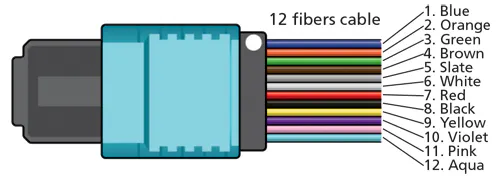
MPO stands for Multi-Fiber Push-On – an industry-standard multi-fiber connector defined by IEC 61754-7 (and TIA-604-5 in the US).Originally developed for ribbon fiber cables, an MPO connector houses a linear array of fibers in one rectangular ferrule.Typical MPO ferrules contain 8, 12, 24 or more fibers side by side. (Higher counts like 32, 48 or 72 fibers exist for super‑high‑density switch fabrics). MPO connectors are available in both male (with pins) and female (without pins) versions to facilitate proper alignment. Each MPO connector has a key (usually marked by a white dot) that indicates fiber 1 and ensures correct polarity(8-, 12-, and 24-fiber MPO connectors are typically centered in the housing, while 16- and 32-fiber MPO connectors use an offset key to avoid misalignment of the transmit/receive channels).
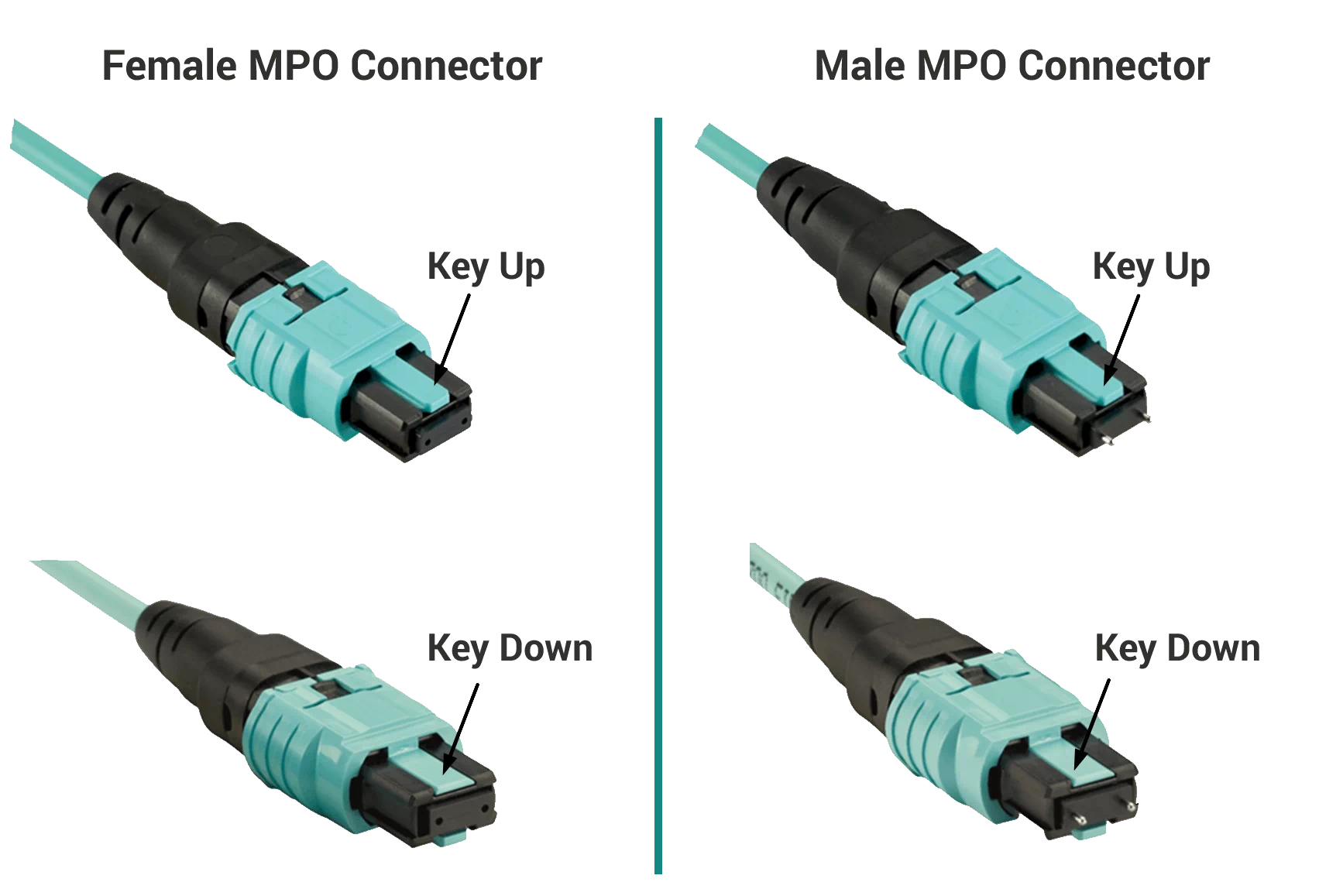
MPO connectors are standardized: compliant plugs and adapters must meet IEC 61754-7 and TIA-604-5 physical dimensions and the endface geometry requirements of IEC 61755‑3‑31.In other words, any MPO-style connector meeting these standards will mate with any other (intermateable). In the data center, MPO-terminated trunk cables are extensively used for backbone links. A 12- or 24-fiber MPO trunk takes less rack space than multiple duplex cables and connects into MTP/MPO cassettes or patch panels. MPO is also the de facto interface for parallel optics: e.g. 40GBASE-SR4 and 100GBASE-SR10 use 8- or 12-fiber MPO cables to run 10–25 Gbps per lane simultaneously.(New 200G/400G/800G links often use 16- or 24-fiber MPOs with higher‑rate lanes.) In summary, MPO is the generic term and standard for multi-fiber connectors used in today’s high-density links.
What Is MTP connector?
MTP® is a trademarked, high-performance version of the MPO connector developed by US Conec. The MTP name does not denote a different fundamental form factor; it is fully compliant with MPO standards (IEC 61754-7, TIA-604-5) and intermates with generic MPO connectors.However, MTP connectors have additional precision features to boost optical and mechanical performance. As US Conec describes it, the “MTP connector is an MPO engineered to very tight tolerances for improved alignment, durability, and performance”.in practice, this means all MTP connectors are MPO connectors, but not all MPOs are MTP®.
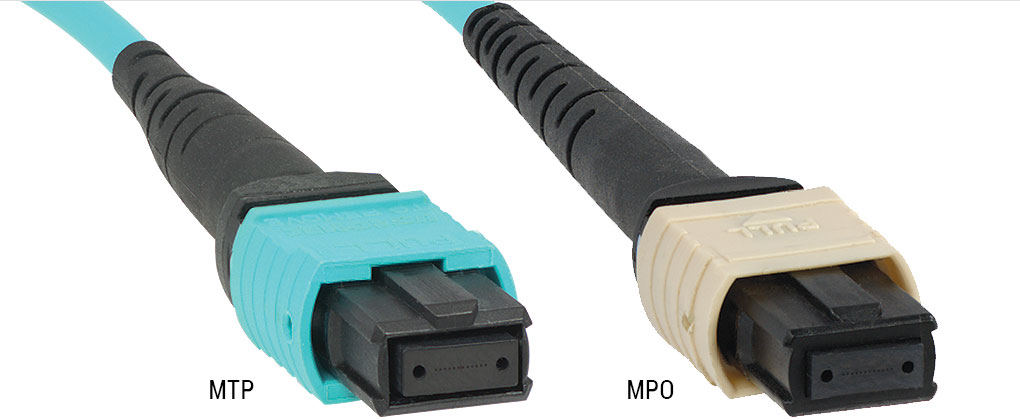
Key enhancements in MTP components include a floating ferrule design (allows ferrules to maintain contact under mechanical load), higher-precision guide pins (stainless steel, elliptical tips), reinforced spring and clamp mechanisms, and a removable connector housing.For example, MTP ferrules are molded from polyphenylene sulfide (PPS) thermoplastic for superb temperature/moisture stability, whereas many generic MPO ferrules use different materials.These design improvements translate into measurably lower insertion loss and better return loss performance in MTP assemblies. In short, an MTP connector is simply a premium, field-friendly variant of the MPO connector, fully standards-compliant but optimized for next-generation networks.
MPO vs MTP: Mechanical Design Differences
MPO and MTP connectors share the same basic form, but MTP implements several mechanical refinements. Key differences include:
Alignment Pins: Generic MPO connectors typically use two flat-tipped pins to align the ferrules. In contrast, MTP connectors use elliptical-tipped stainless-steel pins held to tight tolerances.The elliptical pin shape is more reliable over many matings and sheds less debris, improving repeatable alignment and reducing wear.

Pin Clamp: The mechanism that secures the alignment pins also differs. Many MPO designs use a simple plastic clamp to hold the pins in place. MTP connectors instead use a metal, recessed pin clamp that firmly grips the pins.This metal clamp resists fatigue and can endure well over 1,000 matings (versus the 500‑mating minimum in standards) without losing pins. The MTP’s robust clamp and centered spring prevents misalignment due to loose pins.

Ferrule Float: Standard MPO ferrules are fixed in their housing. MTP ferrules are floating – they can move minutely under load to maintain good fiber-to-fiber contact.This patented floating ferrule design ensures that when connectors are pressed together (for example, plugging directly into a switch port), the fibers stay in physical contact. Floating ferrules greatly reduce insertion loss under stress and are a major reason some switch makers prefer MTP interfaces.

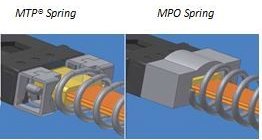
Spring & Ribbon Clearance: The spring that pushes the ferrule forward is shaped differently in MTP connectors. MTP springs are slightly wider to maximize clearance for ribbon fibers.The spring ends are also guided by a centering collar in MTP connectors, which prevents spring deformation. Together, these changes prevent the spring from digging into the fiber ribbon or bending pins, a problem seen in some MPOs.The result is higher durability and lower risk of fiber damage in MTP assemblies.
Connector Housing: Only the MTP connector features a removable housing. The outer sleeve of an MTP can be popped off in the field.This allows technicians to re-polish a ferrule endface or even change the connector’s gender or polarity after termination. Generic MPO connectors have fixed housings, so any rework requires replacing the entire unit. The MTP’s removable housing (and corresponding MTP Pro toolkit) adds a level of serviceability and versatility that generic MPOs lack.

Materials: MTP connectors use high-grade materials for stability. The ferrule and housing are precision-molded from PPS thermoplastic, which resists humidity and temperature changes better than some epoxy-based MPO ferrules. In contrast, generic MPO ferrules are often lower-cost materials. The MTP material choice helps maintain tight tolerances over time and across environments.
In summary, MTP connectors incorporate precision-engineered guide pins, clamp, spring, and ferrule mechanisms to achieve more consistent mating and longer life.These mechanical design upgrades translate to more reliable connections and lower loss in high-density cabling systems.
MPO vs MTP: Optical Performance Differences
Mechanically, the MTP enhancements directly improve optical performance. By imposing tighter endface tolerances and better alignment, MTP connectors achieve lower insertion loss and often higher return loss than generic MPOs.
Insertion Loss (IL): All fiber connections incur some loss, but MTP components are designed for minimal IL. For example, US Conec specifies that a standard singlemode MT ferrule has a max mated insertion loss of ~0.75 dB, whereas an MT Elite® (MTP) ferrule is ≤0.35 dB.Similarly, a standard multimode MPO ferrule is ~0.6 dB, compared to ≤0.35 dB for an MT Elite multimode ferrule. In practice, high-quality MTP fiber cables routinely measure around 0.2–0.3 dB loss per connector, while generic MPOs often approach 0.5–0.6 dB or higher. Tighter geometry control in MTP (smaller fiber hole tolerances, better fiber end polish, consistent protrusion) reduces air gaps and misalignment, yielding better channel budgets.
Return Loss (RL): Return loss measures how much light is reflected back. MTP connectors are commonly offered in APC polish (8° angled) which gives very high return loss (≥60 dB), reducing back-reflection in single-mode links. Generic MPO products are often UPC-polished (~0.5° angle), with return loss around 45 dB. While both MPO and MTP can meet the minimum standard (≥50 dB APC, ≥40 dB UPC), using APC-angled MTPs in singlemode dramatically cuts reflections. For multimode, return loss differences are smaller, but maintaining precise fiber protrusion (as in MTP) helps match cores fiber-to-fiber and limit modal noise.
Channel Consistency: With MPO/MTP, multiple fibers mate at once, so uniform performance across all fibers is crucial. Random-mating tests (per IEC 61755-1) show the advantage of MTP. For a 12‑fiber link, US Conec reports that >97% of MTP Elite™-based connections have ≤0.25 dB loss, whereas generic 12‑fiber MPOs allow up to ~0.45–0.50 dB per channel.The mean loss is also lower (≈0.12 dB mean for Elite vs 0.20–0.25 dB mean for standard).In short, the worst-case loss is much tighter with MTP Elite components. Lower insertion loss and tighter channel consistency mean more margin for high-speed or long-reach links. As CablesPlus notes, “the MTP provides superior insertion loss and reflectance, which is critical for supporting higher-speed applications” like 200G/400G where every fraction of a dB matters.
High-Speed Applications: These optical improvements make MTP preferable in the latest parallel optic systems. Data-center switches running 200G-800G (often over single-mode DR/DR4 links) are very sensitive to loss and reflections.Many OEMs now use MTP/MPO interfaces by default for 40G–400G (and upcoming 800G/1.6T) optics. In contrast, older lower-cost MPOs may not guarantee the low loss needed for these applications.
conclusion
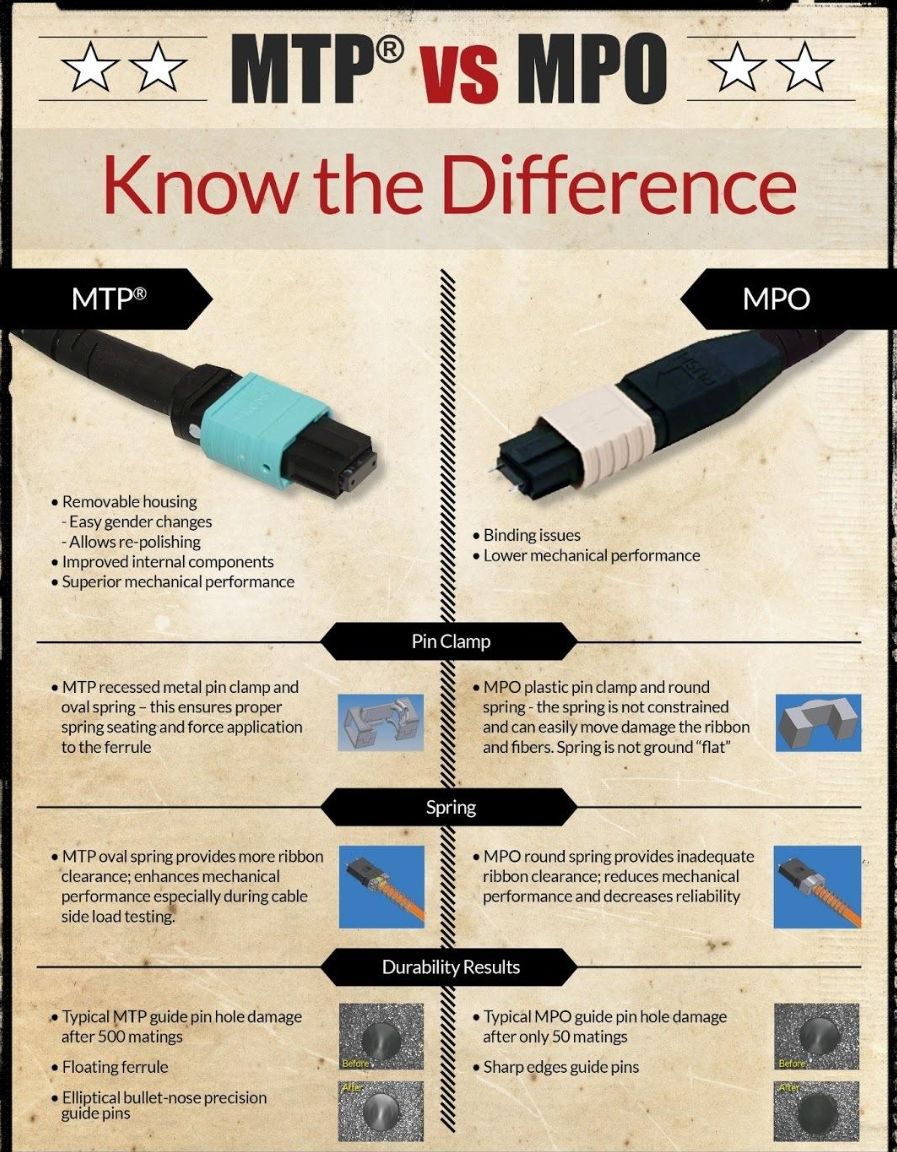
The comparison shows that MTP connectors build on the MPO standard with improved materials and tighter tolerances. In mechanical terms, MTP’s design ensures better ferrule alignment and durability.Optically, MTP assemblies consistently deliver lower insertion loss and higher return loss, which is crucial for next-generation, parallel-optic transceivers.
Overall, MTP connectors enable lower-loss, higher-quality MPO cabling. Systems using MTP cabling can achieve tighter link budgets and higher reliability. These gains are well-documented in manufacturer specs and industry benchmarks.When deploying critical high-density links (e.g. in hyperscale or AI data centers), engineers often choose MTP-based assemblies for the extra margin.

???? Ready to Deploy Your Future-Proof Network?
Don’t navigate your infrastructure upgrade alone.
From 400G migrations to structured cabling overhauls, our engineers provide Free BOM Analysis and tailored recommendations to ensure your network is fast, reliable, and under budget.
Expert Guidance. Factory Direct Pricing. Zero Hassle.
FAQ: MPO vs MTP Connector Differences
Q1: Can I plug an MTP connector into an MPO adapter?
A: Yes, absolutely. Think of MPO as the “Interface Standard” (like USB) and MTP as a “High-End Brand” (like Samsung). They share the exact same physical form factor (IEC-61754-7). You can mate a Wolontek MTP trunk cable with any standard MPO transceiver (QSFP) or cassette without any issues.
Q2: How can I visually tell the difference between MTP and MPO?
A: Look closely at the connector housing.
MTP Connectors: Will usually have the “US Conec” logo or “MTP®” stamped on the plastic body. They also feature rounded (elliptical) stainless steel guide pins.
Generic MPO Connectors: Usually have no brand logo and typically use chamfered (sharp-edged) guide pins.
Wolontek Guarantee: If you order MTP from us, we provide the US Conec Certificate of Compliance.
Q3: Why is MTP considered “better” than generic MPO?
A: It solves three specific mechanical problems:
Floating Ferrule: The MTP ferrule floats inside the housing, ensuring physical contact even under cable load.
Elliptical Pins: Reduces wear on the fiber holes, allowing for 500+ matings (vs. ~200 for MPO).
Removable Housing: MTP connectors allow you to change gender or polarity in the field; generic MPOs are usually permanent.
Q4: Is MTP worth the extra cost?
A: It depends on your application.
For 400G/800G: Yes. The optical loss budget is too tight to risk using generic connectors. The MTP Elite’s low loss is mandatory.
For 10G/40G (Static): Maybe not. If you plug it in once and never touch it again, a high-quality Standard MPO saves you about 30% on cost.
Q5: What is the difference between MTP and MTP Elite?
A: “MTP Elite” is the Low-Loss version of the standard MTP connector.
Standard MTP Loss: ~0.25dB (Typical)
MTP Elite Loss: ~0.10dB (Typical) At Wolontek, we use MTP Elite ferrules for all our high-speed 40G/100G trunk cables to ensure maximum performance.