

in fiber optic networks, stability is everything.
If you have ever managed a long-haul DWDM link or even a local metro network, you know the headache of signal fluctuations. One moment your power levels are perfect; the next, a temperature drop or a slight cable bend causes the signal to drift. This can fry your sensitive receivers or, worse, cause data loss for your clients.
That is why we need to talk about APC (Automatic Power Control).
At Wolon, we have spent over 15 years manufacturing optical components here in Wuhan’s Optics Valley. We’ve seen firsthand how the right control mode can save a network engineer hours of troubleshooting.
Here is what you actually need to know about APC, without the textbook jargon.
What is APC? (Think “Cruise Control”)
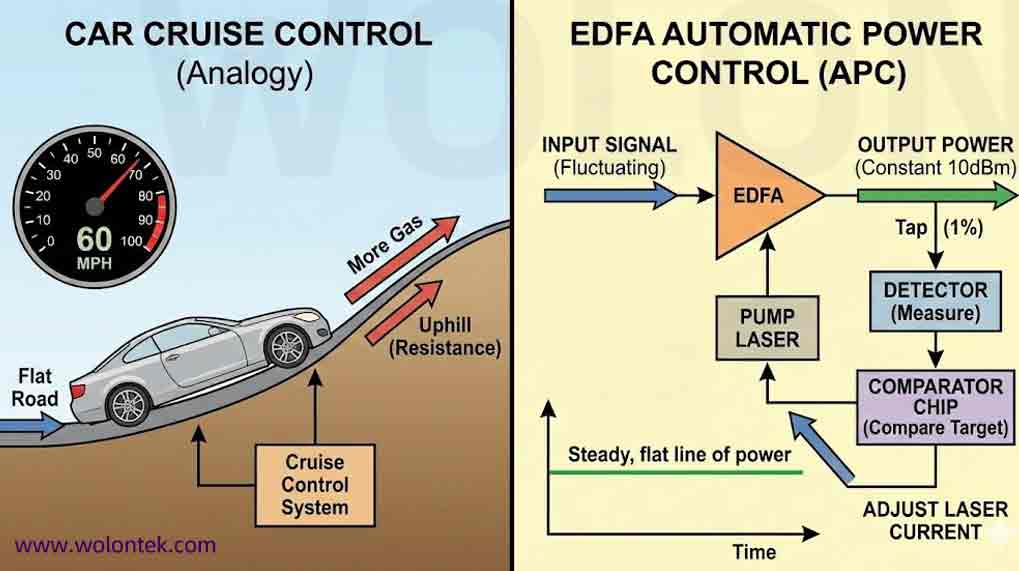
The easiest way to understand Automatic Power Control (APC) is to think of the cruise control in your car.
When you set your car to 60 mph, you want it to stay at 60 mph, whether you are driving on a flat road or going uphill. The car automatically gives the engine more gas if it feels resistance.
APC does the exact same thing for an EDFA (Erbium-Doped Fiber Amplifier):
-
The Goal: Keep the Output Power constant (e.g., exactly 10dBm).
-
The Reality: Input signals fluctuate. Cables age. Temperatures change.
-
The Solution: The APC circuit watches the output. If it sees the power drop, it automatically boosts the pump laser. If the power gets too high, it dials it back.
It’s a “set it and forget it” mode that protects your downstream equipment from getting hit with too much power.
How It Actually Works
It’s a simple loop. Inside the amplifier, we tap a tiny fraction (maybe 1%) of the light and send it to a detector.
-
Measure: The detector reads the current power.
-
Compare: A chip compares it to your target setting.
-
Adjust: If there is a mismatch, it adjusts the laser current instantly.
This happens in milliseconds. So, even if your network is acting up, the device receiving the signal sees a steady, flat line of power.
APC vs. AGC: The Big Decision
This is the most common question we get from clients: “Should I use APC or AGC?”
While APC locks the output power, AGC (Automatic Gain Control) locks the amplification factor (the gain). They are different tools for different jobs.
Here is a cheat sheet we give our customers:
| Feature | APC (Power Control) | AGC (Gain Control) |
|---|---|---|
| What is locked? | The total Output Power stays flat. | The Gain (dB) stays flat. |
| If input drops… | The amplifier works harder to keep the output up. | The output drops, but the amplification ratio stays the same. |
| Best for… | Protecting receivers (like SFP+) that need a specific, constant power level. | Multi-channel systems (DWDM) where you need balance across all wavelengths. |
| Analogy | Cruise Control (Speed stays the same, regardless of hills) |
Gas Pedal Position (Engine effort stays the same, speed varies) |
Table: Quick comparison between APC and AGC modes in optical amplifiers.
From the Factory Floor: We often suggest APC for single-channel links or when you are connecting directly to sensitive equipment that can’t handle power surges.
It’s Not Magic (The Honest Truth)
I want to be transparent here. APC is great, but it has one trade-off.
Because the system fights to keep the output power high, if your input signal drops too low, the amplifier might push itself too hard. This can increase the background noise (we call this ASE noise).
It’s like trying to listen to a quiet radio station by turning the volume to 100%—you hear the music louder, but you hear more static too. So, while APC stabilizes power, good network design is still key.
Why This Matters for Your Supply Chain
You might be thinking, “I just buy the cables and boxes, why do I care about the circuit control?”
Because quality manufacturing matters. Implementing a stable, responsive APC circuit requires precise engineering.
This is what we do at Wolon.
-
Real Scale: We operate 3 factories with over 1,000 staff. We aren’t a small trading office; we build this stuff.
-
Certified Safe: All our electronics and optical gear are CE and RoHS certified. This means our APC circuits are tested to be safe and reliable.
-
Custom Solutions: Need an EDFA with a specific APC range? We offer OEM services. We can tweak the hardware to fit your specific network architecture.
We have helped clients in over 80 countries—from the freezing winters of Russia to the humid coasts of South America—keep their signals stable.

Let’s Talk About Your Network
Whether you need a robust EDFA, a reliable SFP+ module, or just some honest advice on fiber cabling, we are here to help.
Don’t settle for unstable signals. Let’s build a network that just works.
Frequently Asked Questions (FAQ)
Q1: What is the main difference between APC and AGC in simple terms?
Think of APC (Automatic Power Control) as “Cruise Control” for your output power—it keeps the signal level flat (e.g., 10dBm) no matter what happens to the input. AGC (Automatic Gain Control), on the other hand, is like a fixed multiplier. If your input drops by half, your output drops by half, but the amplification ratio (the “Gain”) stays the same.
Q2: Is APC suitable for DWDM multi-channel systems?
It depends. For single-span links, APC is excellent for stability. However, for complex long-haul DWDM networks with many channels, AGC is often preferred to prevent “channel tilt” (power imbalance between wavelengths). Not sure which one fits your network? Ask our engineering team for a free link budget analysis.
Q3: Is APC the same as APR?
No, and this is a common confusion!
APC is for Stability: It keeps the laser on and steady during normal operation.
APR (Automatic Power Reduction) is for Safety: If a fiber cable breaks, APR instantly lowers the power to protect your eyes from laser injury. At Wolon, our EDFA modules typically support both functions to ensure performance and safety compliance (IEC standards).
Q4: Can Wolon customize the APC output levels for my specific project?
Absolutely. Because we own 3 manufacturing bases and control the production line, we offer full OEM services. We can preset the APC target values at the factory to match your specific link loss requirements, saving you setup time on-site.
Q5: Do your APC-enabled components work in extreme temperatures?
Yes. All Wolon SFP+ modules and EDFAs undergo rigorous temperature cycling tests (-40°C to +85°C) in our labs. The APC circuit is designed to compensate for temperature-induced laser efficiency drops, ensuring your network stays up even in harsh winters or hot summers.