
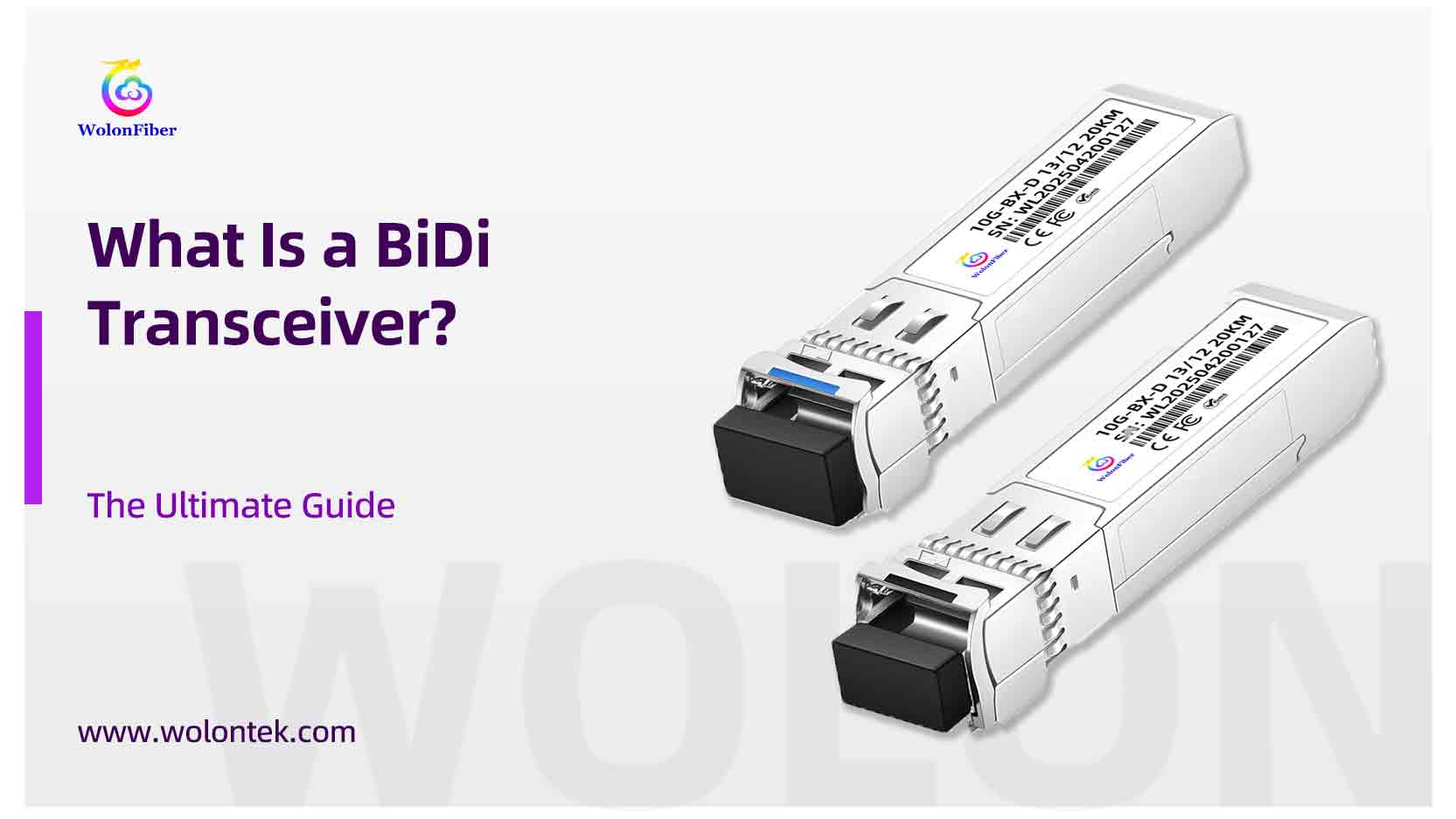
a BiDi Transceiver (short for bidirectional transceiver) is an optical module that sends and receives data over a single strand of optical fiber by using two different wavelengths—one for transmit and one for receive. In practical terms it lets one fiber carry both directions of traffic simultaneously, shrinking cabling, simplifying installations, and often cutting costs compared with conventional two-fiber (duplex) links.
Below I explain how BiDi optics work, the common types and wavelength pairs, real-world tradeoffs, and where BiDi makes the most sense.
How BiDi optics work
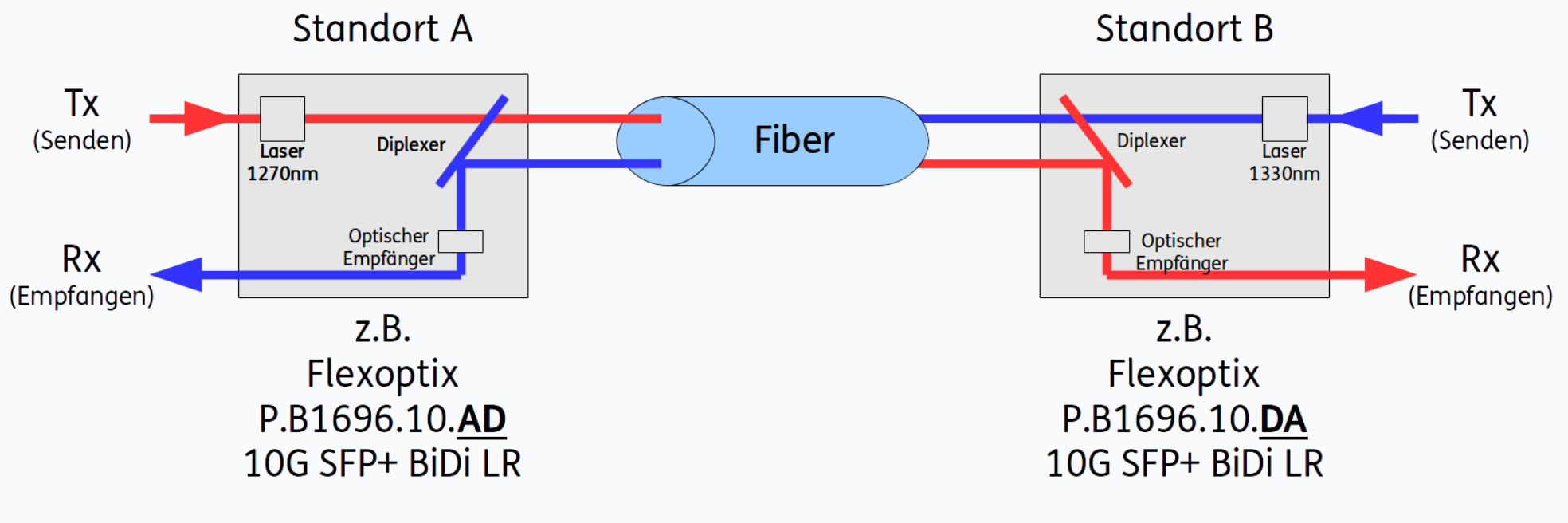
BiDi modules use wavelength-division multiplexing (WDM) on a very small scale: the transmitter emits light at one wavelength while the receiver listens at a different wavelength. At each end of the link a complementary module is fitted so that one side transmits at λ1 and receives at λ2, and the other side transmits at λ2 and receives at λ1. The two signals coexist on the same Single-mode fiber and a tiny wavelength filter in the module separates them. This is not full DWDM complexity—BiDi is usually implemented with a fixed pair of wavelengths and integrated filters in the optics.
Common wavelength pairs and form-factors
BiDi optics are available in SFP, SFP+, XFP and QSFP formats. Typical wavelength pairs depend on the data rate and the target distance:
-
1G BiDi SFP often uses pairs like 1310/1490 nm or 1310/1550 nm (common in FTTx and access).
-
10G BiDi SFP+ commonly uses 1270/1330 nm or 1270/1330 nm variants for metro links; some long-reach variants use 1490/1550 nm pairs.
-
Higher distance or DWDM-grade BiDi (for hundreds of kilometers) use different laser types and wavelength allocations.
Datasheets from module vendors show many permutations—when choosing modules, match the exact wavelength pair and form factor on both ends. Mixing incompatible wavelength pairs or form factors will not work.
Performance Specifications
Both technologies deliver the same data rates and similar distances:
|
Metric |
Duplex Transceiver |
|
|---|---|---|
|
1G data rate |
Up to 1 Gbps |
Up to 1 Gbps |
|
10G data rate |
10.3125 Gbps |
10 Gbps per channel |
|
1G range |
10–120 km (SMF) |
550 m–120 km |
|
10G range |
Up to 80 km |
Up to 80 km |
40G QSFP+ BiDi operates two 20-Gbps lanes for 40 Gbps total. It reaches 150 meters over OM4 multimode fiber with LC duplex connectors.
100G QSFP28 BiDi delivers full 100 Gbps speeds across 75–150 meters. It uses OM3–OM5 Patch Cables.
Latency stays the same between both types. Your signal quality depends on optical components and electronics, not fiber count. BiDi modules need strict wavelength isolation. They use high-performance WDM filters to prevent crosstalk.
Why choose BiDi? The real benefits
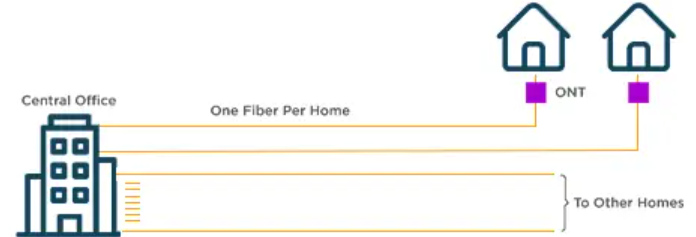
1.Fiber conservation. The most obvious advantage is halving fiber consumption: one fiber instead of two for each duplex link. This matters in dense campus backbones, older ducts with limited spare fibers, and fiber-to-the-home (FTTx) access.
2.Simpler cable management. Less cabling means fewer panels, smaller cable bundles, and easier moves/changes—useful in crowded patch rooms and multi-tenant buildings.
3.Cost savings where fiber is scarce. In retrofit or last-mile projects the cost of running additional fiber (trenching, conduit, permits) can dwarf optics costs; BiDi can be the lower-total-cost option.
Tradeoffs and limitations (what vendors rarely shout about)
Compatibility and vendor/part matching. BiDi modules are wavelength-pair specific. You must use complementary modules (or a vendor-certified pair). Some switches only validate duplex optics and may reject aftermarket BiDi modules—check switch vendor compatibility.
Optical budget & distance limits. Because BiDi modules include extra optics (filters, sometimes different lasers/receivers), their link budgets can differ from duplex modules. That affects maximum distance—always check the datasheet for the specific model and fiber type.
Spare fibers are still useful. BiDi halves fiber count per logical link but does not provide physical redundancy. For high-availability networks you still want spare fibers or diverse routes.
Typical applications — where BiDi shines
FTTx / access networks. Service providers use BiDi to deliver upstream/downstream services over a single strand into customers or aggregation nodes.
Metro and campus interconnects with limited fiber. When ducts are full or adding fibers is costly, BiDi lets you expand capacity without civil works.
Data center and branch links where cabling density matters. In some edge and colocation racks a single-fiber approach simplifies cabling, though duplex remains common in many DC designs.
Practical deployment checklist (to avoid common mistakes)
1.Confirm wavelength pair matching. Order complementary BiDi modules (e.g., 1270→1330 and 1330→1270).
2.Match fiber type and distance. Use single-mode fiber (SMF) for most BiDi modules—multimode BiDi exists but is less common. Compare the optical budget on the datasheet to real cable loss (connectors, splices).
3.Check switch/router compatibility. Some network gear enforces vendor optics; verify that the host accepts third-party BiDi optics or buy vendor-approved modules.
4.Plan for spare capacity or redundancy if availability is critical—BiDi reduces fiber count but doesn’t replace network-level redundancy planning.
Short FAQ
-
Q:Can I mix BiDi with duplex modules on the same link?
No. BiDi requires complementary wavelength pairs on each end; duplex optics use separate fibers for TX/RX. They’re not directly interchangeable.
-
Q:Are BiDi modules more expensive?
Per-module cost can be similar or slightly higher than standard SFP/SFP+ because of integrated WDM filters; the overall project cost is usually lower if you avoid new fiber runs.
WOLON’s BiDi lineup offers SFP and SFP+ single-fiber modules engineered for practical field use: factory-tested wavelength pairs, tight optical budgets for real world distances, and cross-vendor compatibility testing to reduce integration risk.
If your project needs to free up fibers or avoid costly duct work, WOLON BiDi optics deliver a clean, vendor-friendly way to double link capacity without changing your fiber plant. Contact WOLON for datasheets, compatibility lists and trial samples to verify optics on your switches and cabling before full deployment.
