
If you manage a Dense Wavelength Division Multiplexing (DWDM) network, you know the “Spare Parts Nightmare.”
To guarantee 100% uptime, you need spare modules for every channel. If you run a standard 40-channel C-Band system, that means stocking 40 different fixed-wavelength SFP+ modules on your shelf. Channel 21 fails? You can’t replace it with Channel 22. You need to find the exact specific SKU.
It is expensive, inefficient, and prone to human error.
Enter the Tunable DWDM SFP+. It is the “Universal Soldier” of optical networking. One module that can be programmed to become any channel you need, instantly.
In this guide, we break down why ISP architects and Data Center managers are switching to Tunable optics, how they actually work, and whether the higher unit cost is worth the massive operational savings.
What is a Tunable SFP+?
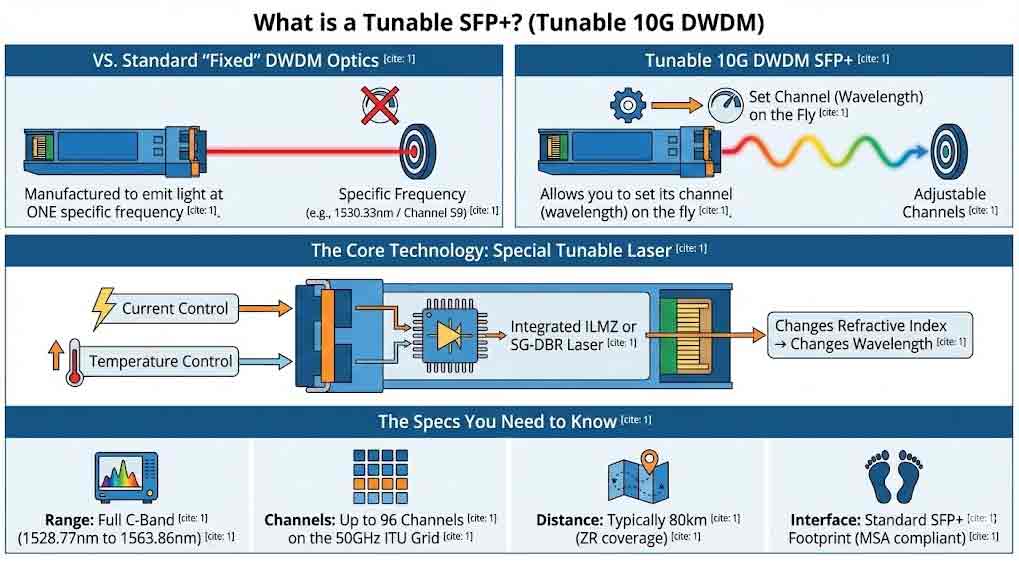
A Tunable 10G DWDM SFP+ is an Optical transceiver that allows you to set its channel (wavelength) on the fly.
Unlike standard “Fixed” DWDM optics that are manufactured to emit light at one specific frequency (e.g., 1530.33nm / Channel 59), a Tunable module contains a special laser (usually an integrated ILMZ or SG-DBR) that can change its refractive index based on temperature or current control.
The Specs You Need to Know:
-
Range: Full C-Band (1528.77nm to 1563.86nm).
-
Channels: Supports up to 96 Channels on the 50GHz ITU Grid.
-
Distance: Typically 80km (ZR coverage).
-
Interface: Standard SFP+ footprint (MSA compliant).
The Business Case: Why Switch?
Customers often ask us: “Tunable modules cost more than Fixed modules. Why should I pay extra?”
The answer lies in TCO (Total Cost of Ownership).
A. The End of “Spare Part Inventory”
Imagine you have 50 sites. Instead of keeping hundreds of fixed modules gathering dust “just in case,” you stock one box of Tunable modules.
-
Fixed Scenario: Stocking Channel 17, 18, 19, 20… (Huge CAPEX tied up in inventory).
-
Tunable Scenario: Stock 10 Tunable units. They fit anywhere. Result: You reduce your spare parts inventory value by up to 90%.
B. Software-Defined Provisioning (No Truck Rolls)
Picture this: You need to change a wavelength to balance the network load.
-
With Fixed Optics: You must send a technician to the site (Truck Roll), climb the tower, and physically swap the hardware.
-
With Tunable Optics: You log into the switch CLI remotely, type a command, and the wavelength changes. Result: Zero downtime, zero travel costs.
How Do You Tune Them? (Practical Guide)
This is the technical barrier for many users. How do you actually tell the module to be “Channel 33”?
There are two main ways to tune a Wolon SFP+:
Method A: Host Tuning (Via Switch CLI)
Modern switches (Cisco Nexus, Juniper MX, Arista) support direct tuning via software.
-
Cisco Example: Transceiver type specifics channel-number 33
-
Juniper Example:
set interfaces xe-0/0/0 optics-options wavelength 1550.92 -
Note: Your switch IOS/Junos must support the “Tunable” feature. If the switch is old, it might not see the tuning commands.
Method B: The “Wolon Tuning Box”
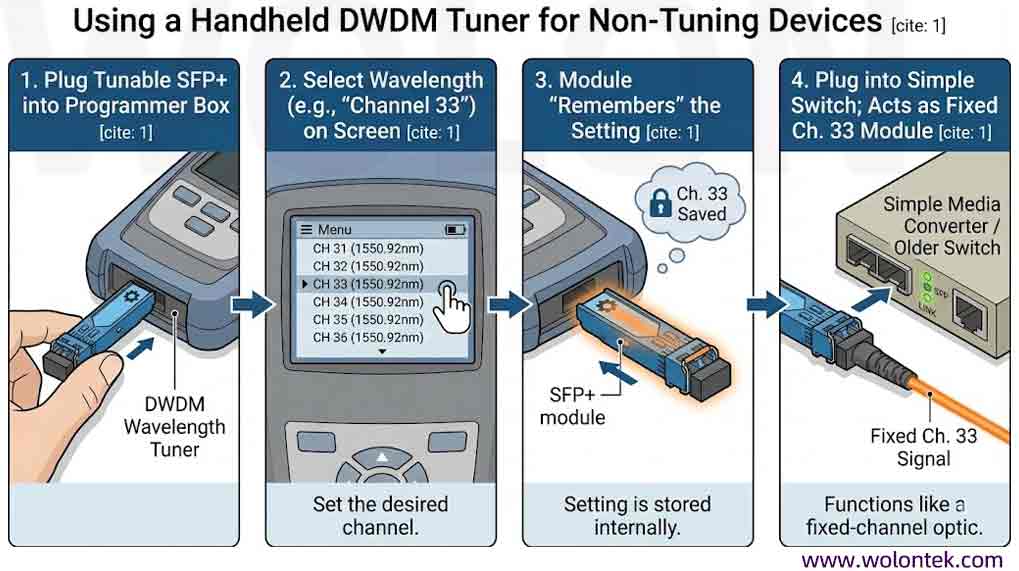
If you are using simple media converters or older switches that don’t know how to tune, you can use our handheld DWDM Wavelength Tuner.
1.Plug the SFP+ into the box.
2.Select “Channel 33” on the screen.
3.The module “remembers” this setting.
4.Plug it into your dumb switch, and it acts exactly like a fixed Channel 33 module.
Comparison: Fixed vs Tunable DWDM
Is Tunable Right for You?
We recommend Tunable SFP+ modules if:
-
You are an ISP or Carrier: Managing spares for hundreds of nodes is a logistical nightmare. Tunables solve this.
-
You use ROADM networks: Reconfigurable Optical Add-Drop Multiplexers require the flexibility of tunable wavelengths to steer traffic dynamically.
-
You are building a “Future-Proof” Ring: You don’t know exactly which channels you will need in 2 years. Tunables let you expand without buying new hardware.
When to stick with Fixed? If you are setting up a simple, static Point-to-Point link that will never change, and budget is the absolute #1 priority, fixed modules are still a solid choice.
Summary: Simplify Your Network
The days of labeling Ziploc bags with “Channel 21” and praying you have the right spare are over.
Wolon Tunable SFP+ modules offer 80km reach, full C-Band tuning (50GHz & 100GHz), and compatibility with major switch brands. We even calibrate them to ensure stable operation across extreme temperature ranges.
📉 Stop Stocking 80 Different Spares.
Consolidate your entire warehouse into One Single SKU.
Equip your field technicians with our Handheld Tuning Box Bundle so they can configure wavelengths on-site in seconds.
Bundle Offer: Ask for the “Field Tech Kit” special.
❓ FAQ: Tunable DWDM SFP+ Deployment
Q1: Can I use a Tunable SFP+ in a switch that doesn’t support tuning commands?
A: Yes, but there is a trick. Legacy switches (or simple media converters) often lack the CLI commands to configure wavelength. In this case, you must tune the module externally first using a handheld programming box (like the Wolontek Wavelength Tuner).
Key Feature: The module has non-volatile memory. Once you set it to “Channel 33” externally, it remembers that setting. You can then plug it into the “dumb” switch, and it will function exactly like a fixed Channel 33 module.
Q2: Do Tunable modules consume more power than fixed DWDM modules?
A: Yes, slightly. A standard fixed DWDM SFP+ typically consumes 1.0W – 1.2W. A Tunable SFP+ consumes around 1.5W – 1.8W.
Why? The tunable laser requires a more complex TEC (Thermo-Electric Cooler) and control ASIC to maintain frequency stability. While most modern switches handle this easily, ensure your switch port power budget isn’t maxed out if populating 48 ports simultaneously.
Q3: Can I use a 50GHz Tunable module on a 100GHz grid Mux/Demux?
A: Absolutely. The 50GHz grid (0.4nm spacing) is twice as dense as the 100GHz grid (0.8nm spacing).
The Math: Every “Even” channel on the 50GHz grid aligns perfectly with the 100GHz grid. You simply configure the tunable module to the specific ITU frequencies supported by your 100GHz Mux. It is fully backward compatible.
Q4: Does the wavelength drift over time?
A: No. Wolontek Tunable SFP+ modules feature an internal Wavelength Locker (Etalon filter). This component constantly monitors the laser output and adjusts the TEC temperature/current to keep the frequency locked within ±2.5GHz of the ITU grid center, even as the module ages or external temperature changes.
Q5: What are the specific CLI commands to tune this on Cisco/Juniper?
A: It depends on the OS version, but common commands are:
Cisco IOS-XE: transceiver type specifics channel-number <channel>
Juniper Junos: set interfaces <interface> optics-options wavelength <nm>
Arista EOS: transceiver channel <channel>
Note: Always check if your specific switch model supports the “Tunable Optics” license or feature set.