

The standard duplex Lc Patch Cord—the workhorse of the industry for years—is starting to show its age in these ultra-high-density environments. The “zip-cord” design (two separate cables fused together) takes up too much space and kills airflow.
Enter the Uniboot LC. One boot, one cable, two fibers. It cuts cabling bulk by 50%. But not all Uniboots are created equal. Some possess flimsy clips; others require a PhD to switch polarity.

I have evaluated the supply chain to bring you the top 5 suppliers who aren’t just selling cables, but are solving the density problem. Here is your definitive list for high-density cabling solutions.
Why the Move to Uniboot Matters (Beyond Just Looks)
Before we name names, let’s clarify the stakes. Why are you upgrading your standard Lc Patch Cord inventory to Uniboot?

It comes down to finger access and thermal management. In a switch fully populated with 48 or 96 ports, trying to depress the latch on a standard LC connector is a surgical procedure. A well-designed Uniboot Lc Patch Cord often comes with a push-pull tab or a streamlined housing that allows you to patch and unpatch without disturbing the adjacent ports.
Furthermore, reducing the cable diameter from the standard 3.0mm dual-zip to a single 2.0mm or 2.4mm round cable drastically improves airflow in the rear of the cabinet. Your cooling fans don’t have to work as hard, and your energy bill drops.
Here are the suppliers leading this charge.
1. Corning
Best For: The “Gold Standard” of polarity switching.
You cannot discuss fiber optics without nodding to Corning. They practically wrote the book on it. In the high-density arena, their EDGE™ Uniboot Lc Patch Cord design is arguably the benchmark against which all others are measured.
What makes Corning stand out isn’t just the glass quality (which is superb); it’s the usability.
The nightmare of Uniboot cables used to be changing polarity—flipping the transmit and receive fibers. With early designs, you needed a jig or a tool, and you risked exposing the bare fiber.
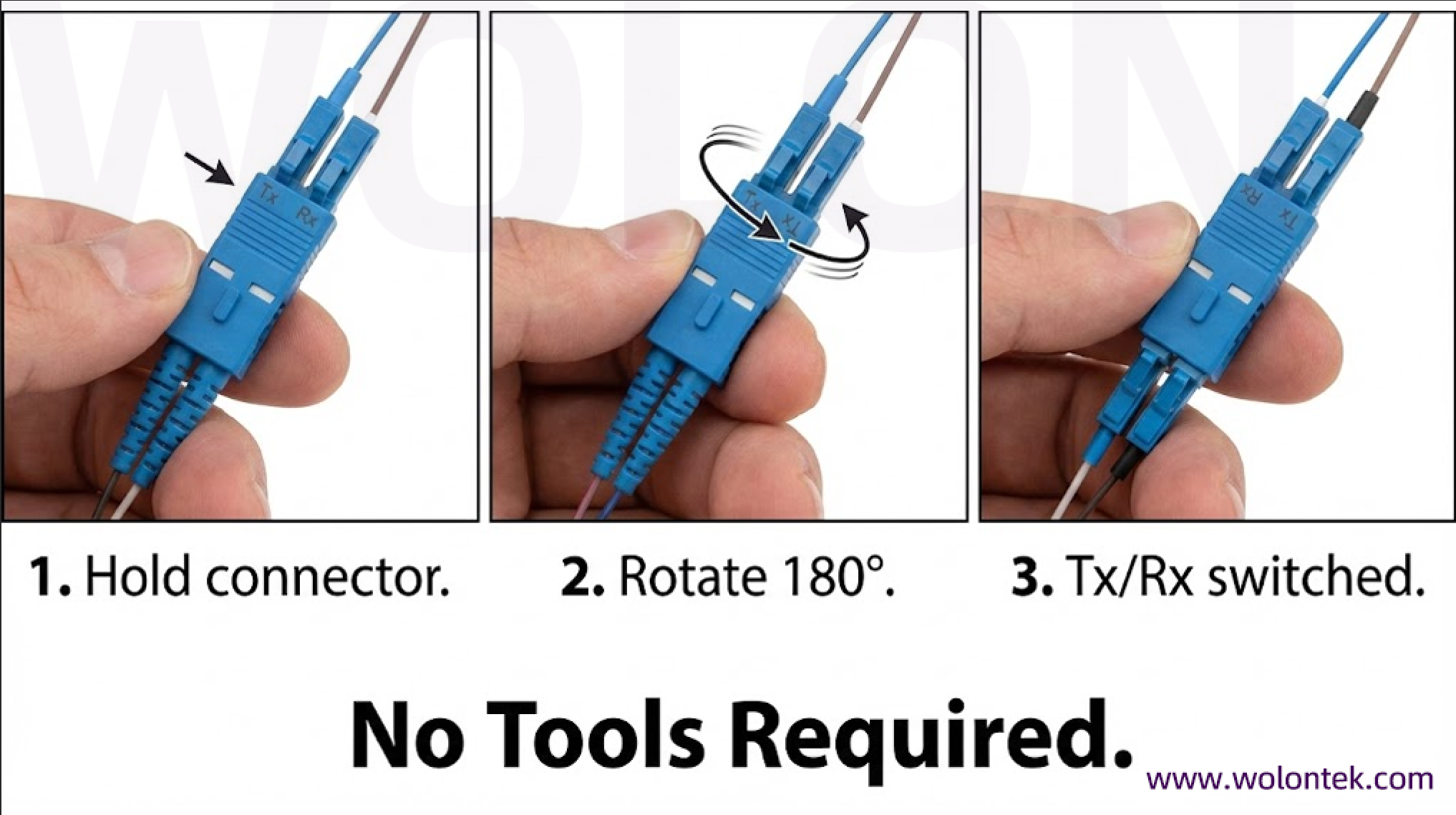
Corning’s design allows you to rotate the connector body 180 degrees to switch polarity. No tools, no exposed fiber, no stress. If your data center frequently reconfigures links, paying the premium for Corning’s engineering saves hours of labor time. They define what a premium Lc Patch Cord should feel like.
2. CommScope
Best For: Performance consistency in massive deployments.
CommScope is the heavyweight champion of structured cabling. If you are building out a Hyperscale data center, you are likely looking at their Systimax portfolio.
Their Uniboot Lc Patch Cord solutions are built like tanks. The focus here is on the “ferrule” (the ceramic tip) and the spring mechanism. In high-density patching, side-loading (pressure on the cable pulling the connector sideways) causes signal loss. CommScope’s housing is designed to be rigid enough to maintain optical alignment even when the cable management is tight.
While they might lack the flashy “tool-less rotation” marketing of some competitors, their insertion loss data is rock solid. When you buy a CommScope Lc Patch Cord, you are paying for the guarantee that the 10,000th cable performs exactly like the first one.
3. WOLON

Best For: Factory-direct customization and cost-efficiency.
While the American giants dominate the spec sheets, the manufacturing reality often leads back to China’s Optical Valley. WOLON has emerged as a formidable player for enterprises that want high-quality Uniboot cords without the massive brand markup.
WOLON distinguishes itself by being an OEM (Original Equipment Manufacturer) that has rapidly adapted to Western standards. Their Uniboot Lc Patch Cord series is particularly interesting because they offer high customization. Do you need a specific pull-tab length? Do you need a custom color for a redundant A/B path that isn’t standard yellow or aqua? WOLON can spin up that production line quickly.

They use high-grade ceramic ferrules (often sourced from the same Japanese suppliers as the big brands) ensuring low insertion loss. For an enterprise looking to restock thousands of patch cords for a new build-out, WOLON offers a balance of “Grade A” performance and factory-direct pricing that is hard to beat.
4. Panduit
Best For: The “Push-Pull” Mechanism.
Panduit approaches the Lc Patch Cord from an infrastructure perspective. They understand that the biggest problem in high density isn’t the glass; it’s the human hand.

Panduit’s Pan-MPO and Uniboot LC products feature some of the best “push-pull” boot designs in the market. Instead of trying to squeeze your fingers between two connectors to find a latch, you simply pull on the boot itself to disengage the connector.
This sounds like a minor detail until you are working on a 144-port panel. The ability to insert and remove a cord using the boot rather than the latch changes the game for maintenance speeds. Their Uniboot Lc Patch Cord is a favorite among technicians who actually have to do the patching work day in and day out.
5. FS.com
Best For: Speed and accessibility for SMBs.
FS.com has disrupted the market by making fiber optics accessible. They are not a manufacturer in the traditional sense like WOLON or Corning, but a massive supply chain aggregator.

For the mid-sized enterprise, FS is often the go-to. Their Uniboot Lc Patch Cord availability is unmatched. You can log on, select a specific polarity (Type A-B or A-A), select a length, and have it shipped overnight.
Their Uniboot design is simple and effective. It features a switchable polarity design (though slightly more fiddly than Corning’s). However, for 90% of “set it and forget it” applications, it works perfectly. If you need fifty LC patch cords tomorrow for an emergency expansion, FS is the reliability king of logistics.
Evaluating the “Uniboot” Design: What to Look For
When you are soliciting quotes from these suppliers, don’t just ask for “Uniboot.” You need to be specific to get the right product.
1. Polarity Reversibility
This is the big one. In a standard duplex Lc Patch Cord, you cross the cables physically. In a Uniboot, the fibers are inside one jacket. You must ask: Can I switch the polarity in the field without tools?
- Good: Requires a simple jig.
- Best: Requires only a finger rotation (like the offering from WOLON or Corning).
2. The Pull Tab
In high-density usage (HD), a pull tab is mandatory. Some manufacturers sell “Uniboot” cables that are just round cables with standard clips. This defeats the purpose. Ensure the Lc Patch Cord has an extended tab that allows you to remove the connector from a dense row of switches without using a specialized extraction tool.
3. Cable Diameter
Standard Uniboot comes in 3.0mm, but the trend is moving toward 2.4mm and even 2.0mm. A 2.0mm Lc Patch Cord offers the best airflow characteristics. However, be careful—going too thin can reduce the durability of the cable if your cable management trays are rough.

The Verdict: Who Should You Choose?
The “best” supplier depends entirely on your project scope.
If you are designing a Tier-4 financial data center where money is no object and brand warranty is paramount, Corning or CommScope are your safe bets.
If you are a practical network manager who needs high-performance gear, excellent customizability (like specific lengths to keep racks tidy), and a price point that keeps the CFO happy, WOLON is the smart, strategic choice.
If you need a few cables immediately for a quick fix, FS.com wins on logistics.
The era of the messy, tangled rack is over. The technology exists to make your layer-1 infrastructure beautiful, breathable, and manageable. It starts with choosing the right Uniboot Lc Patch Cord.
Simplify Your High-Density Rack with WOLON
Is your cable management fighting against you?
Stop wrestling with bulky zip-cords. Upgrade to the WOLON Uniboot LC Patch Cord Series. We combine a sleek, space-saving 2.0mm design with a tool-less reversible polarity mechanism that makes installation a breeze.
- Zero-Stress Patching: Integrated push-pull tabs for easy access in crowded 1RU switches.
- Factory-Direct Precision: Every Lc Patch Cord is 100% interferometry tested for low insertion loss.
- Custom Built: You define the length, the mode (OS2, OM3, OM4), and the boot color.

Don’t let your cabling be the bottleneck. [Explore the WOLON Uniboot LC Series Here] – Streamline your network, maximize your airflow.