
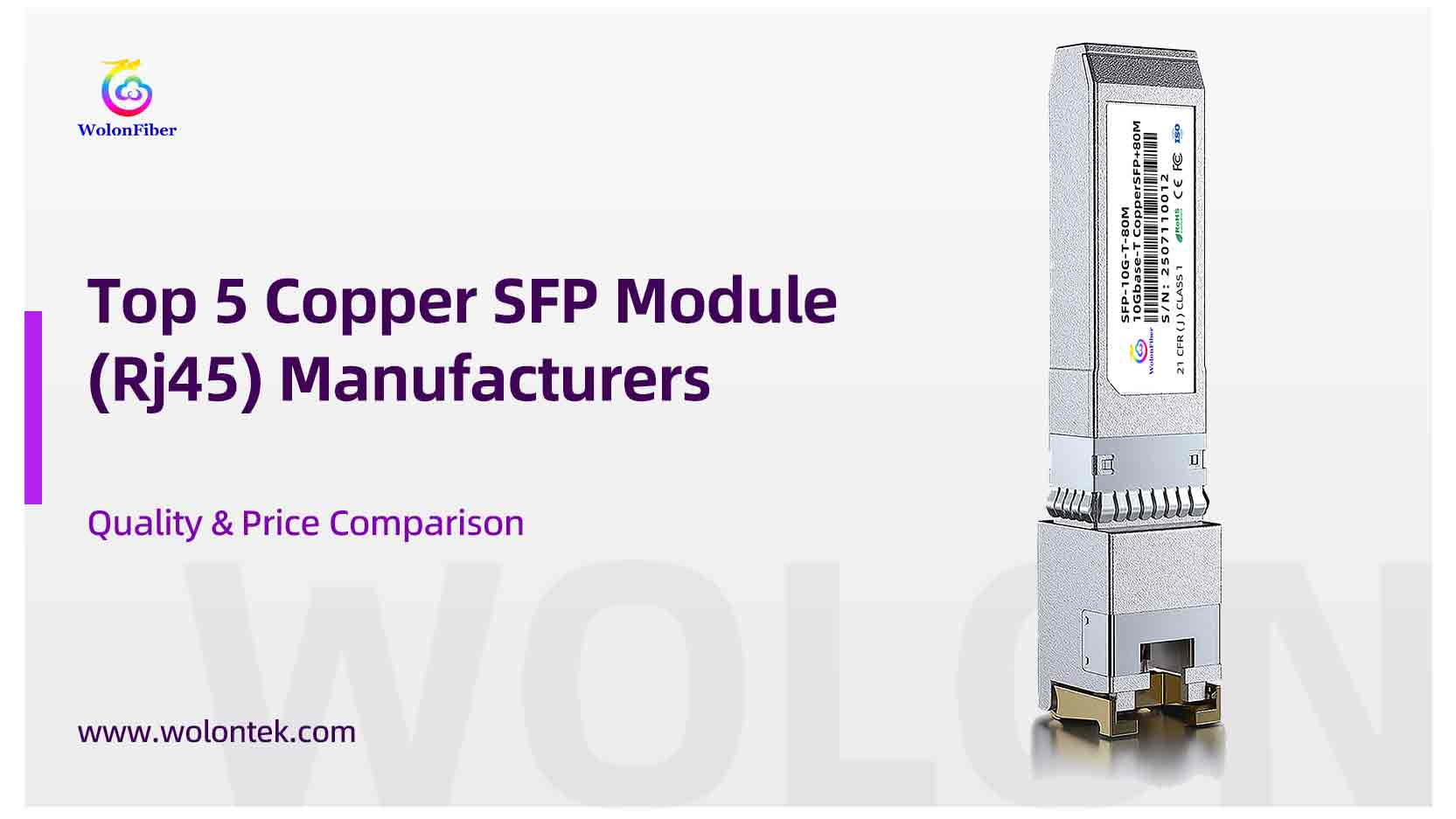
If you need to connect a server or a workstation to a switch using standard Cat6a/Cat7 cabling, you need a Copper SFP Module (RJ45).
It sounds simple, but buying these modules is a minefield.
-
The Price Gap: A Cisco 10G Copper SFP+ can cost $300+. A generic one costs $20.
-
The Heat Issue: Copper modules consume more power (2.5W+) than fiber. Cheap ones overheat and shut down.
-
The Distance: Can it really do 80 meters, or will it fail at 30?
In this guide, we review the Top 5 Manufacturers globally. We analyze who uses the best chipsets (Marvell/Broadcom) and who offers the best value for money in 2026.
Quick Comparison: The Top 5 Copper SFP Module Manufacturers at a Glance
We compared the leaders based on Chipset Quality, Price, and Heat Dissipation.
1. Cisco (The Industry Standard)

Best For: Fortune 500 Networks & Critical Infrastructure.
Cisco sets the standard. Their SFP-10G-T-X is the reference model for the entire industry.
Quality: Flawless. Cisco strictly qualifies the PHY chips (usually from Marvell) to ensure they handle heat within strict thermal envelopes.
The Downside: The “Cisco Tax”. You are paying 10x-20x the manufacturing cost just for the sticker. Unless your support contract mandates “Cisco Genuine Optics,” it is a waste of OPEX.
2. Wolon (The Factory Direct Alternative)
Best For: ISPs, Distributors, and Integrators who want Marvell Performance at Factory Prices.
Wolon bridges the gap between quality and cost. We don’t just assemble parts; we source premium PHY chips (Marvell 88X3310 for 10G) to ensure our modules run cool.
The Chipset Secret: Many cheap factories use older, power-hungry chips to save money. Wolontek uses the latest Low-Power (<2.3W) revisions. This means our modules won’t overheat your switch.
Compatibility: We code the EEPROM in-house to appear as “Cisco,” “Ubiquiti,” “Arista,” or “Juniper” hardware.
Price: By buying direct, you get the module for ~$20-$30 (depending on volume), saving you thousands on a full rack deployment.
B2B Opportunity: Are you a distributor? We offer full White Label services. We can put your logo on the metal latch and the label.
Ordering for a large project? See our guide on [How To Import Fiber Optic Cables From China] to understand our shipping process.
3. FS.com (The Retail Giant)

Best For: IT Admins needing 1 or 2 modules fast.
FS (Fiberstore) is the Amazon of networking. Their website is fantastic, and they keep stock in local warehouses (US/Germany/Australia).
Pros: Fast shipping for small orders. Good quality control.
Cons: They are a retailer. For bulk orders (e.g., 500 units for a data center), their pricing is significantly higher than buying direct from a manufacturer like Wolontek.
4. Finisar (Now Coherent)

Best For: OEMs and High-End Engineering.
Finisar is often the actual manufacturer behind brands like Cisco or HP. They are the “Intel” of the optical world.
Pros: Engineering perfection. If you are building a switch and need a qualified component, you talk to Finisar.
Cons: Very hard to buy direct. They generally do not deal with end-users or small ISPs.
5. 10Gtek (The Amazon Choice)

Best For: Home Labs & Consumer Gear.
If you search on Amazon, you will see 10Gtek. They dominate the consumer/prosumer market (UniFi, Synology users).
Pros: Easy to buy on Amazon with Prime shipping.
Cons: Geared towards the consumer market. Support and consistency for large-scale enterprise deployments may vary compared to dedicated B2B suppliers.
Technical Deep Dive: Why Do Copper SFPs Get Hot?
The #1 complaint about 10G Copper modules is heat. Unlike Fiber (which uses lasers), Copper uses electricity to push data over standard wires. This requires a PHY Chip to perform complex signal processing (canceling echo/crosstalk).
The Difference in Chips:
-
Cheap/Old Chips: Consume 3.0W+. These get extremely hot (70°C+) and can trigger switch fans to run at 100%.
-
Modern Chips (Wolontek Uses These): Consume <2.5W. They run cooler and are stable up to 80 meters on Cat6a.
Distance Reality Check:
-
10GBASE-T: Max distance is 30 meters (standard) or 80 meters (high-end).
-
NBASE-T (2.5G/5G): Can often reach 100 meters on older Cat5e cables.
Note: Always check if you need the “30m” version (cheaper/lower power) or the “80m” version.
Conclusion: Which Module Should You Buy?
Buying for a Bank/Gov? Stick with Cisco. The warranty is worth the politics.
Buying for a Home Lab? Grab 10Gtek or FS for quick delivery.
Buying for a Business/ISP/Data Center? Choose Wolon.
-
You get the Marvell Chipset reliability.
-
You get Universal Compatibility.
-
You pay the Factory Price.

Stop Paying for the “Sticker”.
You saw the specs. Wolon uses the exact same Marvell & Broadcom chipsets as the big brands.
Why pay 5x more just for a logo? Get the same performance, fully unlocked.
FAQ: Buying Copper SFP (RJ45) Modules
Q1: Why do 10G Copper SFP+ modules get so hot?
A: It’s simple physics. Fiber modules use light, which consumes very little power (<0.8W). Copper modules use electricity to push 10Gbps data over wire, requiring complex signal processing that consumes 2.5W to 3.0W.
Wolon Advantage: We use the latest Marvell 88X3310 (or equivalent) chipsets that are optimized for lower power consumption (~2.3W), running significantly cooler than older generic modules.
Q2: Will using a third-party SFP void my switch warranty?
A: No. It is a common myth spread by big brands (FUD). In the US (Magnuson-Moss Warranty Act) and EU, manufacturers cannot void your hardware warranty just for using a compatible accessory. Furthermore, Wolon modules are coded to be recognized as “Valid” hardware by the switch OS.
Q3: Can I run 10GBASE-T over Cat5e cable?
A: Officially, No. For stable 10Gbps, you need Cat6a or Cat7 cabling. However, Wolontek offers Multi-Rate (NBASE-T) modules. If you connect them to old Cat5e cabling, they can automatically negotiate to 2.5G or 5G speeds, giving you a speed boost without rewiring your building.
Q4: What is the difference between “30m” and “80m” versions?
A:
30m Version: Cheaper, consumes less power. Designed for “Top of Rack” (Server to Switch) connections.
80m Version: More expensive, consumes max power. Designed for connecting devices in different rooms.
Pro Tip: Don’t buy the 80m version if you only need a 3-meter link; the 30m version runs cooler.
Q5: Can I mix Cisco and Ubiquiti modules?
A: Yes. The SFP slot is a standard (MSA). You can have a Cisco switch on one end (with a Cisco-coded module) and a Ubiquiti switch on the other end (with a Ubiquiti-coded module). The copper cable between them doesn’t care. Wolontek can code each module to match the specific device it plugs into.