
The optical transceiver market is undergoing an unprecedented super-cycle. Fueled by the explosive growth of AI clusters (NVIDIA GPUs), machine learning fabrics, and 5G/6G network deployments, the demand for high-speed 400G and 800G optical modules has pushed global supply chains to their absolute limits.
For IT procurement managers and data center architects, sourcing reliable optical transceivers is a balancing act between lead time, OEM compatibility, and CAPEX optimization.
While major switch brands (like Cisco, Arista, and Juniper) sell “first-party” transceivers, they do not actually manufacture them. They buy from specialized optical foundries, re-brand them, and add a massive markup. To truly optimize your optical budget, you need to know the actual manufacturers driving the industry.
Here are the Top 10 Optical Transceiver Manufacturers dominating the global market in 2026, categorized by their strategic strengths.
Facing 20-week lead times for OEM optics? Bypass the brand markup and source 100% MSA-compatible transceivers directly from our 400-employee Wuhan facility. Get a Quick Factory-Direct Quote from WolonFiber ➤
Top 10 Optical Transceiver Manufacturers in the World (2026)
The Global Hyperscale Titans
These are the multi-billion-dollar giants supplying massive volumes of 400G, 800G, and emerging 1.6T transceivers directly to cloud hyperscalers like AWS, Google, and Meta.
1. InnoLight Technology (中际旭创)
Headquarters: Suzhou, China (innolight.com)
Best For: 800G AI Clusters & Cloud Hyperscalers
Overview: InnoLight is currently the undisputed global leader in optical transceiver market share. They were the first to scale 800G OSFP/QSFP-DD modules for AI GPU clusters. If you are building a massive AI data center, InnoLight is likely the foundry behind the optics.
2. Coherent (Formerly Finisar)
Headquarters: Pennsylvania, USA (coherent.com)
Best For: Telecom & Comprehensive Optical Components
Overview: Coherent (which acquired Finisar) is a legendary name in optics. They manufacture everything from the bare VCSEL/EML laser chips to the finished transceivers. They are highly favored by western telecom operators and enterprise networks requiring unmatched historical reliability.
 Procurement Reality Check:
Buying directly from Tier-1 titans like InnoLight or Coherent often requires massive Minimum Order Quantities (MOQs). Need an agile alternative? WolonFiber manufactures rigorous DOM/DDM tested 400G/800G transceivers with 100% Cisco/Arista compatibility at a fraction of the cost.
Request a Free Test Transceiver for Your Switch ➤3. WolonFiber – The Factory-Direct OEM Alternative
Headquarters: Wuhan, China (Optical Valley)
Best For: High-ROI Enterprise IT, ISPs, & 100% OEM Compatibility
Route: Factory-Direct to Global Integrators
While the top 6 giants focus heavily on massive hyperscale contracts and telecom infrastructure, what if you are a regional ISP or enterprise IT manager who cannot meet their massive MOQs? This is where an agile, OEM-compatible foundry steps in.
Headquartered right in Wuhan’s Optical Valley—sharing the same deep engineering ecosystem as giants like Accelink—WolonFiber serves as the agile, high-ROI physical layer partner.
 Send Us Your Part Numbers for an Instant Direct Match
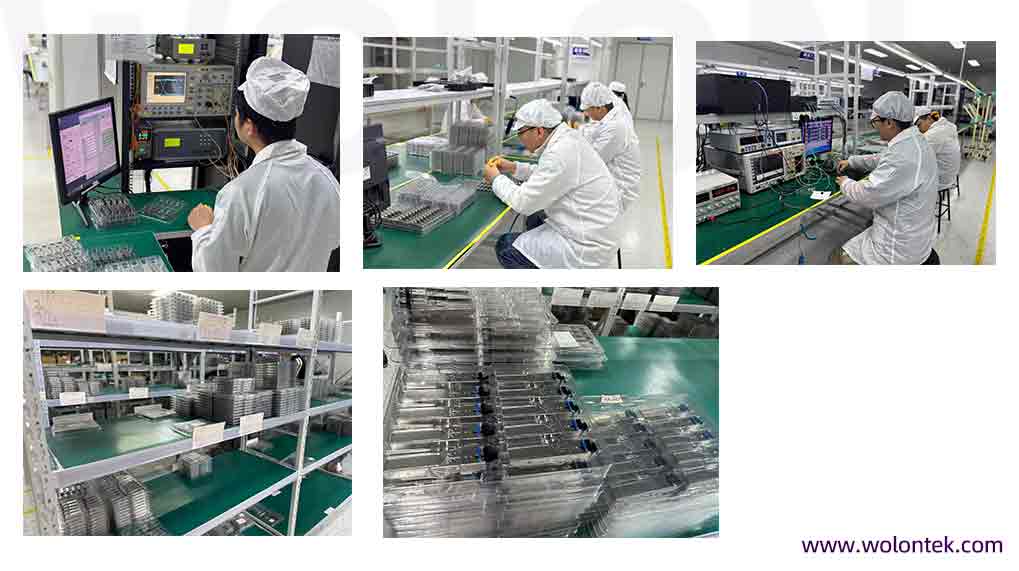
We don’t inflate prices for brand prestige. Our 400-strong workforce engineers and manufactures strict-tolerance optical transceivers (ranging from 1G SFP up to 400G QSFP-DD) designed for pure performance and budget optimization.

Why Integrators Source Transceivers from WolonFiber:
100% OEM Compatibility (EEPROM Coding): The biggest fear in buying third-party optics is switch rejection. We custom-code our transceivers in-house to perfectly match the EEPROM signatures of Cisco, Arista, Juniper, HP, and Huawei switches. Plug and play, guaranteed.
Bypass the Brand Markup: You get Tier-1 component quality (utilizing premium lasers and DSPs) without the 60% logo markup charged by switch manufacturers.
Rigorous DOM/DDM Testing: Every module undergoes strict Digital Optical Monitoring (DOM) testing for temperature, voltage, and laser bias current before leaving our Optical Valley facility.
Unified Procurement: Stop managing ten different vendors. We supply the transceivers, the MTP high-density cables, and the patch panels all from one direct factory source.
4. Eoptolink Technology (新易盛)
Headquarters: Chengdu, China (eoptolink.com)
Best For: Fast 400G/800G Deployment & Cloud Networks
Overview: Eoptolink has surged in recent years due to its highly agile manufacturing and deep partnerships with US cloud providers. They are renowned for their low power consumption designs in high-speed PAM4 transceivers.
5. Cisco (Acacia Communications)
Headquarters: California, USA (cisco.com)
Best For: Coherent Optics & Long-Haul DCI
Overview: While Cisco is a switch vendor, their acquisition of Acacia made them a core manufacturer of coherent optical transceivers. These highly specialized, expensive modules are used for long-haul Data Center Interconnect (DCI) stretching hundreds of kilometers.
6. Accelink Technologies (光迅科技)
Headquarters: Wuhan, China (accelink.com)
Best For: Telecom Backbones & 5G Fronthaul
Overview: Born out of the Chinese government’s research institutes, Accelink is a dominant force in telecom optics. They have massive market share in 5G base station deployments and passive optical network (PON) components.
7. Hisense Broadband (海信宽带)
Headquarters: Qingdao, China (hisensebroadband.com)
Best For: FTTx & Access Network Modules
Overview: If you are deploying Fiber-to-the-Home (FTTH), Hisense Broadband is likely supplying your GPON/XGS-PON optical modules. They hold a massive global market share in the broadband access sector.
8. Lumentum
Headquarters: California, USA (lumentum.com)
Best For: Photonic Integrated Circuits (PIC) & Telecom
Overview: Lumentum shifted its focus slightly away from standard datacom modules to focus on high-margin telecom transmission, tunable transceivers, and supplying the core laser chips to other module assemblers.
9. Broadcom
Headquarters: California, USA (broadcom.com)
Best For: Core Laser Chips & Silicon Photonics
Overview: Broadcom is the hidden giant. While they manufacture transceivers, their true power lies in supplying the DSPs (Digital Signal Processors) and VCSEL/EML chips that power almost everyone else’s optical modules on this list.
10. Intel (Silicon Photonics)
Headquarters: California, USA (intel.com)
Best For: 100G/400G Silicon Photonics Modules
Overview: Intel revolutionized the market by integrating optical lasers directly onto silicon wafers (Silicon Photonics). This process allows for highly scalable, automated manufacturing of 100G and 400G modules, primarily used in enterprise cloud networking.
Quick Reference Matrix: Top Optical Transceiver Manufacturers (2026)
To help you navigate the complex optical supply chain, here is a quick breakdown of the top manufacturers by their core technological strengths and ideal procurement profiles:

Global Transceiver Market Landscape
Summary: Sourcing the Right Optics
The global optical transceiver market is clearly divided. If you are building a multi-billion dollar AI supercomputer, you buy directly from InnoLight or Coherent.
However, if you are outfitting a regional data center, upgrading a hospital’s IT core, or deploying an ISP network, paying premium brand markups destroys your CAPEX. You need reliable, universally compatible transceivers straight from the manufacturing source.
 Request a Free Test Transceiver & Factory-Direct Pricing Catalog
Do switch brands like Cisco or Arista manufacture their own optical transceivers?
No. Major networking hardware brands typically do not manufacture their own optics. They purchase transceivers from specialized optical foundries (like InnoLight or Coherent), flash them with proprietary EEPROM firmware, and apply their own brand logo with a significant markup.
Are third-party compatible transceivers safe to use in enterprise switches?
Yes, absolutely. Because all optical transceivers are built to strict Multi-Source Agreement (MSA) standards, the hardware is universal. As long as you source from a reputable factory that uses precise EEPROM coding and rigorous DOM/DDM testing, a compatible module will perform identically to an OEM-branded module at a fraction of the cost.
What is the difference between OEM and third-party optical modules?
The primary differences are the brand label and the price. A premium factory-direct compatible transceiver uses the exact same core components (like Broadcom DSPs and laser chips) and follows the same MSA physical standards as the OEM versions, but eliminates the 50% to 70% brand markup.
Who is the largest optical transceiver manufacturer in the world?
As of recent market data, InnoLight Technology holds the largest global market share, driven primarily by massive volume shipments of 400G and 800G modules to US cloud hyperscalers for AI clusters. Other major players include Coherent, Eoptolink, and Cisco (Acacia).
Why should I buy directly from a manufacturer instead of a distributor?
Buying factory-direct (from manufacturers like WolonFiber) bypasses the distributor margins, ensuring you get the lowest possible CAPEX for your project. Furthermore, working directly with the factory allows for customized EEPROM coding for mixed-switch environments and guarantees faster turnaround times for bulk orders.