
The ST fiber connector is still a key part of many networks. It uses a classic bayonet-style lock. This reliable fiber optic ST choice features a 2.5 mm ferrule. You get a design that puts strength and easy handling first, rather than just packing ports closely. Do you maintain campus backbones, industrial links, or mixed-tech labs? ST fiber is often your best tool.

Optical Performance of ST Fiber Connectors
Clean and terminate ST fiber connectors the right way. They give you low, repeatable insertion loss. This is key for active links. Factory-made ST jumpers usually hit low loss numbers—often near 0.12 dB for single-mode and ~0.15 dB for multimode. Planning for the field? Budget 0.2–0.3 dB per connector. These numbers show that ST technology meets enterprise and industrial needs easily. You don’t need to over-engineer it.
Mechanical Simplicity for Field Technicians
The ST design features a quarter-turn bayonet and spring-loaded ferrule. You can connect and disconnect it easily. It works well even with gloves on or in dark spaces. This simple design helps a lot during field work, quick repairs, or training. The connector uses a strong 2.5 mm ceramic ferrule. So, it keeps alignment and holds up against heat over hundreds of uses. This toughness matters outside of data centers.

ST to LC Versatility in Hybrid Networks
ST format fits almost anywhere. That is a huge plus. The same mechanics support both multimode and single-mode fibers. Plus, adapters let it fit into modern networks. You often see ST to Lc fiber patch cables or ST-to-SC adapters. These bridge old setups with new gear. This makes inventory easy for vans and labs. Carry just a few ST patch cords and hybrid adapters. That covers most connection needs.
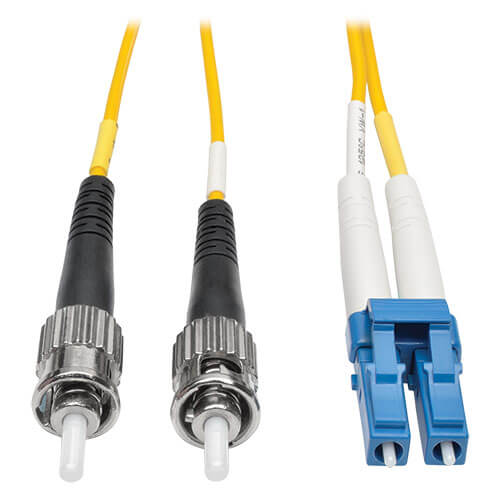
Where ST Fiber Fits Best: Application Checklist
-
Legacy campus backbones: Old buildings often use ST in closets. Keep these links. It costs less than rewiring everything.
-
Industrial and ruggedized runs: The positive locking mechanism is secure. It handles vibrations in industrial cabinets well.
-
Educational labs and test benches: ST connectors are easy to handle. This makes them great for teaching and temporary links.Does your site match these? Then ST fiber optic cable assemblies are a smart choice.
Density Trade-offs: ST vs. LC Connectors
ST is strong, but it is bigger than Small Form Factor (SFF) connectors like LC (1.25 mm ferrule). So, ST won’t give you the high port density you need for modern panels. New hyperscale builds use LC (and MPO/MTP) as the standard. But you might prioritize physical access, easy field use, or legacy support. In those cases, ST is still the better practical pick.

Polishing Types and Link Budgeting
You can get ST connectors in different polish types (PC/UPC or APC). This changes return loss—a big factor for single-mode links. Check vendor datasheets for exact insertion-loss and return-loss specs. Good manufacturers list mating-cycle ratings. Trust those for your link budgets. Verifying field tests? Assume ~0.3 dB loss per connector. This ensures you have enough headroom.
Common Pitfalls and Solutions
-
Dust and contamination: This is the main reason for failure. Clean ferrules with lint-free wipes and right solvents before connecting. Also, use a microscope to check them.
-
Forcing density: Don’t use ST in tight, high-density panels. Cable management gets hard and ruins the handling benefits.
-
Field termination variability: Field-polished or mechanical ends seldom match factory specs. Test every link after installation. Document the loss you measure. Don’t just rely on general spec sheets.

Practical Buying and Repair Tips
-
Stock up on ST fiber patch cables (both single-mode and multimode). Keep ST-to-LC adapters too. This helps manage mixed racks.
-
Use pre-polished, factory-made jumpers for main backbone links. Save field terminations for emergency repairs.
-
Label cords and ports is a must. Clear labels stop mix-ups between single-mode and multimode types. This helps in old installs where jacket colors might look different.
Final Take: Why ST Technology Persists
ST fiber connector value comes from function, not trends. It isn’t the densest option. It isn’t the default for new data centers either. But reliable mechanics and ease of use keep it relevant. Do you maintain networks where field service, toughness, and legacy support matter? Then ST fiber stays a key part of your toolkit.