

In the world of optical networking, the QSFP (Quad Small Form-factor Pluggable) is the heavy lifter. Unlike the smaller SFP which handles a single lane of traffic, a QSFP is a four-lane beast designed to quadruple your bandwidth without taking up four times the space.
Whether you are a network architect planning a spine-leaf topology or a procurement manager sourcing QSFP transceivers for a server room, understanding the nuances of this module is critical. In this guide, we will break down what is a qsfp, the different types available, and how to pick the right one for your environment.
What is a QSFP Transceiver?
To understand what is a qsfp, you just need to focus on the first letter: “Q” for Quad.
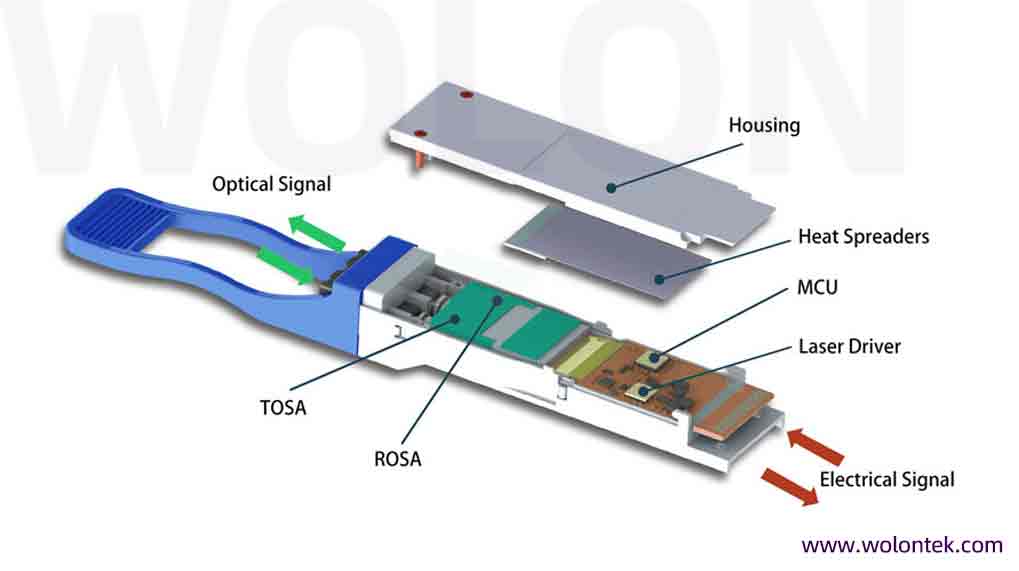
A standard SFP Module has one electrical channel (1 lane). A QSFP transceiver, however, integrates four independent transmit and receive channels into a single hardware module.
-
Think of it this way: If an SFP is a single-lane road, a QSFP is a four-lane superhighway.
This design allows for incredible density. By bonding four channels together, a single QSFP port can deliver speeds ranging from 40Gbps (4 x 10G) all the way up to 400Gbps (4 x 100G) in newer iterations, all while keeping the module size slightly larger than a standard thumb drive.
If you are debating which form factor fits your new switch, or you want to see a side-by-side physical comparison, we have written a dedicated “battle guide” for you. Check out our deep dive here: [SFP VS QSFP: How to Decide Which Module Your Switch Needs].
Prefer a visual explanation?
Types of QSFP Transceivers
Not all qsfp transceivers are created equal. When our clients send us inquiries at Wolon, they often get confused between the physical form factor (the metal casing) and the electrical protocol (the speed).
Here is how we categorize the different QSFP types in the manufacturing industry:
1. Classification by Speed & Evolution (Protocol)
The physical size (form factor) has stayed roughly the same, but the engine inside has evolved significantly.
QSFP (The Original)
The original standard, now largely obsolete. It supported 4 channels of 1Gbps (4G total). You rarely see this in modern networks.
QSFP+ (40G QSFP)
The “+” signaled a major jump. This module supports four 10 Gbit/s channels carrying 10 Gigabit Ethernet, Fibre Channel, or InfiniBand.
Use Case: Core switches in enterprise networks connecting to 10G access switches.
QSFP28 (100G QSFP)
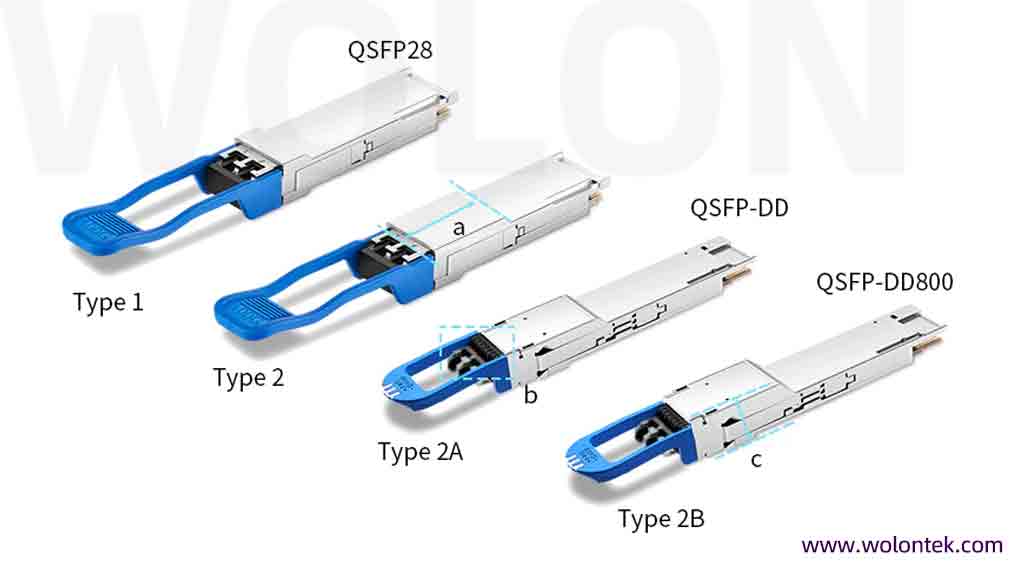
This is the current “workhorse” of the industry. It implements four channels of 25Gbps high-speed differential signals.
Why “28″? It signifies capable speeds up to 28Gbps per lane.
Use Case: Hyperscale data centers and ISP backbones.
QSFP56 & QSFP-DD (200G/400G)
The bleeding edge. QSFP-DD (Double Density) adds an extra row of contacts to support 8 lanes, enabling 400G and 800G speeds.
2. Classification by Media Type (Interface)
How does the QSFP connect to the cable? This depends on the media type.
Copper DAC (Direct Attach Cable)
What it is: The QSFP module is permanently fused to a copper cable.
Best For: Short distances (< 7 meters) inside the same rack. It’s the cheapest way to connect a server to a switch.
Multimode Fiber (SR4 – Short Reach)
Interface: MPO/MTP connector (12-fiber or 8-fiber).
How it works: It uses 4 fibers to transmit and 4 to receive.
Best For: Distances up to 100m (OM3) or 150m (OM4).
Singlemode Fiber (LR4/ER4/ZR4)
Interface: Duplex LC connector.
How it works: It uses WDM (Wavelength Division Multiplexing) technology to squeeze 4 wavelengths onto a single pair of fibers.
Best For: Long-haul connections (10km, 40km, or even 80km).
3. Classification by Working Temperature
In our factory testing lab, we separate qsfp transceivers into two distinct bins based on where they will be used.
-
Commercial Grade (COM): 0°C to 70°C.
Standard for air-conditioned data centers and office server rooms.
-
Industrial Grade (IND): -40°C to +85°C.
Mandatory for outdoor cabinets, base stations, or unconditioned warehouses. These use more robust chipsets to survive extreme heat and cold.
Comparison Table: QSFP+ vs. QSFP28
This is the most common question we get: “Can I plug a QSFP28 into a QSFP+ port?” Let’s look at the specs.
| Feature |
QSFP+ (40G) Standard |
QSFP28 (100G) High Performance RECOMMENDED
|
|---|---|---|
| ⚡ Channel Speed (The Core Difference) |
4 x 10 Gbps Uses 10G lanes (NRZ). |
4 x 25 Gbps Uses faster 25G lanes to hit 100G. |
| Connector | MPO-12 or Duplex LC |
MPO-12 or Duplex LC (Same cabling infrastructure!) |
| Power (Typical) |
< 3.5 W | < 4.5 W |
| Standard | IEEE 802.3ba | IEEE 802.3bm |
| Backward Compatible? | N/A |
✅ Yes QSFP28 ports can often run QSFP+ 40G optics (check switch config). |
Pro Tip: Based on the official IEEE 802.3 Ethernet Standards, which define the physical layer specifications for 40G and 100G interfaces.While a QSFP28 port can usually accept a QSFP+ module (running at 40G), you cannot force a 100G QSFP28 module to work in an old 40G QSFP+ port. The hardware just can’t handle the speed.
How to Choose the Right QSFP for Your Network
Selecting the right QSFP isn’t just about matching the speed. You need to consider the “Link Budget” and compatibility.
1. Check the “Coding” (Compatibility)
A generic QSFP won’t work in a HP Aruba or Cisco switch unless it is coded correctly. Switches “talk” to the Transceiver via the EEPROM chip. If the code doesn’t match, the port will shut down.
-
At Wolon, we flash the specific EEPROM codes for over 100 different brands before shipping.
2. Distance vs. Cost
< 100m: Go with QSFP28 SR4 (Multimode). It’s cheaper but requires expensive MTP cables.
< 2km: Use QSFP28 CWDM4 or CLR4. This is the “sweet spot” for large data centers—it uses cheap LC singlemode fiber but costs less than long-range modules.
> 10km: You need QSFP28 LR4.
Conclusion: Making the Right Connection
Navigating the world of QSFP transceivers—from the legacy 40G QSFP+ to the blazing fast 400G QSFP-DD—can feel like learning a new language. But it boils down to three simple questions: What speed do you need? What distance are you covering? And does it match your switch’s coding?
Don’t let the fear of “incompatibility” force you into paying 10x the price for branded modules from the switch manufacturer. The hardware inside a $500 branded module is often identical to a $50 third-party module—if you buy from a reputable source.
Your network deserves reliable optics, not a markup.
At Wolon, we don’t just sell modules; we engineer connectivity. With our own dust-free workshops and advanced coding labs in China, we ensure every QSFP transceiver is strictly tested for temperature stability and switch compatibility before it ever touches a shipping box.
Frequently Asked Questions (FAQ)
Q: Can I use a QSFP28 (100G) transceiver in a QSFP+ (40G) port?
A: Generally, no. A legacy 40G QSFP+ port typically cannot support the higher electrical speed of a 100G module. However, the reverse is often true: most modern 100G QSFP28 switches are backward compatible and can accept a 40G QSFP+ module (running at 40G speeds). Always check your switch datasheet to be sure.
Q: What is the difference between SR4 and LR4?
A: It comes down to distance and fiber type:
SR4 (Short Reach 4-lane): Uses Multimode fiber (MPO connector) for short distances (up to 100m). Ideal for connecting servers to switches within a rack.
LR4 (Long Reach 4-lane): Uses Singlemode fiber (LC connector) for long distances (up to 10km). Ideal for connecting buildings or data centers.
Q: Do I need to clean the QSFP transceiver before plugging it in?
A: Yes! Even new modules can collect dust during shipping. A microscopic dust particle on the fiber core can block the signal or permanently scratch the lens. Always use a “One-Click” cleaner or optical cleaning pen on both the module and the cable connector before mating.
Q: What is “Breakout” mode?
A: A QSFP port is powerful because it contains 4 electrical lanes. “Breakout” allows you to split one high-speed port into four lower-speed ports using a breakout cable. For example, a single 40G QSFP+ port can be split into four 10G SFP+ links, allowing you to connect one core switch to four downstream servers.
Q: Will using a third-party Wolon QSFP void my switch warranty?
A: No. In the US (Magnuson-Moss Warranty Act) and many other regions, switch manufacturers cannot void your hardware warranty simply for using third-party optics. If the optic itself causes damage, they may not cover that specific repair, but the overall switch warranty remains valid. Wolon modules are coded to meet MSA standards, ensuring safe operation.