When you plan a network, picking the right Transceiver speed is less about following a trend and more about matching real constraints: how many ports you need, how far the fiber must run, whether your gear prefers single or multi-lane electrical interfaces, and how much power and cooling your chassis can spare. Below I walk through the common speeds — what they mean in practice, where they still make sense, and the straightforward trade-offs that matter when you’re making purchase or upgrade decisions.

1G — simple, cheap, still useful
One-gigabit SFP modules are the workhorses in access and campus networks. They’re inexpensive, easy to terminate, and play nicely with legacy switches and appliances. Short-reach multimode 1000BASE-SX parts are commonly used inside buildings — you’ll see quoted reaches like a few hundred meters on OM3/OM4, while 1G single-mode LX parts are the go-to for 10-kilometer campus links. If you only need connectivity for a printer closet, a door controller, or a single legacy server, 1G keeps costs down and operations simple.
10G — the classic top-of-rack uplink
Ten-gig SFP+ rose to prominence because it balances price, density, and power for many enterprise racks. For short runs inside a data hall, 10GBASE-SR on OM3/OM4 gives hundreds of meters of reach; for longer runs, LR optics over single-mode hit the 10-km marks. 10G still makes sense when downstream devices are 10G or when you need inexpensive, low-power uplinks that won’t stress your cooling budget. But for new greenfield server deployments, ask whether 25G would serve the same job at lower cost per gigabit.
25G — the efficient single-lane upgrade
25G changed the upgrade map for a reason: it gives 2.5× the bandwidth of 10G without blowing out port density. The SFP28 package keeps the same physical footprint as SFP while supporting 25Gbps electrical lanes, which aligns neatly with modern NICs and switch ASICs. For many cloud and hyperscale designs 25G per lane — combined into 100G uplinks or used as direct host links — reduces cabling and improves watts-per-Gbps compared with 10G. In short, 25G is often the economical, practical step for server farms and switch refreshes.
40G — legacy and specific-fit cases
Forty-gigabit ports used to be a common spine or aggregation choice, usually built from four 10G lanes (QSFP+ SR4). Today, many organizations skip 40G in new designs because 100G built from 4×25G or native 100G optics gives better long-term density and cost per bit. Still, if you’re working with older uniform switches or need to preserve existing 10G breakout cabling, 40G can be a pragmatic short-term bridge. Think of it as the compatibility tool you keep on hand, not the future standard.
100G — density and signaling choices
When you hit 100G you start seeing two distinct implementation philosophies: lane aggregation (4×25G NRZ) and higher-order signaling (PAM4 with DSP/FEC). QSFP28 is the dominant 100G form factor, and you’ll find SR4 (parallel multimode), LR4 (single-mode DWDM lanes), and single-wavelength PAM4 variants depending on reach and cost targets. The practical upshot: 100G gives a clean, high-density option for spines and long-haul interconnects, but you must check whether your platform prefers multi-lane NRZ or single-wavelength PAM4 optics because that affects compatibility and thermal budget.
200G — stepping up without breaking racks
Two hundred gigabit optics come in a few flavors — QSFP56 (a 56-Gbaud family), QSFP-DD and OSFP for higher density and future migration. Vendors implement 200G with combinations like 4×50G NRZ, 2×100G PAM4, or other multi-lane mixes; the specific approach determines power draw and reach. For many networks, 200G is the sensible spine/backbone choice today (it’s dense but not yet as thermally aggressive as some 400G options), and if you’re planning for 400G later, picking QSFP-DD or OSFP can simplify that path.
A short, practical checklist before you buy
-
Match the form factor to your chassis. Don’t buy a speed that won’t physically plug into your switches.
-
Decide fiber type by distance. Multimode for short (within hall/room), single-mode for >2–10 km and carrier links. Always confirm fiber attenuation and connector loss.
-
Think watts per gigabit. Higher-order modulation (PAM4) and DSP increase power — make sure your switch can cool it.
-
Plan breakout and migration. 25G lanes map neatly to 100G breakouts; 4×25G and 100G are friendlier for future-proofing than older 40G stacks.
conclusion
Use 1G/10G where endpoints demand it or to keep operating costs low. For new server fabric builds, favor 25G and 100G for best cost-per-bit and easier migration. Choose 200G where backbone density matters and consider QSFP-DD/OSFP if you want a straightforward path to 400G. And always verify optical budgets, power and compatibility on the exact switch models you run — those practical checks are where projects succeed or stall.
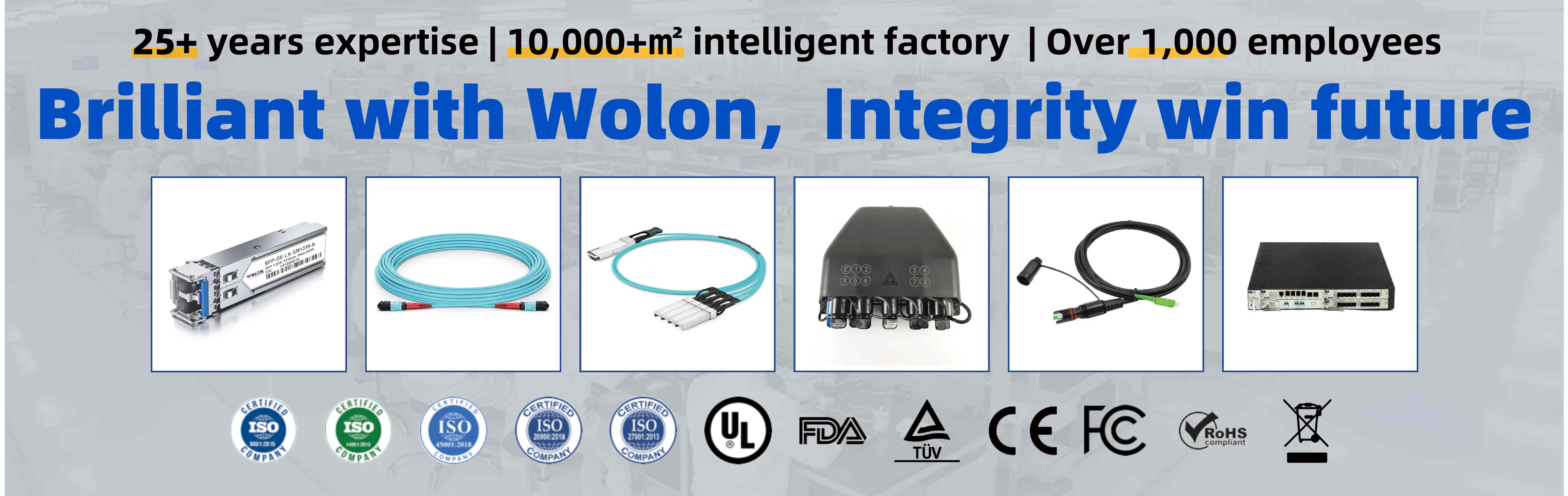
WOLON ships a full suite of factory-tested transceivers and cabling to match these needs: SFP/SFP+ for 1G/10G, SFP28 for 25G, QSFP+ and QSFP28 for 40G/100G, and QSFP56 / QSFP-DD / OSFP options for 200G and beyond. Each module from WOLON includes burn-in testing, clear optical budget labels, and a vendor compatibility matrix so you can buy with confidence and avoid surprise incompatibilities.