
If you have ever purchased an optical transceiver, you have seen the phrase “MSA Compliant” printed on the datasheet. Most IT buyers gloss over this, assuming it is just another boring IEEE regulatory standard.
It is not.
The Multi-Source Agreement (MSA) is arguably the most important document in the fiber optic industry. It is the only mechanism that prevents massive switch manufacturers (like Cisco, Juniper, and Arista) from locking you into a closed hardware ecosystem and charging a 500% markup on optical transceivers.
If you are trying to cut your network deployment costs without sacrificing reliability, you need to understand exactly what a Multi-Source Agreement is, how it governs form factors like the QSFP MSA, and why it makes third-party optics completely safe to deploy.

The Problem: IEEE vs Physical Hardware
The IEEE (Institute of Electrical and Electronics Engineers) defines the protocols. They dictate how a 10G or 100G Ethernet signal should be encoded and transmitted. However, the IEEE rarely dictates the physical shape of the module that plugs into the switch.
Without a physical standard, every switch manufacturer would design a proprietary port shape. You would be forced to buy a specific Cisco-shaped module for a Cisco switch, and an HP-shaped module for an HP switch.
The Solution: The Multi-Source Agreement
To prevent this hardware monopoly, independent optical manufacturers formed consortiums. A Multi-Source Agreement (MSA) is an agreement among multiple competing transceiver manufacturers to build products that share the exact same physical and electrical specifications.
When an MSA committee defines a new form factor (like SFP+ or QSFP28), they publish strict blueprints detailing:
-
Mechanical Dimensions: The exact millimeter measurements of the metal housing and the locking latch.
-
Electrical Interface: The exact pinout layout so the module draws the correct voltage from the switch chassis.
-
Software Interface: Specifically, the SFF-8472 standard, which dictates how the module reports digital diagnostics (DDM/DOM) like temperature and laser power to the switch operating system.

The Engineering Reality: Because of the MSA, the physical hardware inside a $1,500 OEM transceiver and a $50 WolonFiber transceiver is functionally identical. The metal cage, the laser diodes, and the pinouts follow the exact same MSA blueprints.
The Master MSA Form Factor Cheat Sheet
As network speeds have evolved from 1 Gigabit to 800 Gigabits, the MSA consortiums have continuously released new physical specifications to handle heat dissipation and parallel data lanes.
If you are auditing hardware or building a BOM, here is the complete engineering breakdown of every major MSA form factor, past and present:
 Technical Definition
 Engineering Application & Status
Why Do Switches Reject “MSA Compliant” Third-Party Optics?
If an MSA-compliant transceiver is physically and electrically identical to an OEM module, why does your Cisco switch suddenly display an “Unsupported Transceiver” error when you plug it in?
It is a software lock. OEMs program their switch operating systems to read the EEPROM memory chip inside the optical module. If the EEPROM does not contain the specific vendor’s cryptographic signature, the switch shuts down the port.
This is where true factory integration matters.
At WolonFiber, we manufacture our optical transceivers strictly according to SFF and MSA physical standards at our Optical Valley facilities in Wuhan. But before a module ships, our engineering team flashes the exact OEM vendor code (Cisco, Arista, HPE, Juniper) onto the module’s EEPROM.
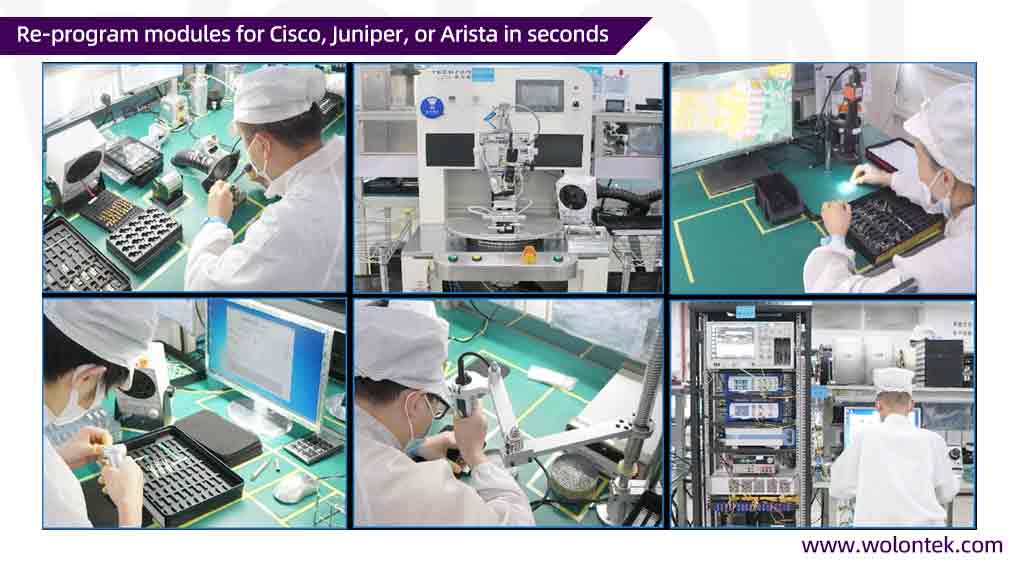
You get an optic that is 100% physically compliant with the global MSA standard, and 100% software-compatible with your proprietary switch routing hardware—without paying the distributor markup.
 Source MSA-Compliant Optics Direct from the Manufacturer
Cut out the middleman without sacrificing reliability. Explore Wolontek’s full range of transceivers (SFP+, QSFP28, QSFP-DD), rigorously tested for seamless integration across all major switch brands.
Explore Factory-Direct Transceivers
What does MSA stand for in networking?
In networking, MSA stands for Multi-Source Agreement. It is a collaborative standard among competing fiber optic manufacturers to ensure that transceivers (like SFP or QSFP) share the exact same physical dimensions, electrical pinouts, and software interfaces across all brands.
What is the QSFP MSA?
The QSFP (Quad Small Form-factor Pluggable) MSA is a specific hardware standard that defines a transceiver utilizing four independent data lanes. It is the foundational blueprint for 40G (QSFP+) and 100G (QSFP28) high-density network deployments.
Are MSA compliant transceivers safe to use?
Yes. MSA compliant transceivers are built to the exact same physical and electrical tolerances as OEM-branded modules. As long as the transceiver’s EEPROM is correctly coded for your specific switch brand, it will perform identically to a factory original.
What is the difference between IEEE and MSA?
The IEEE defines the logical data protocols (how the data is encoded, like 100BASE-SR4). The MSA defines the physical hardware (the size of the metal housing, the latch mechanism, and the pin layout) required to transmit those IEEE protocols.