
If you are standing in front of a server rack, holding a bundle of cables and wondering whether to go the high-density route or stick to the traditional method, you aren’t alone. The choice between MPO (Multi-fiber Push On) and LC (Lucent connector) isn’t just about connector shape; it is a strategic decision about speed, space, and future-proofing.
Here is the short answer: Use Mpo Trunk cable solutions when you need to bridge long distances between racks, aggregate data for high-speed backbones (40G/100G and beyond), or when cable congestion is choking your airflow. Conversely, stick to the trustworthy Lc Patch Cord when you are making the final “last mile” connection between a breakout cassette and the individual server or switch port, or when operating strictly within a 1G to 10G environment where flexibility is king.
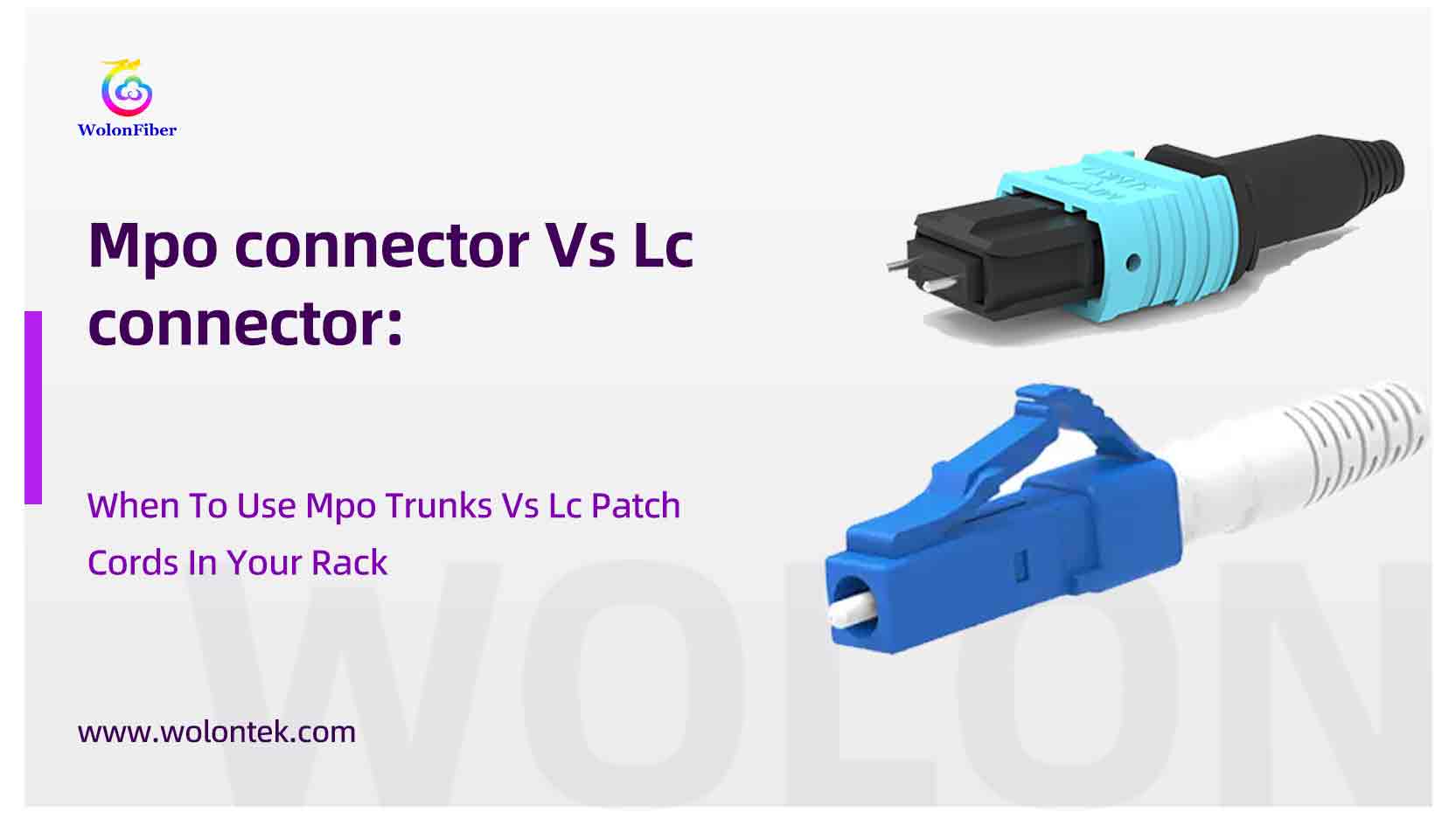
In this guide, we will strip away the jargon and look at the practical realities of managing your rack’s physical layer. We’ll explore why high-density environments are practically begging for MPO, and why the humble LC connector is still the MVP of port-level flexibility.
The Battle for Rack Space: The Context
We have all seen those nightmare photos of data centers—the ones where the “waterfall” of yellow and orange cabling is so thick you can’t even see the equipment behind it. That is known as cable sprawl, and it is the enemy of efficiency.

As network speeds migrate from 10G to 40G, 100G, and now 400G, the physical infrastructure has to change. You simply cannot achieve 100G speeds easily by stacking dozens of duplex LC cables without creating a management disaster. This is where understanding the distinct roles of MPO and LC becomes critical for a network engineer.
The Reliable Workhorse: The LC Patch Cord
Let’s start with what we know. The LC connector has been the industry standard for arguably two decades. It is small, it clicks satisfyingly into place, and it’s easy to terminate.
When does the LC win? The Lc Patch Cord is your go-to solution for flexibility and simplicity. In a typical rack, your active equipment (servers, switches, routers) likely features SFP+ or SFP28 ports. These transceivers are designed for duplex communication—one fiber sending, one fiber receiving.

If your rack is primarily operating at 10G or 25G, and you are connecting a top-of-rack (ToR) switch directly to servers immediately below it, LC patch cords are perfect. They are inexpensive, easy to replace if damaged, and allow you to move a single connection without disrupting a bundle of 12 or 24 other fibers.
However, the LC’s weakness is density. If you need to run 96 fibers from one rack to another, running 48 individual LC duplex cables is a logistical headache. It fills up your vertical cable managers, blocks cool air from reaching your active gear, and makes tracing a fault nearly impossible.
The Heavy Lifter: The MPO Trunk
Enter the MPO (and its high-performance cousin, the MTP). Unlike the LC, which handles two fibers, a single MPO connector typically handles 12 or 24 fibers (and sometimes up to 72).
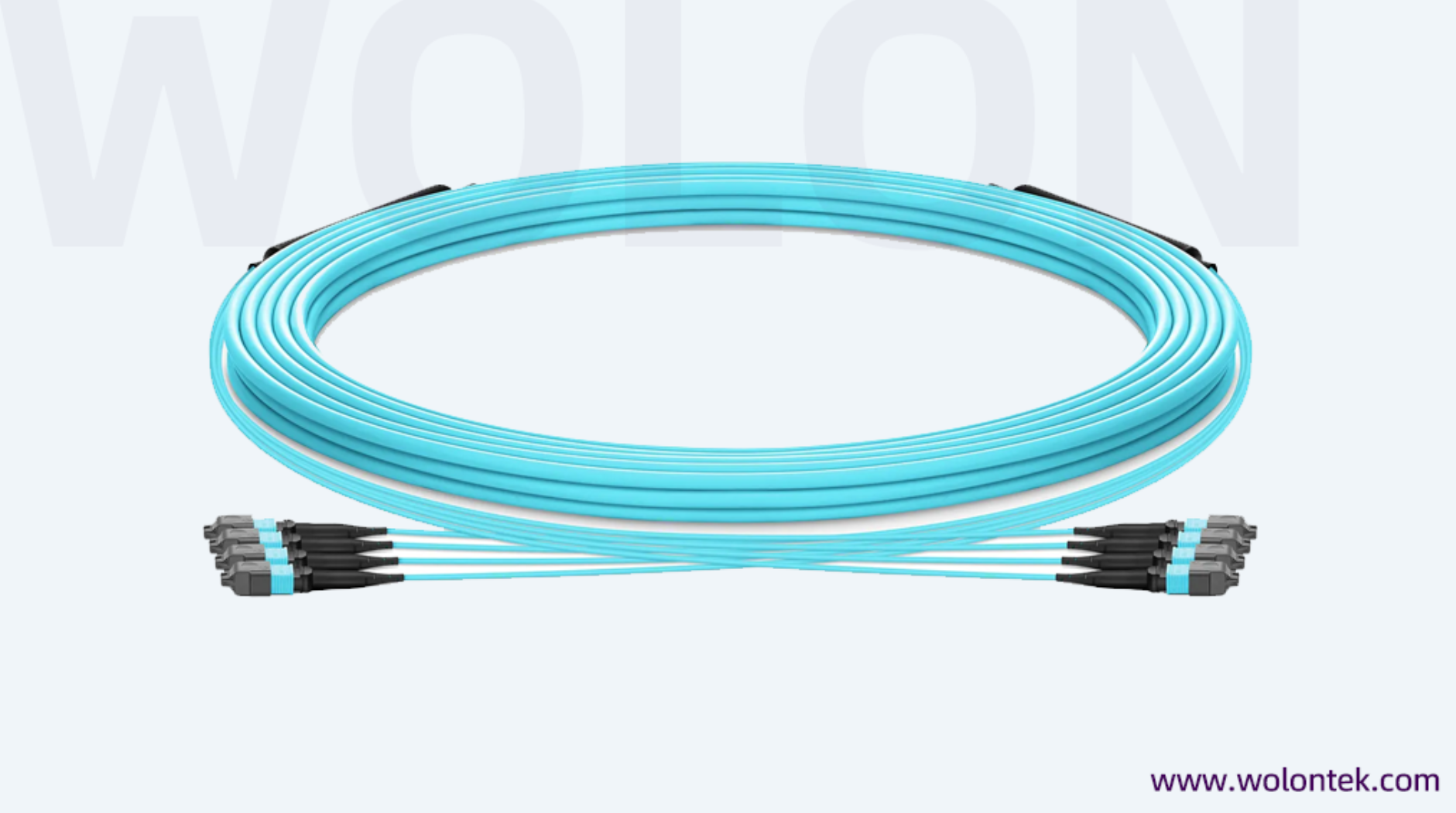
When does the MPO win? You should be reaching for an Mpo Trunk cable when you need to move a massive amount of data between two points with a small physical footprint. Think of the MPO trunk as a multi-lane superhighway.
-
High-Speed Migration (40G/100G): This is the biggest driver. Protocols like 40GBASE-SR4 or 100GBASE-SR4 use parallel optics. They don’t send data over two fibers; they send it over eight (4 transmit, 4 receive). You physically cannot use a standard duplex LC cable for these transceivers. You must use an MPO interface.
-
Structured Cabling Backbones: Even if you are running 10G today, using MPO trunks between racks is smarter. You run one thin MPO trunk from Rack A to Rack B. At each end, you plug that trunk into a cassette that breaks it out into LC ports. This keeps the overhead cabling neat. When you eventually upgrade to 40G, you just swap the cassette for an adapter panel, and your backbone cabling stays exactly the same.
-
Airflow and Cooling: In high-density racks, air damming is a real risk. Replacing 12 bulky LC cables with a single, slender MPO trunk drastically reduces cable bulk, allowing your expensive cooling system to actually do its job.
The Real-World Decision Matrix: How to Choose
So, you are designing your rack layout. How do you actually decide? Let’s break it down into practical scenarios.
Scenario 1: The “Spine-and-Leaf” Architecture
If you are connecting a Spine switch in a central rack to Leaf switches in adjacent racks, you should almost certainly be using MPO trunks.
-
Why: You are aggregating traffic. Running huge bundles of LC cables overhead is messy and risky.
-
The Setup: Use an Mpo Trunk cable to run from the central patch panel to the distributed racks. This gives you a permanent, high-density link that is “plug and play.”
Scenario 2: Connecting Servers to the ToR Switch
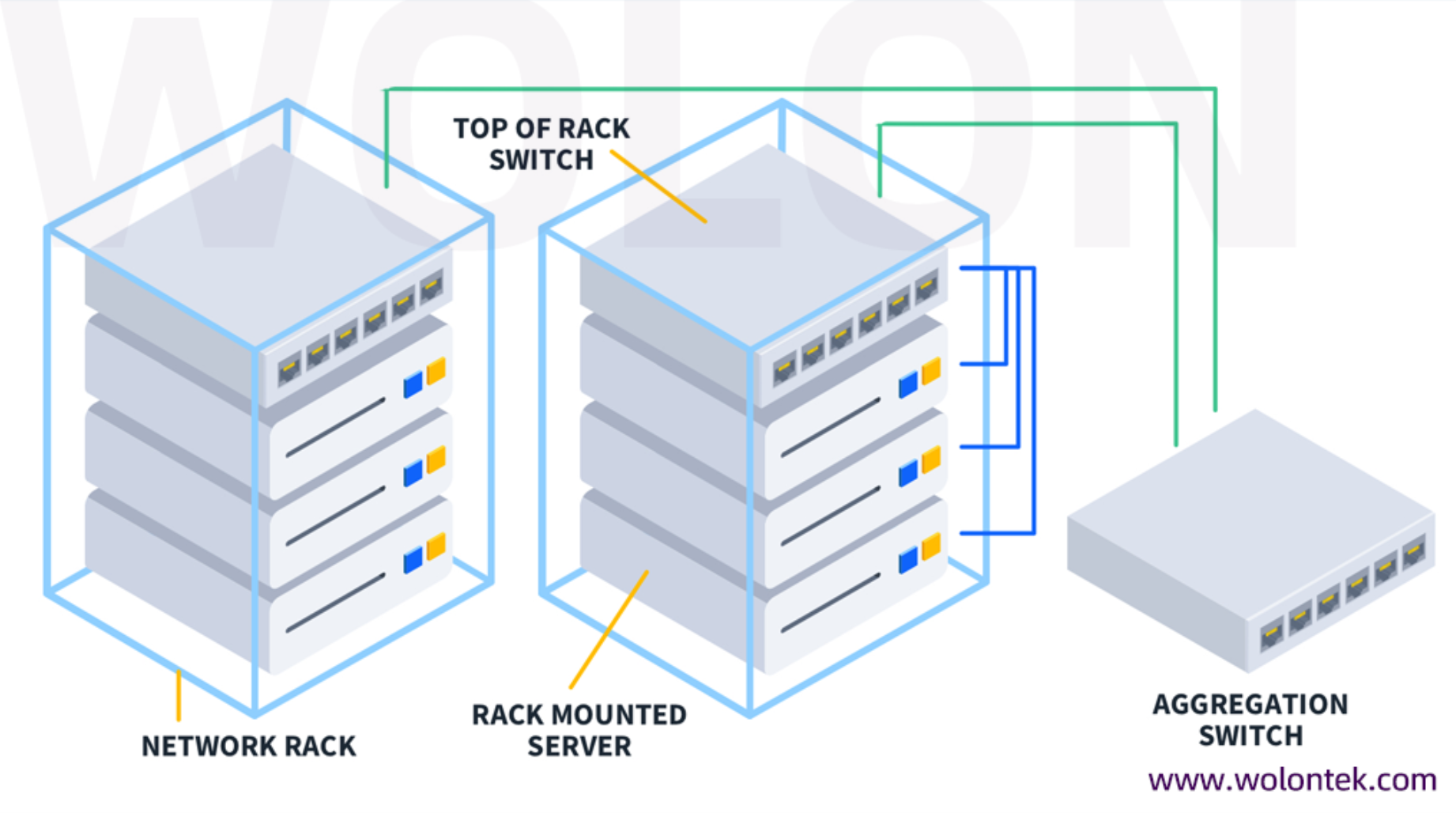
For connecting the servers within the same rack to the switch at the top, stick to LC.
-
Why: You need granular control. If Server 3 goes down, you want to unplug just Server 3.
-
The Setup: Use an Lc Patch Cord to go from the server’s NIC to the switch or the structured cabling patch panel. It’s cost-effective and easy to manage over short distances (1-3 meters).
Scenario 3: The 40G/100G Up-Link
If you are connecting switches together (uplinks) at speeds of 40G or higher using QSFP modules, you have no choice but to use MPO (unless you are using BiDi transceivers, but that’s a different topic).
-
Why: The transceiver interface demands it.
-
The Setup: Direct MPO-to-MPO connection.

The Hybrid Approach: The “MPO to LC” Ecosystem
The truth is, it is rarely “MPO vs. LC.” In a well-designed modern data center, these two work in harmony. The most professional racks use MPO for the “long haul” and LC for the “last hop.”
Imagine this setup: You install a high-density fiber enclosure at the top of your rack. Into the back of this enclosure, you plug a 144-fiber MPO trunk. Inside the enclosure, cassettes break those MPOs down. On the front of the enclosure, you see standard LC ports.
From there, you use short, neat LC patch cords to connect to your switches.
This approach gives you the best of both worlds. You get the density and airflow benefits of MPO for the bulk of the run, but you retain the friendly, flexible interface of LC for your equipment connections. It also makes polarity management much easier, as the cassettes usually handle the “transmit-to-receive” flipping internally.
Critical Considerations: Polarity and Gender
We cannot talk about MPO without a warning note on polarity. Unlike an Lc Patch Cord, where you can simply swap the two connectors if the light isn’t getting through, MPO is keyed. You have Type A, Type B, and Type C polarities, and you also have to deal with “Male” (with pins) and “Female” (without pins) connectors.
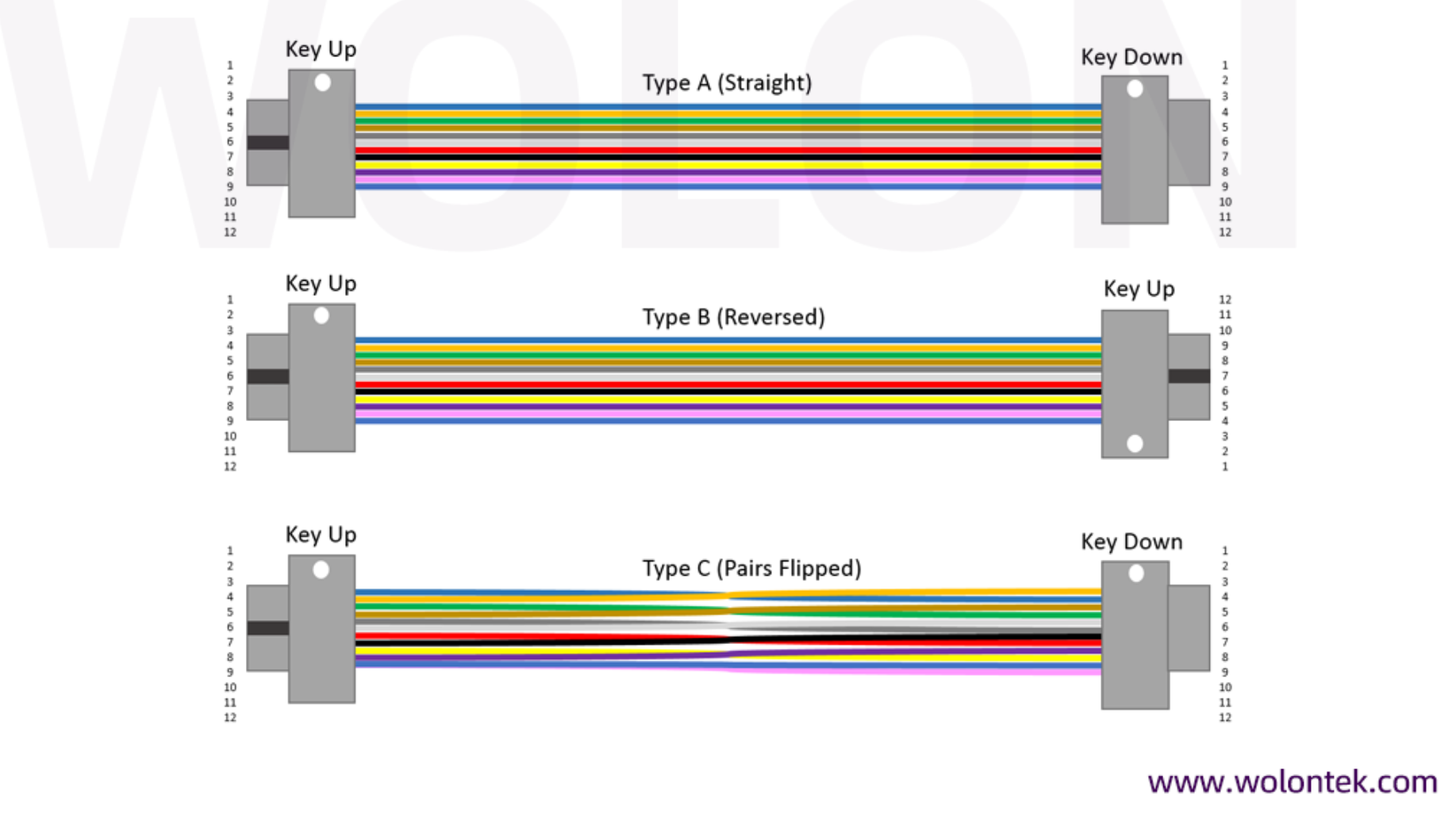
If you are deploying MPO trunks, you need to map this out beforehand. Plugging a male connector into a male Transceiver will damage the fiber end-face (and your wallet). Generally, trunk cables are female-to-female, and the cassettes or equipment are male, but you must verify this with your manufacturer specs.
Future-Proofing Your Investment
Finally, consider the lifespan of your cabling. Fiber infrastructure usually outlasts the active equipment by two or three generations. The servers you buy today will be scrap metal in five years, but the fiber you run could be there for fifteen.
Investing in a high-quality MPO backbone now means you are ready for 400G and 800G. While 10G over LC is fine for today, it is a dead-end road for the backbone. By utilizing MPO trunks for your permanent links, you are essentially building a highway that can handle faster cars as they are invented.
Conclusion
To summarize, the decision between MPO and LC in your rack isn’t a competition; it’s about placement.
If you are dealing with high-density trunking, backbone cabling, or speeds of 40G+, MPO is the clear winner. It saves space, improves airflow, and speeds up installation time significantly. However, for direct device connections, short patches, and 10G links, the Lc Patch Cord remains the undisputed king of flexibility and cost-efficiency.
The smartest network architects use MPO to get the data to the rack, and LC to distribute the data within the rack. By balancing these two technologies, you ensure your physical layer is not just neat and organized, but ready for whatever bandwidth demands the future holds.
Upgrade Your Network with WOLON
Are you looking to eliminate cable spaghetti and prepare your data center for the next generation of speed? At WOLON, we specialize in manufacturing premium optical interconnect solutions that bridge the gap between density and durability.

Whether you need a custom-length Mpo Trunk cable with low-loss ferrules for your backbone, or high-performance Lc Patch Cords that ensure zero-error data transmission for your servers, WOLON has the engineering expertise to support your infrastructure. Our products are rigorously tested to meet Telcordia standards, ensuring that when you click our cables into place, they stay connected.

Don’t let your cabling be the bottleneck. Visit the WOLON product catalog today to find the perfect fiber solution for your rack architecture.
