

Let’s be real: If you are wondering “how much does fiber optic cable cost” for your next project, you’ve probably seen quotes that make zero sense.
One supplier in your inbox promises $0.05 a foot, while a domestic distributor is asking for ten times that. You search “how much does fiber optic cable cost” on Google, and get vague answers from five years ago.
As someone who has spent the last decade on the production floors here at Wolontek, I can tell you exactly why that gap exists. I’ve seen buyers choose the “pennies” option only to have the jacket crack six months later because the manufacturer skimped on UV additives.
Today, I’m putting my “sales” hat aside to give you an honest, transparent look at what you should actually be paying in 2025.
Quick Answer: 2025 Fiber Optic Cable Price Cheat Sheet
If you are just looking for the numbers to plug into your budget, here is the current market average (Ex-Factory Prices) we are seeing for bulk orders.
| Cable Type | Best For… | Estimated Cost (Per Meter) | Ref: Cost (Per Foot) |
|---|---|---|---|
| Single-mode (OS2) | Long haul, ISP, Campus Backbone | $0.30 – $2.80 | $0.09 – $0.85 |
| Multimode (OM3/OM4) | Data Centers, AI Workloads | $2.00 – $14.00 | $0.60 – $4.25 |
| Armored (Outdoor) | Direct Burial, Harsh Environments | $1.15 – $6.50 | $0.35 – $2.00 |
| Pre-Terminated | “Plug & Play” Projects | ⚡ Custom Quote | +20-30% Premium |
1. Breakdown of Material Costs: What Are You Paying For?
When you buy from a factory like ours, your price isn’t a random number; it’s a direct reflection of the raw materials.
-
Single-mode fiber (OS2): This is the industry workhorse. In 2025, the base glass price has stabilized. You are looking at $0.30 to $2.80 per meter. The price swing usually depends on the fiber count (e.g., 12-core vs 96-core) and brand. The price swing usually depends on the core brand. Generic glass is cheap; premium glass (like Corning) costs more but guarantees lower attenuation over long distances.
-
Multimode (OM3/OM4): Essential for high-speed data centers. Because the core is wider and harder to manufacture to 2025 standards, it’s a jump in price: $1.50 to $6.00 per foot.
-
Armored cables: If there’s any chance of a shovel or a rat hitting that line, you need steel tape armor. That “insurance” That ‘insurance’ bumps the price to $1.15 – $6.50 per meter. While higher than standard duct cable, it is significantly cheaper than replacing a chewed-through line.

2. The “Hidden” Specs: Why Cheap Cable Is Expensive
I often get asked, “Why is your cable more expensive than this guy on Alibaba?” The answer is usually in the chemistry. Here is where the “price gap” actually comes from:
The Jacket: PVC vs. LSZH
In 2025, almost every serious project spec requires LSZH (Low Smoke Zero Halogen) for safety. It’s better for the environment and your lungs in a fire. However, the raw polymer for LSZH is about 25-40% more expensive than standard PVC. If a quote looks too good to be true, they are probably selling you PVC labeled as something else.
The “Core” Quality
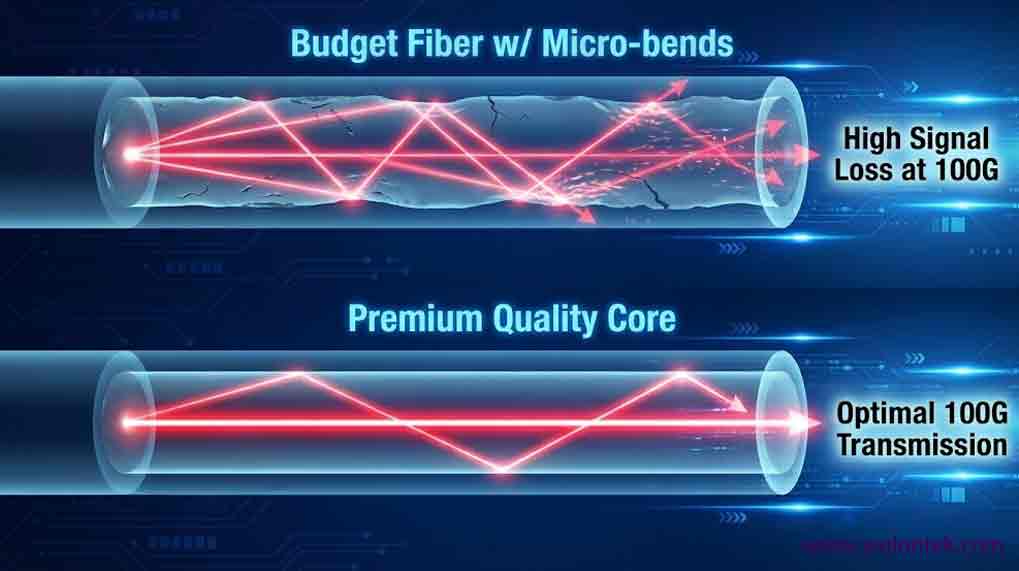
Not all glass is created equal. We’ve tested “budget” fibers from competitors that have micro-bends right out of the box. This causes massive signal loss once you hit 100G speeds. You might save $500 on the reel, but you will lose $5,000 in troubleshooting labor later when the link fails.
3. Labor vs. Material: The Real Cost Driver
Here’s a secret many distributors won’t tell you: The cable is usually the cheapest part of your project.
In 2025, skilled fusion splicing labor is in high demand. Labor can easily eat up 60% to 80% of your total budget. Every time a technician has to strip, clean, cleave, and fuse a fiber, it costs you significant money.
Pro Factory Tip: This is why we’ve seen a massive surge in orders for Pre-Terminated Cables. We do the terminations here in our controlled Hubei factory, so your guys on-site just “plug and play.” Yes, the cable costs a bit more upfront, but it can save you nearly 70% on field labor costs.
[Pre-terminated vs. Field Splicing]:
4. How to Lower Your Cabling Costs (Without Losing Quality)
If I were buying cable for my own project today, here is my checklist to save money:
-
Stop Over-Specifying: Don’t buy armored cable for an indoor, climate-controlled office just because “it sounds safer.” It’s overkill and a waste of budget.
-
Buy the Reel, Not the Meter: If you’re an ISP or contractor, buying 10km+ reels directly from a manufacturer (like Wolontek) drastically lowers the unit price because we don’t have to stop our extrusion machines to change setups.
-
Check the “2025 Standards”: Ensure your supplier is citing current ITU-T (like G.652.D) or UL ratings. If they can’t show you the certification paperwork from this year, walk away.
Final Verdict: Getting a Fair Price
Is fiber more expensive than copper? Upfront, yes. But with AI workloads demanding 400G and 800G speeds, fiber is a one-time investment that will outlast the building it’s installed in.

Ready to check your numbers?
Don’t let a “middleman markup” kill your project budget. Send your BOM (Bill of Materials) to Wolontek today.
Have a technical question? Call our engineers: +86-18302784206
FAQ:
Q1: How much does fiber optic cable cost per foot in 2025?
A: The price varies significantly by type. On average, Single-mode (OS2) ranges from $0.09 to $1.52 per foot, while Multimode (OM3/OM4) can cost between $1.50 and $6.00 per foot. Factors like armor, jacket rating (LSZH), and raw material indices influence the final ex-factory price.
Q2: Why is there a large price difference between fiber suppliers?
A: The gap usually comes down to material quality and labor. Cheaper cables often use recycled PVC jackets or inferior glass cores that suffer from micro-bends. Additionally, buying directly from a manufacturer like Wolontek eliminates distributor markups, often saving you 20-30%.
Q3: Is Pre-Terminated fiber worth the extra cost?
A: Yes, for most projects. While the upfront material cost is 20-30% higher, Pre-Terminated cables eliminate the need for on-site splicing labor, which is the most expensive part of installation. This can reduce total project costs by up to 70%.
Q4: Does Wolontek offer custom fiber optic cable pricing for bulk orders?
A: Absolutely. As a direct manufacturer, we offer volume-based discounts. We can also customize the cable structure (e.g., armored, tactical, aerial) to fit your specific project budget. Contact us for a free price audit.