
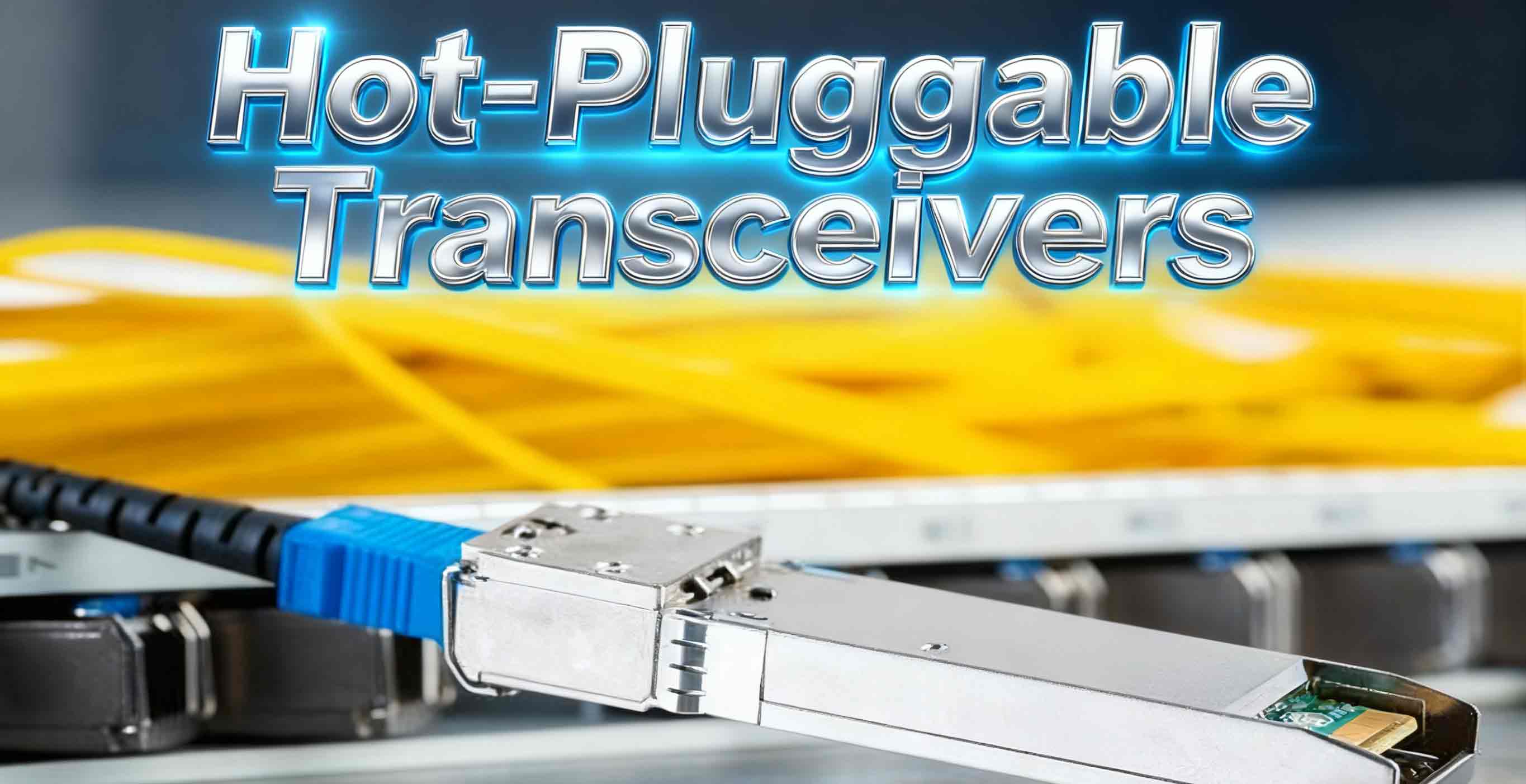
A single engineering feature — the ability to remove or insert a module while a system is powered — substantially affects how networks are designed, operated and maintained. This article explains precisely what “hot-pluggable” means for optical transceivers, compares the operational benefits and the engineering trade-offs, details how the capability is implemented, and sets out concrete handling and operational rules that minimize risk. All claims are grounded in industry specifications and vendor guidance.
What “hot-pluggable” means
“Hot-pluggable” describes a transceiver module that can be inserted into or removed from a powered host socket without damaging either the host or the module and without causing the host to crash or irreparably corrupt data on other ports. For SFP/SFP+/QSFP families this capability is specified via MSAs (multi-source agreements) and supported by host firmware and electrical sequencing that ensure pins and rails stabilize in a safe order during insertion and removal. In practice, hot-plug behavior depends on both the module’s mechanical design (cage, latch, keying) and the host board’s power and detect sequencing.
How hot-plug capability is implemented
Three cooperating subsystems make hot-pluggability safe and repeatable:
Mechanical design and latching. Form-factor standards (SFP, SFP+, QSFP, SFP-DD, etc.) define module housings, extraction levers and insertion/extraction force limits so modules seat reliably and can be removed without applying damaging leverage to the PCB. The mechanical tolerance and latch design control connector alignment and reduce risk of bent pins.
Pin-sequencing and electrical protection. Host cards implement pin sequencing so ground and detection pins make Contact before power and high-speed differential lanes become active. This sequencing, plus transient protection circuitry on hosts and modules, prevents current surges or latch-up conditions that could disturb SERDES, laser drivers, or other sensitive components. MSA documents and vendor engineering notes specify acceptable voltage ranges, presence-detect behavior, and controlled insertion/extraction forces.
Host firmware and initialization logic. Software on the switch/router polls a module’s EEPROM, checks the module’s identity and capabilities, and then initializes the port once presence is confirmed and the physical layers are ready. Proper firmware behavior prevents race conditions and ensures the port’s MAC/PHY state is managed without impacting other traffic. Vendor installation notes explicitly recommend host firmware handle presence interrupts and delay lane activation until initialization completes.
Operational benefits — why operators rely on hot-plug
Reduced downtime and faster MTTR. The ability to swap a failed module without powering down chassis dramatically shortens mean time to repair. Technicians can replace optics in production racks during maintenance windows of one-link scope rather than scheduling device-level outages. This operational flexibility is a foundational reason data centers adopt pluggable optics.
Modularity and upgrade flexibility. Hot-pluggable modules let operators change media type, wavelength, or reach (e.g., multimode→single-mode, 10G→25G optics) without redesigning host boards. That modularity supports staged upgrades and mixed inventories across a fleet.
Inventory efficiency and spare management. Stocking a small set of spare SFP/SFP+/QSFP modules covers many field scenarios; swapping a module is faster and less risky than replacing whole line cards or devices. This reduces capital and operational expense for spares.
Trade-offs and limitations — what hot-plug doesn’t remove
Mechanical wear and contamination. Frequent insertion cycles increase mechanical wear on cages and connectors; exposed optical faces invite dust and contamination when modules are handled in the field. These are personnel and process risks rather than inherent architectural flaws, but they do require operational controls.
Host design complexity. To achieve safe hot-swap, host PCBs must include correct detect sequencing, transient suppression and firmware support. That design and verification work adds modest cost and complexity compared with fixed, soldered transceivers. Industry MSAs ensure interoperability but do not eliminate the need for careful host implementation.
Field handling risk (ESD, fiber damage). Modules are electro-optic devices sensitive to ESD and improper handling. Operators must follow handling best practices to avoid damaging lasers, photodiodes or impairing optical performance.
Safe handling and operational best practices (concrete rules)
Operators and field technicians should follow concise, proven practices:
Remove cables before extraction. Disconnect fiber/copper cables prior to module removal to avoid mechanical leverage and connector damage. Vendor guidance uniformly recommends this sequence.
Use dust caps and clean connectors. Keep both module and cable ends capped when idle, and use standardized cleaning routines before insertion; contamination is a leading cause of signal degradation.
Observe ESD precautions. Use grounded straps or mats when handling modules; treat them as sensitive electro-optical components.
Allow host to register absence. Some vendors recommend a short delay between removal and insertion (seconds) so the host clears port state and avoids race conditions—follow platform documentation for exact timings.
When hot-pluggability is not the right choice
Soldered or hermetically sealed optics remain appropriate when extreme environmental ruggedness, radiation tolerance or ultra-dense form factors are required. In such niche cases the benefits of field serviceability are outweighed by the need for permanent, sealed optical engines. For mainstream data-center, enterprise and carrier switching, however, hot-plug modules are the operational norm.
Short decision checklist
-
Need in-service replacements, staged upgrades, or spare reuse → choose hot-pluggable modules.
-
Need extreme ruggedness, highest shock/vibration tolerance, or sealed optics → consider fixed or soldered optical engines.
-
Always plan for handling controls, dust caps, ESD protection and host-firmware behavior when deploying pluggable optics.
For teams that require reliable, field-serviceable optics, WOLON’s hot-pluggable transceiver family (SFP/SFP+/SFP28/QSFP/QSFP28) is engineered to industry MSAs, designed for robust insertion cycles, and shipped with clear DOM telemetry and handling documentation. WOLON modules are built for repeatable hot-swap operations in data-center and carrier environments — making replacements predictable, fast and safe.
