CWDM and DWDM both squeeze more traffic onto a single fiber, but they do it for different jobs. Pick the wrong one and you pay for needless complexity or run out of capacity. Below is a practical, on-site engineer’s guide — concise, actionable, and free of fluff.
Quick snapshot
-
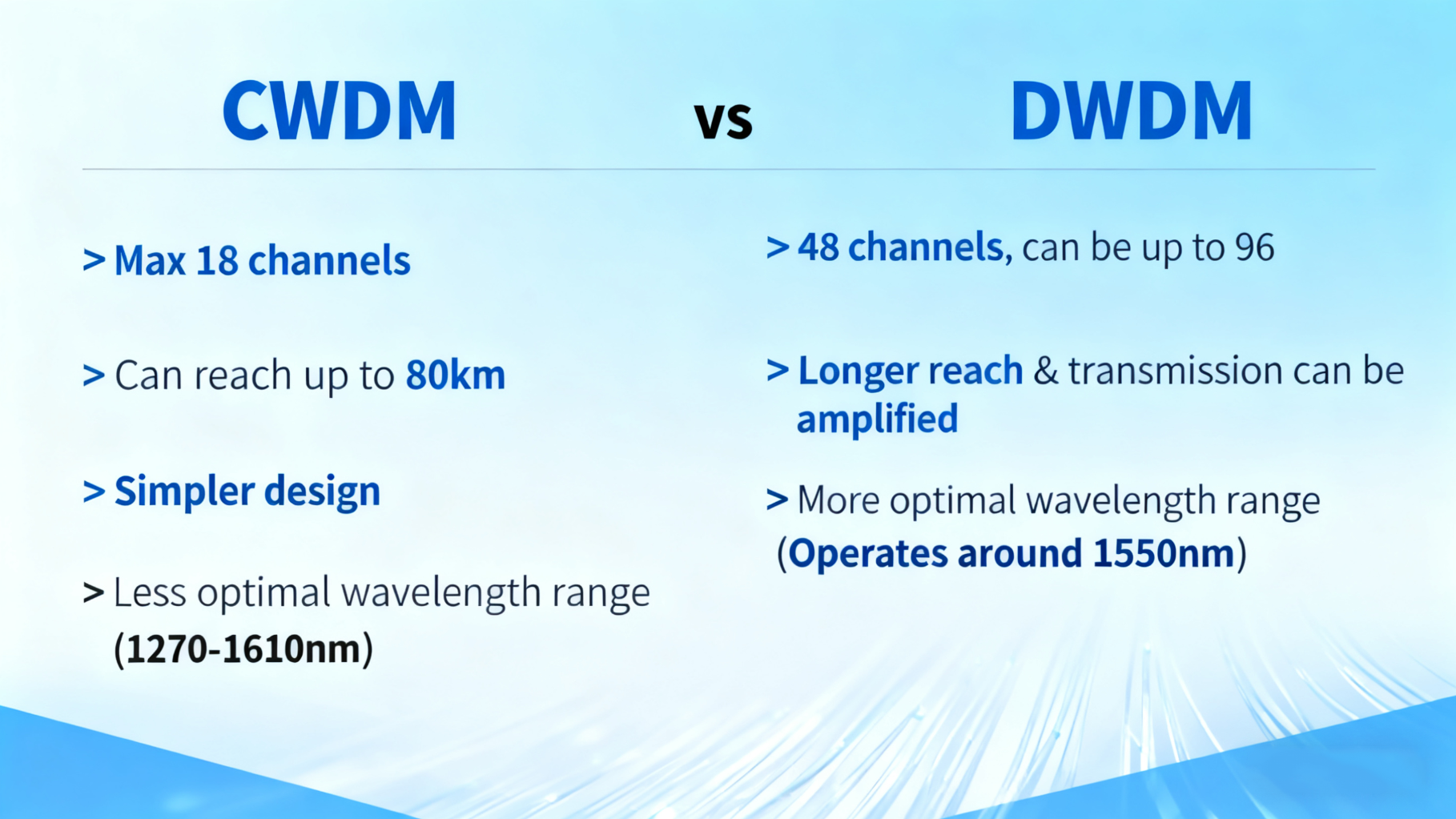
CWDM — wide channel spacing (≈20 nm), simple optics, low cost. Good for short-to-medium links and access rings.
-
DWDM — dense ITU grids (100/50/25 GHz and finer), tight wavelength control, higher cost, far greater capacity. Suited for backbones and long-haul links.
Channel spacing and capacity
CWDM spreads channels far apart, so you get a small number of wavelengths (commonly under 18 usable channels). The advantage is tolerance: uncooled lasers and cheap passive mux/demux work fine. DWDM packs many more channels into the C-band. If you need dozens of 10G/25G or multiple 100G/400G lanes on the same fiber, DWDM is the only practical option.
Field rule: if you can add fibers to grow, CWDM is cheaper. If a fiber pair is precious, choose DWDM.
Lasers, stability, and module cost
CWDM modules tolerate more wavelength drift — they use simpler, cheaper lasers. DWDM modules require narrow-linewidth, temperature-stabilized lasers or tunables. That makes DWDM optics costlier and inventory-sensitive: you can’t swap a DWDM module without minding its exact channel.
Field rule: budget for tighter inventory control with DWDM; treat CWDM transceivers as largely plug-and-play.
Reach, amplification and signal quality
CWDM often runs without amplifiers and performs well on campus and short metro links — tens of kilometers is common. DWDM assumes line systems: EDFAs, gain-flattening, ROADMs, and careful OSNR planning. Coherent optics in DWDM change the math: they demand OSNR margins and different dispersion handling.
Field rule: for routes over several tens of kilometers, assume DWDM or active amplification will be required.
Operational complexity
CWDM = passive, lower daily ops. DWDM = active systems, monitoring, and more hands-on maintenance. If your team is small or you don’t have an optical engineer, DWDM’s operational burden can outweigh its technical benefits.
Field rule: pick DWDM only if you have the people or managed services to run it.
Interoperability and testing
DWDM tolerances are tight. You must verify wavelength accuracy, channel isolation, and OSNR. An Optical Spectrum Analyzer (OSA) is often necessary during commissioning. CWDM is forgiving but still needs insertion-loss and return-loss checks, and a fiber plant test to rule out water-peak problems on older fibers.
Field rule: never skip an OTDR sweep and basic power testing — regardless of CWDM or DWDM.
Migration and hybrid options
A pragmatic approach is common: CWDM at the edge for immediate low-cost capacity and DWDM in the backbone where fiber is scarce or growth is heavy. Reserve and label at least one fiber for future DWDM upgrades. Hybrid mux/demux and overlays let you evolve without ripping out existing cabling.
Field rule: plan your patching and fiber labeling for future re-use; it saves days during upgrades.
Practical deployment checklist (do these, in order)
-
Test the fiber plant — OTDR, insertion loss, and check for water-peak attenuation.
-
Define growth — current needs and a 3–5 year forecast.
-
Run power & OSNR budgets — include all connectors, mux/demux losses, and amplifier noise figures if used.
-
Pick the right mux/demux — certified passive units for CWDM; certified DWDM mux/demux and ROADMs for backbone.
-
Label and document — fiber IDs, wavelengths, transceiver serials. Keep a single source of truth.
-
Stock spares and test gear — transceivers, power meter, OTDR; add an OSA for DWDM.
-
Require factory burn-in — buy modules with burn-in reports to reduce field failures.
Short decision rules
-
Choose CWDM when links are under ~40–70 km, channel count is small, and cost simplicity matters.
-
Choose DWDM when fiber is scarce, you need dense channels, long reach, or plan to scale heavily with coherent optics.
WOLON supplies factory-tested, competitively priced Optical Modules for both CWDM and DWDM deployments. Our CWDM line is built for low-cost, predictable metro and access links; our DWDM modules use wavelength-stable lasers and tunables for backbone use. Every module gets factory burn-in and test reports, plus serial tracking and technical support — meaning fewer surprises on site and more predictable economics.