
Walk into a modern data center, and you might notice something changing. The thick, messy “spaghetti” of blue cables is disappearing. It’s being replaced by impossibly thin, pencil-lead sized wires that make cable management look like art.
That is the rise of 28awg “Slim” cables.
But as a factory that manufactures kilometers of ethernet wire gauge every day, we have to issue a warning. While thin cables look sexy in a photo, physics is still physics. If you pick the wrong gauge for a PoE camera run, you aren’t just losing speed—you could be melting insulation.
In this guide, we’re going to put the three champions—24 awg, 26awg, and 28awg—into the ring. We’ll look at diameter, heat, and why the old-school 23awg ethernet cable is still the king of the walls.
The Contenders: Understanding the Hierarchy
Before we argue about which one is better, let’s define the players. Remember the rule: Higher Number = Thinner Wire.“Still confused why the math is backwards? We explain the entire ‘wire drawing’ manufacturing process in our deep dive: [Cable Gauge AWG Guide].”
1. The Heavyweight: 23AWG & 24AWG
-
Identity: The Backbone.
-
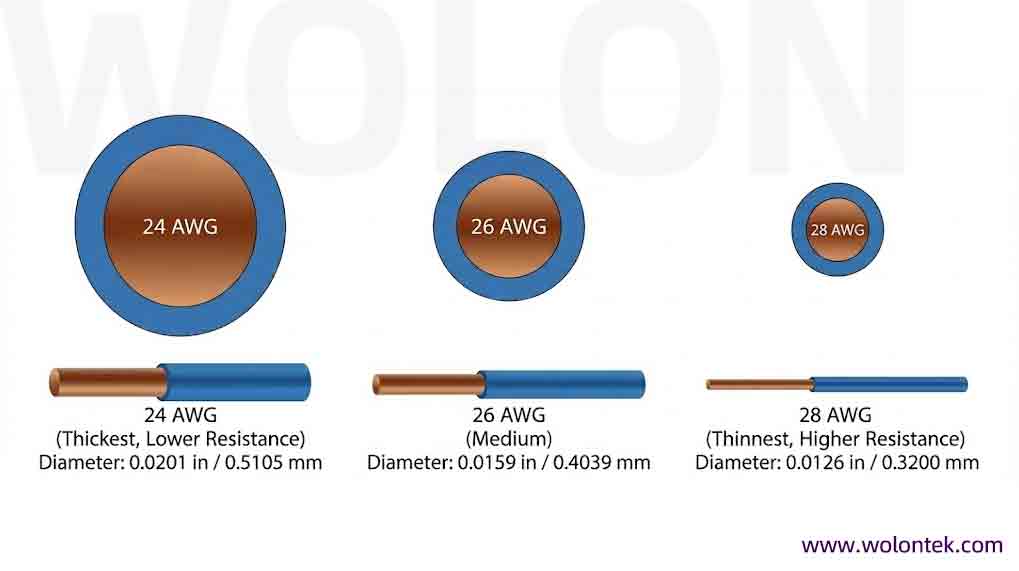
Specs: 24awg cable diameter is approx 0.51mm. Cat6 23awg cable is even thicker at 0.57mm.
-
The Vibe: Stiff, heavy, hard to bend.
-
Best For: Long-distance runs inside walls (Structured Cabling) and high-power PoE++.
2. The Middleman: 26AWG
-
Identity: The Standard Patch.
-
Specs: Thinner stranded copper.
-
The Vibe: Flexible but sturdy.
-
Best For: Connecting your PC to the wall, or standard 1-meter patch cords in a closet.
3. The Ninja: 28AWG (Slim Run)
-
Identity: The Rack Saver.
-
Specs: Tiny 0.32mm conductor.
-
The Vibe: Extremely flexible, feels like a phone charger cable.
-
Best For: High-density switch patching (48-port) where airflow is critical.
The “Heat” Problem: Why Factory Engineers Worry
Here is the data point most marketing brochures hide.
When you push power (PoE) through a thin wire, resistance creates heat.
-
24 awg handles heat effortlessly. It’s a garden hose.
-
28awg struggles. It’s a drinking straw.
If you use a single 28awg cable to power a Wi-Fi AP, it’s fine. The heat dissipates into the air.
The Trap: If you bundle forty-eight 28awg cables together in a tight zip-tie and pump 30W of power through all of them, the cables in the middle of the bundle can’t breathe. The temperature spikes.
Factory Rule: If using 28awg for PoE, never bundle more than 12 cables together. Give them space. If you need big bundles, stick to 24 awg.
Detailed Comparison: Which Gauge Wins?
We broke down the specs based on what we test on our Fluke machines.
| Feature |
Standard 23/24 AWG |
⚖️ Patch 26 AWG |
Slim Run 28 AWG |
|---|---|---|---|
| Conductor Size |
Thickest Low Resistance |
Medium |
Thinnest High Resistance |
| Airflow in Rack |
Poor Blocks fans |
Okay |
✨ Excellent Best for High Density |
| ➰ Bend Radius |
Stiff Needs space |
Flexible |
Ultra-Flexible Great for tight corners |
| ⚡ Max PoE Distance |
100 Meters Full Standard |
~60-70 Meters |
< 15 Meters Short Patches Only! |
| Heat Generation | ❄️ Cool | Warm |
Hot Avoid large bundles |
Scenario Guide: What Should I Buy?
Don’t overthink the ethernet awg charts. Just look at your job site.
Scenario A: Wiring a Building (Inside Walls)
Winner: 23AWG / 24AWG Never, ever put 28AWG or 26AWG inside a wall.
For Gigabit speed, use 24 awg (typical for cat 5 cable wire gauge).
For 10-Gigabit future-proofing, use cat6 23awg cable or cat6a gauge. The thicker copper is mandatory for signal integrity over 50 meters.
Scenario B: The “Spaghetti” Rack
Winner: 28AWG You have a 48-port switch and you can’t even see the port labels because of the cable mess. Switching to 28awg patch cords will save your life. They are 50% thinner. You can see the lights, you can close the rack door, and your switch fans can finally breathe.
Scenario C: The “Cheap” Fix
Warning on 25 Gauge Wire Sometimes you will see 25 gauge wire sold online. This is an oddball size. It’s usually a cost-cutting measure by factories trying to make a “fake” Cat6 that uses less copper than 24AWG but claims to be better. Avoid non-standard gauges. Stick to the standard 24, 26, or 28.
Final Verdict
The war between 28awg vs 26awg vs 24awg isn’t about speed—it’s about heat and space.
-
Go Slim (28AWG) if your rack is crowded and airflow is blocked.
-
Go Thick (23/24AWG) if you are running PoE power or going long distances.
-
Go Standard (26AWG) if you just need a cheap, reliable cable for your desk.
Whether you need Heavy-Duty Infrastructure or High-Flex Rack Cabling, we guarantee the AWG is accurate and the copper is pure.
(Bulk Cat6 / Cat6a Reels) Quote Rack Patch Cords
(Slim 28AWG / Standard 24AWG)
Frequently Asked Questions (FAQ)
Q: Does using 28AWG “Slim” cable slow down my internet speed?
A: No. A high-quality 28AWG Cat6 cable can handle the same 1 Gigabit or 10 Gigabit speeds as a standard thick cable, provided the run is short (typically under 15 meters). The data travels just as fast; the main limitation is physical distance and power handling, not speed.
Q: Can I crimp my own 28AWG patch cables?
A: We do not recommend it. 28AWG conductors are extremely thin (0.32mm). Standard RJ45 connectors are designed for thicker 23/24AWG wires, so 28AWG wires often wiggle loose or fail to make contact. For slim cables, it is much safer and more reliable to buy factory-molded patch cords.
Q: What is the maximum distance for 28AWG cables?
A: While standard ethernet works up to 100 meters, 28AWG is limited due to higher attenuation (signal loss).
For Data: We recommend keeping runs under 30 meters.
For PoE: We recommend keeping runs under 15 meters to prevent voltage drop and overheating.
Q: Is 23AWG better than 24AWG?
A: Yes, for infrastructure. 23AWG is thicker, which means it has lower resistance and better signal integrity. It is the gold standard for Cat6 and Cat6a permanent links inside walls. 24AWG is typically found in older Cat5e cables or cheaper/flexible Cat6 patch cords.
Q: Can I mix different gauges in my network?
A: Yes. It is standard practice to use thick 23AWG solid cable inside the walls (from the patch panel to the wall jack) and then use thinner 28AWG stranded patch cords to connect the switches in the rack. This gives you the best of both worlds: performance in the walls and neat cable management in the rack.