
As modern data centers scale to accommodate artificial intelligence (AI), machine learning, and high-performance NVMe storage, traditional network architectures are facing a critical bottleneck. The sheer volume of data moving between servers is overwhelming host processors.
To overcome this, network architects are shifting away from standard TCP/IP models and adopting Remote Direct Memory Access (RDMA).
But what is RDMA, and how does it fundamentally change data center networking? In this guide, we will explore the engineering principles behind RDMA technology, explain the concepts of “Zero-Copy” and “Kernel Bypass,” and compare the three leading RDMA protocols: Infiniband, RoCEv2, and iWARP.
What is RDMA? Remote Direct Memory Access Protocols Explained
The Bottleneck: Traditional TCP/IP Networking
To understand the value of RDMA, we must first look at how a standard network operates.
In a traditional TCP/IP network, transferring data from Server A to Server B requires significant involvement from the Central Processing Unit (CPU) and the Operating System (OS). When data arrives at a network card (NIC), the CPU must interrupt its current tasks to process the packet headers, copy the data from the kernel buffer into the application space, and perform checksum calculations.
At 10G speeds, this CPU overhead is manageable. However, when scaling to 100G, 200G, or 400G environments, this constant data copying and context switching can consume a massive portion of the server’s compute cycles, leading to high latency and decreased application performance.
What is RDMA? The Core Engineering Concepts
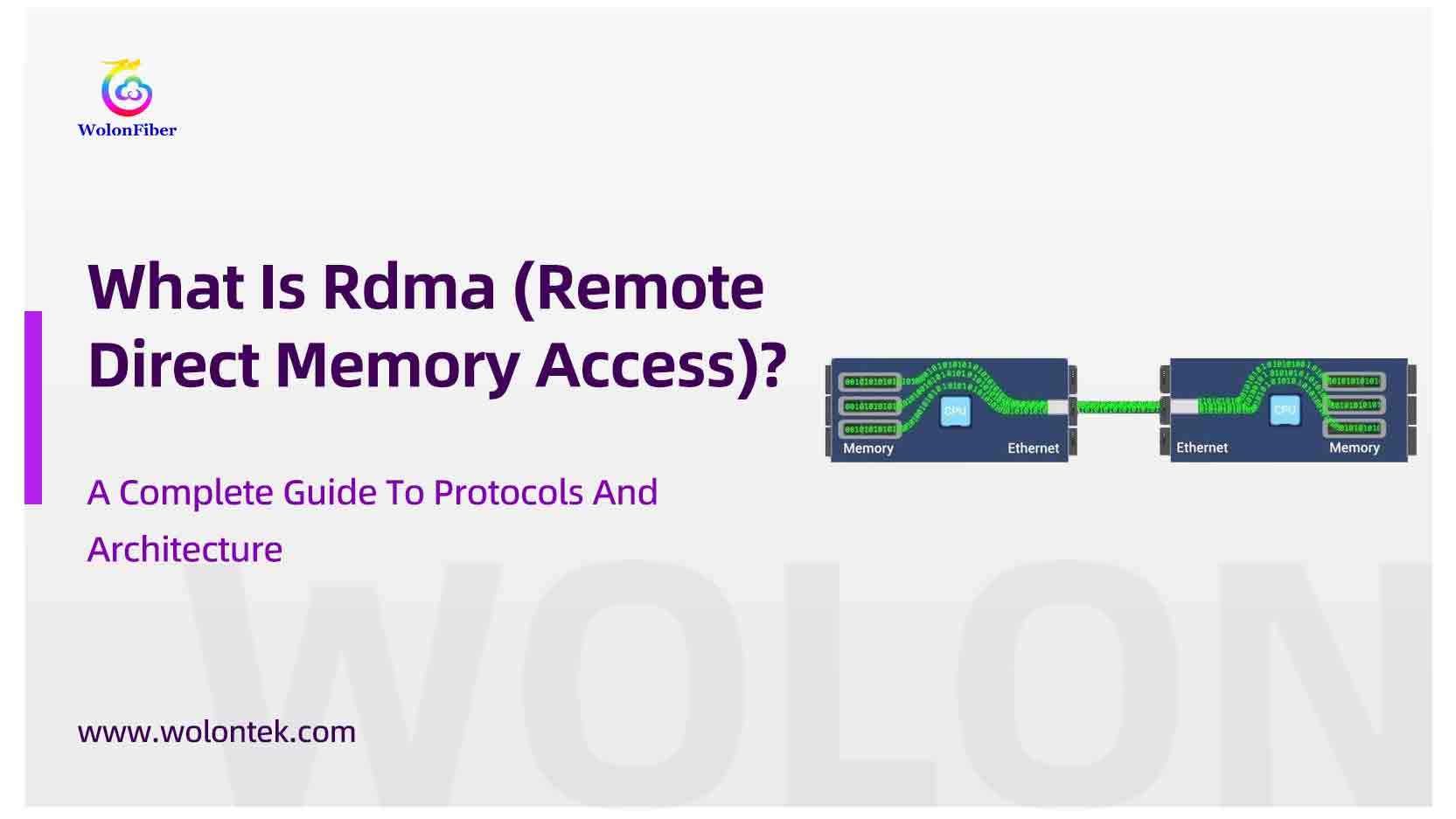
RDMA (Remote Direct Memory Access) is a hardware-driven network technology that solves the CPU bottleneck. It allows a network adapter to transfer data directly from the memory (RAM) of one computer into the memory of another computer across a network, completely bypassing the operating system of both machines.
The efficiency of RDMA networking relies on two primary mechanisms:
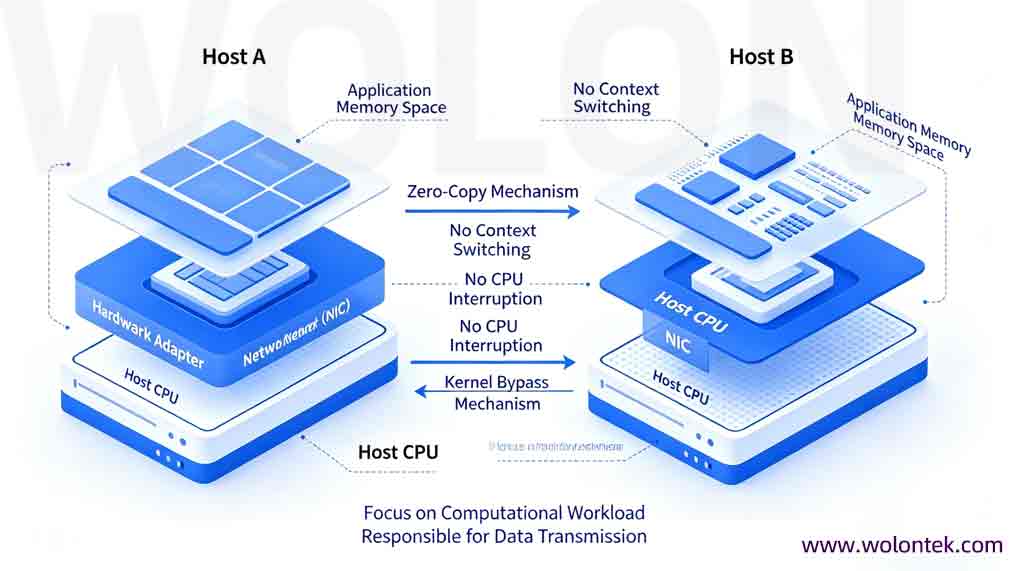
- Zero-Copy: The data payload is never copied into the operating system’s network stack or kernel buffers. It is moved directly from the application’s memory space to the hardware network adapter.
- Kernel Bypass: Because the operating system is bypassed, there are no context switches or CPU interrupts during the data transfer. The application talks directly to the hardware.
By offloading the data transfer entirely to the network interface card (NIC), RDMA achieves sub-microsecond latency and allows the host CPU to dedicate 100% of its resources to actual computational workloads.
Comparing the 3 Major RDMA Protocols
Implementing RDMA requires specific hardware support at the network adapter level. Currently, the industry relies on three distinct RDMA protocols to route this high-speed traffic across a data center.
1. InfiniBand (The Native RDMA Standard)
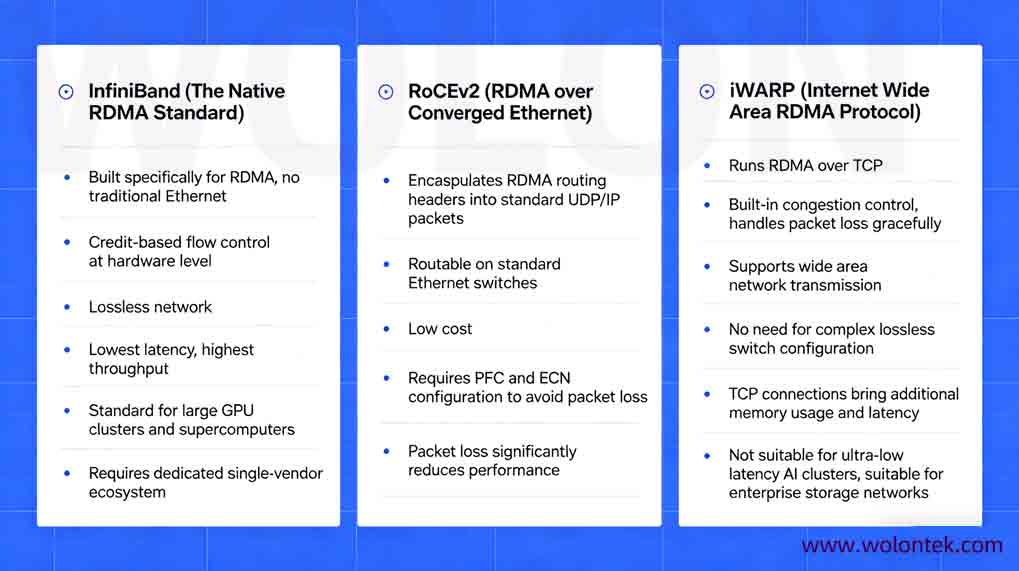
InfiniBand is a purpose-built network architecture designed specifically for RDMA. It does not use traditional Ethernet.
- Engineering Reality: InfiniBand natively implements credit-based flow control, making it a strictly lossless network at the hardware level. It offers the absolute lowest latency and highest throughput available, making it the de facto standard for massive GPU clusters and supercomputers.
- Deployment: It requires a dedicated, single-vendor ecosystem, including specialized InfiniBand switches, Host Channel Adapters (HCAs), and specific InfiniBand-coded optical transceivers.
2. RoCEv2 (RDMA over Converged Ethernet)
Recognizing the high deployment cost of InfiniBand, the industry developed RoCE (RDMA over Converged Ethernet). RoCEv2 encapsulates the RDMA routing headers into standard UDP/IP packets, allowing them to be routed over standard Ethernet switches.
- Engineering Reality: When comparing RoCE vs InfiniBand, RoCEv2 offers a significant cost advantage because it utilizes standard Ethernet infrastructure. However, because Ethernet is naturally “lossy,” network engineers must heavily configure the switches with Priority Flow Control (PFC) and Explicit Congestion Notification (ECN) to prevent packet loss. If a RoCEv2 network drops packets, performance degrades significantly.
3. iWARP (Internet Wide Area RDMA Protocol)
While RoCE relies on UDP, iWARP runs RDMA over a reliable TCP connection.
- Engineering Reality: Because it utilizes TCP, iWARP inherits built-in congestion control. It can handle dropped packets gracefully and route RDMA traffic over long geographic distances (WAN) without requiring complex lossless switch configurations. However, maintaining TCP connections consumes memory and adds slight latency, making it less ideal for ultra-low-latency AI clusters, but highly effective for enterprise storage networks.
The Physical Layer: Why Optics Matter in RDMA Networks
The success of any RDMA deployment—especially RoCEv2—relies entirely on a lossless physical environment. RDMA algorithms are highly sensitive to bit errors and packet loss. If an Optical Transceiver overheats or a DAC cable suffers from crosstalk, the network will drop packets, triggering congestion control and bottlenecking the entire compute cluster.
Building a lossless fabric requires pristine signal integrity, but sourcing branded 400G optics from switch OEMs significantly inflates capital expenditure (CAPEX).
At WolonFiber, we manufacture the strict-tolerance physical infrastructure required for high-performance RDMA deployments directly from Optical Valley, Wuhan. Our engineering teams supply factory-direct, 100% compatible components for both InfiniBand and Ethernet topologies:
- For InfiniBand (HDR/NDR): Precision-engineered Active Optical cables (AOCs) and transceivers, flashed with the specific EEPROM codes required for seamless integration with Quantum switches and ConnectX HCAs.
- For RoCEv2 (100G/400G): High-reliability DAC cables and QSFP28/QSFP-DD transceivers designed to maintain zero-packet-loss leaf-spine architectures.
By partnering with a primary manufacturer, data centers can secure the ultra-low latency required for AI and storage workloads while maintaining strict control over network deployment costs.
👉 [Explore WolonFiber’s Factory-Direct Optical Transceivers and DAC Solutions for RDMA Networks]