1. Introduction: Solving the High-Density Cabling Confusion
Driven by the rapid expansion of AI compute clusters, hyperscale cloud facilities, and 800G ultra-hig h-speed optical networks, modern data centers are facing unprecedented demands for bandwidth density and deployment efficiency. Traditional LC duplex cabling, though mature for low-speed networks, struggles to meet the compact, high-capacity interconnection requirements of 40G, 100G, 400G, and 800G parallel optical architectures.
As the optimal solution for high-density backbone interconnection, factory-preterminated MPO/MTP trunk cables have become the standardized infrastructure for modern structured cabling systems. However, widespread industry confusion still exists among network engineers and procurement teams. Many practitioners frequently mix up MPO/MTP trunk cables with patch jumpers, breakout harnesses, and conversion cables. This misapplication leads to messy hierarchical wiring, incorrect polarity configuration, excessive optical insertion loss, failed network upgrades, and unnecessary infrastructure waste.
Built on strict IEC and TIA international cabling standards and years of data center deployment experience, this authoritative guide fully explains the definition, internal structure, classification specifications, deployment norms, and selection criteria of MPO/MTP trunk cables. It also clarifies core industry misunderstandings to help you build low-loss, stable, and future-proof high-density optical layer infrastructure.
2. What Are MPO/MTP Trunk Cables? Core Definition & Industry Standards
An MPO/MTP trunk cable is a factory pre-assembled, fixed-count multi-fiber optical cable designed specifically for permanent horizontal and vertical backbone interconnections in structured data center cabling systems. Unlike flexible patch cords for device port docking, trunk cables serve as the fixed “backbone skeleton” of the entire optical network, undertaking long-distance and large-capacity fiber signal transmission between regional distribution areas.
All regular MPO/MTP trunk cables comply with global industry specifications, includingIEC 61754-7, TIA-604-5 (FOCIS 5), and TIA-568.3-D structured cabling standards, ensuring universal interoperability with mainstream optical modules, adapter panels, and cassette systems worldwide.
There are two mainstream product tiers in the market:
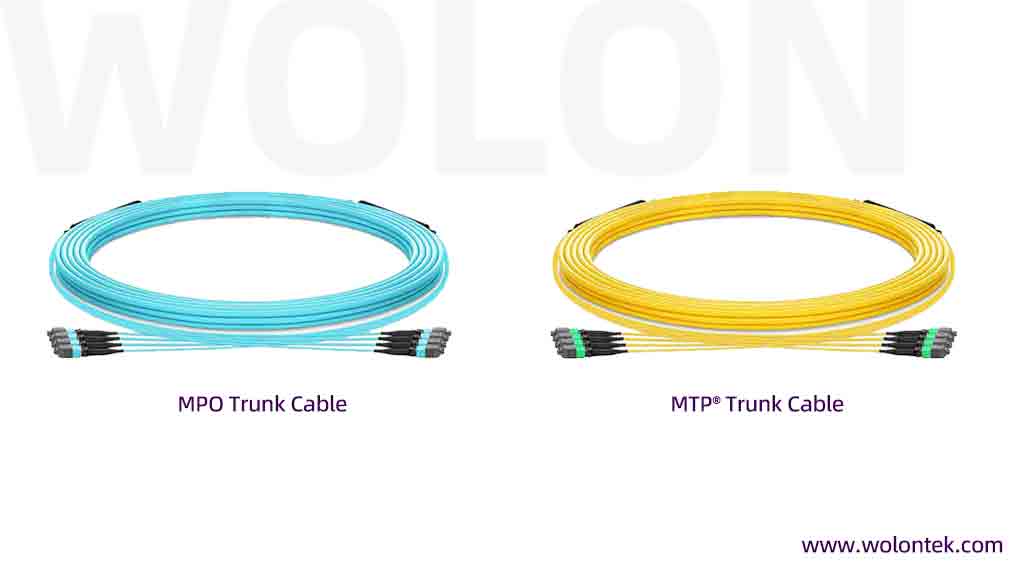
Generic MPO Trunk Cable: A standard-compliant basic version with stable conventional performance, suitable for general enterprise data centers and low-speed network deployment.
Premium MTP® Trunk Cable: A trademarked upgraded product of US Conec, built on MPO standard architecture with optimized mechanical structures including floating ferrules, elliptical guide pins, reinforced metal pin clamps, and detachable housings. It features lower insertion loss, stronger mechanical durability, and more stable long-term transmission performance, ideal for mission-critical 400G/800G AI compute clusters.
3. Trunk Cable vs Jumper vs Breakout vs Conversion Cable: Key Differences
The biggest industry pain point is the indiscriminate use of four types of MPO/MTP cables. Each cable type has fixed application scenarios and hierarchical positioning, and cross-use will directly affect network stability and scalability. The detailed comparison is as follows:
| Cable Type | Core Positioning | Deployment Location | Structural Features | Usage Attributes | Typical Application |
|---|---|---|---|---|---|
| MPO/MTP Trunk Cable | Data center backbone skeleton | MDA to HDA, HDA to EDA long-distance cross-area links | Fixed fiber count, consistent specifications at both ends, factory integral termination | Permanent fixed wiring, no frequent plugging and unplugging | Bulk fiber interconnection for overall data center layout |
| MPO/MTP Jumper Cable | Device port connection line | Switch-to-panel, transceiver-to-adapter short-distance docking | Flexible length, lightweight structure, diverse interface combinations | Frequent plugging, temporary line adjustment and debugging | Daily equipment access and link maintenance |
| Breakout/Harness Cable | Fiber terminal conversion line | Distribution cabinet terminal output port | One end MPO/MTP multi-core, one end split into multiple LC duplex ports | Fixed conversion ratio, used for signal splitting access | Convert multi-core backbone signals to conventional duplex port access |
| Conversion Cable | Heterogeneous network adaptation line | Transition connection of different specification backbone links | Realize mutual conversion of 8/12/16/24 core specifications | Auxiliary adaptation for non-standard link architecture | Legacy network upgrade and heterogeneous link compatibility |
4. Internal Structure & Working Principle of MPO/MTP Trunk Cables
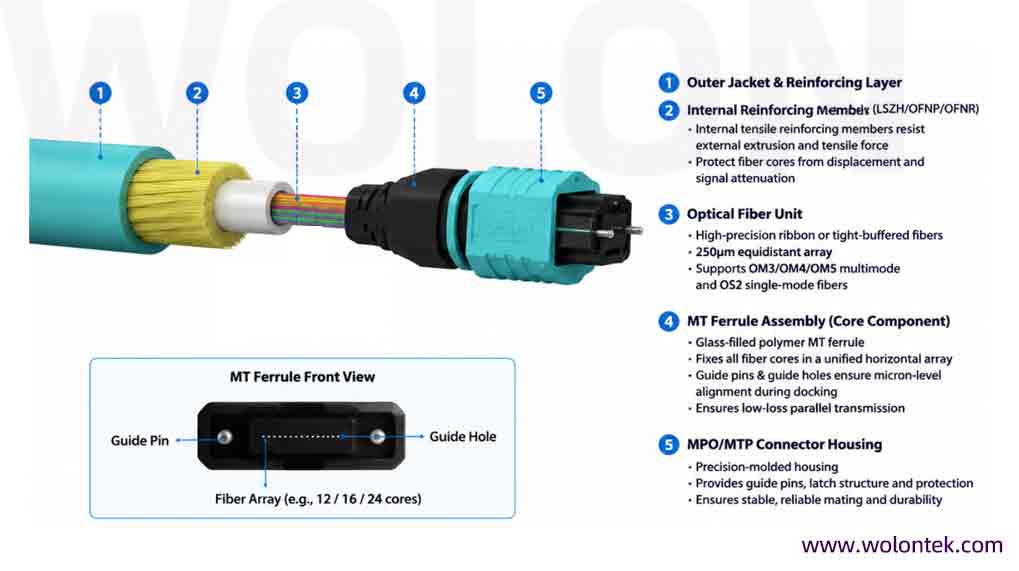
The stable low-loss transmission performance of trunk cables comes from precise industrial structural design. The complete assembly consists of five core parts: outer protective jacket, internal reinforcing member, optical fiber unit, MT ferrule component, and MPO/MTP connector housing.
Outer Jacket & Reinforcing Layer: The outer jacket adopts high-flame-retardant polymer materials such as LSZH, OFNP, and OFNR to adapt to data center fire safety standards. Built-in tensile reinforcing members effectively resist external extrusion and tensile force, avoiding fiber core displacement and signal attenuation caused by cable deformation.
Optical Fiber Unit: Adopts high-precision ribbon or tight-buffered fibers, arranged in an orderly 250μm equidistant array. It supports OM3/OM4/OM5 multimode and OS2 single-mode full-specification fiber bodies, meeting short, medium, and long-distance transmission requirements.
Core MT Ferrule Assembly: As the core precision component, the glass-filled polymer MT ferrule fixes all fiber cores in a unified horizontal array. Combined with precise guide pins and guide holes, it achieves micron-level alignment during docking, ensuring low-loss parallel transmission of multiple optical signals.
Working Principle: Different from single-core serial transmission of traditional LC/SC cables, MPO/MTP trunk cables realize multi-channel parallel optical signal transmission through integrated multi-core array design. This architecture perfectly matches 8-lane and 16-lane parallel transceivers such as SR4, DR4, and SR8, providing stable physical layer support for 40G to 800G high-speed network transmission.
5. Full Classification of MPO/MTP Trunk Cables
MPO/MTP trunk cables can be classified from five core dimensions, covering all engineering deployment scenarios:
5.1 By Fiber Core Count
Conventional mainstream specifications include 4/8/12/16/24/48 cores. Among them, Base-8 (8-core) is the optimal architecture for new-generation 400G/800G AI data centers with 100% fiber utilization. Base-12 (12-core) is the traditional mainstream specification, widely used in legacy 10G/100G high-density backbone renovation projects.
5.2 By End-Face Polishing Type
UPC (Ultra Physical Contact): Flat polishing process, low return loss, suitable for multimode links and short-reach single-mode trunk transmission, covering most conventional data center scenarios.
APC (Angled Physical Contact): 8° oblique polishing process, which deflects reflected light into the fiber cladding. It achieves ultra-high return loss (≥60dB) and is exclusively used for long-haul single-mode backbone links to avoid signal interference caused by back reflection.
5.3 By Polarity Type (TIA-568 Standard)
Type A (Straight-Through): Key Up to Key Down docking, one-to-one fiber core mapping, suitable for conventional duplex link deployment.
Type B (Fully Flipped): Key Up to Key Up docking, overall reverse fiber sequence, the standard polarity for 100G/400G SR4 parallel optical links.
Type C (Pair-Flipped): Adjacent fiber pair reverse mapping, mainly used for legacy duplex network migration and adaptation scenarios.
5.4 By Fiber Mode
Multimode Fiber (OM3/OM4/OM5): Low cost, suitable for short-distance (100m-300m) high-speed transmission, the mainstream choice for data center internal links.
Singlemode Fiber (OS2): Ultra-low attenuation, unlimited transmission distance, suitable for long-distance campus backbone and cross-building data interconnection.
5.5 By Jacket Fire Rating
LSZH: Low smoke, zero halogen, flame retardant, environmentally friendly, suitable for indoor conventional cabinet wiring.
OFNP: Highest fire resistance rating, suitable for data center ventilation ducts and trunk passage laying.
OFNR: Flame retardant and non-conductive, suitable for vertical riser wiring between floors.
6. Standard Deployment Zones & Construction Taboos
MPO/MTP trunk cables have fixed hierarchical deployment logic in data center structured cabling, and standardized laying is the key to ensuring long-term stable operation of the network.
Standard Deployment Scenarios
1. MDA to HDA Backbone: Realize long-distance interconnection between the main distribution frame and horizontal distribution area, undertaking the core data transmission of the entire computer room.
2. HDA to EDA Aggregation: Complete high-density fiber aggregation transmission from the distribution cabinet to the equipment access area, supporting multi-terminal equipment access.
Strict Construction Taboos
1. Trunk cables are prohibited from being used as equipment patch cords for frequent plugging and unplugging, which will cause end-face wear and increased loss.
2. It is not allowed to directly connect trunk cables to transceiver ports without cassette conversion, which will cause link polarity disorder and signal failure.
3. Do not mix UPC and APC end-face trunk cables in the same link, which will lead to serious return loss failure.
7. Core Technical Advantages of MPO/MTP Trunk Cables
Compared with traditional discrete single-core cabling, pre-terminated MPO/MTP trunk cables have comprehensive advantages in efficiency, density, performance and scalability:
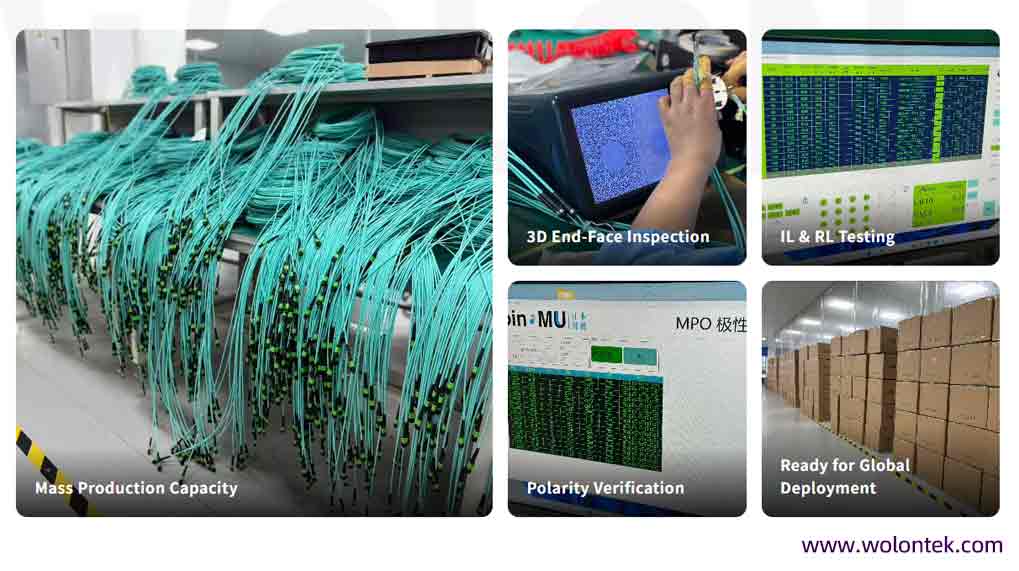
1. Ultra-High Construction Efficiency: All products are 100% factory pre-terminated and 3D interferometer tested. On-site construction eliminates complex fiber splicing and polishing processes, improving deployment efficiency by more than 80% and effectively avoiding artificial splicing loss.
2. Extreme Space Density: Integrated multi-core design replaces dozens of traditional LC cables, greatly saving cabinet space and cable tray occupancy, optimizing data center cold and hot air duct circulation, and improving heat dissipation efficiency.
3. Ultra-Low Optical Loss: Standard MPO trunk cables achieve typical insertion loss as low as 0.2dB, and MTP Elite premium versions can be controlled within 0.1dB, fully adapting to the strict loss budget requirements of 400G/800G high-speed networks.
4. Excellent Future Scalability: Modular hierarchical architecture supports smooth network upgrade from 10G/40G to 100G/400G/800G without replacing the overall backbone cable, maximizing infrastructure ROI.
5. Global Standard Compatibility: Fully compliant with IEC/TIA international standards, compatible with all mainstream brand optical modules, adapter panels, and wiring cassettes in the market, with strong universal interoperability.
8. Professional MPO/MTP Trunk Cable Selection Guide
Reasonable selection based on network architecture and deployment environment is the core of avoiding waste and future-proofing the network:
1. Select by Network Speed & Architecture
For legacy 10G/40G duplex access networks, choose Base-12 trunk cables with high density and cost advantages. For new AI compute centers and 400G/800G parallel optical networks, prefer Base-8/Base-16 trunk cables to achieve 100% fiber utilization and zero idle resources.
2. Select by Transmission Distance
Short-distance indoor machine room links (≤300m): Choose OM4/OM5 multimode UPC trunk cables. Long-distance cross-floor and campus backbone links: Choose OS2 single-mode APC trunk cables to suppress back reflection.
3. Select by Polarity Requirements
All 100G/400G SR4/DR4 parallel optical links uniformly adopt Type B polarity trunk cables; conventional duplex static links adopt Type A polarity.
4. Select by Fire Protection Grade
Data center public trunk passages and ventilation ducts: OFNP highest fire resistance grade. Indoor conventional cabinet wiring: LSZH low-smoke halogen-free environmentally friendly type. Vertical inter-floor wiring: OFNR flame-retardant type.
Q1: What is the difference between MPO trunk cable and MTP trunk cable?
A: Both are physically interoperable and compliant with the same international standards. MPO is a generic industry standard with conventional performance for ordinary enterprise networks. MTP is a premium trademarked upgrade by US Conec, with optimized floating ferrules, elliptical guide pins, and detachable housings, featuring lower insertion loss, better wear resistance, and more stable performance for high-speed mission-critical networks.
Q2: Can MPO/MTP trunk cables be used as patch jumpers?
A: No. Trunk cables are designed for permanent fixed backbone wiring, with thick protective layers and poor flexibility. Frequent plugging and unplugging will cause end-face wear, pin deformation, and increased attenuation. Short-distance device docking must use professional flexible patch jumpers.
Q3: What polarity is suitable for 100G/400G SR4 trunk links?
A: Type B polarity is the unified standard for all SR4/DR4 parallel optical links. It realizes overall flipping of fiber cores through Key-Up to Key-Up docking, matching the Tx/Rx lane arrangement of QSFP transceivers to ensure normal signal transmission.
Q4: Which is better for data center backbones, 8-core or 12-core trunk cables?
A: It depends on the network architecture. Base-12 is more cost-effective and dense for traditional 10G duplex access legacy rooms. Base-8 is the optimal choice for new 400G+ AI data centers, which can perfectly match 8-lane parallel modules without fiber waste and support seamless upgrade to 800G/1.6T networks.
Q5: Do MPO trunk cables need on-site testing after installation?
A: Yes. Although all trunk cables pass 100% factory testing, on-site laying may cause extrusion, bending or contamination. Secondary testing of insertion loss, return loss and polarity is required after construction to ensure link compliance with network loss budget standards.
Q6: What is the standard insertion loss of MPO/MTP trunk cables?
A: Standard generic MPO trunk cables have a maximum insertion loss of ≤0.6dB for multimode and ≤0.75dB for single-mode. Premium MTP trunk cables are controlled within 0.4dB, and MTP Elite ultra-low-loss versions can reach ≤0.35dB, meeting ultra-strict 400G+ loss budget requirements.
Q7: Can UPC and APC trunk cables be mixed in one link?
A: Absolutely not. UPC flat contact and APC 8° angled contact have different physical docking structures and return loss indicators. Mixed use will cause poor end-face fitting, serious signal reflection, excessive loss, and even link disconnection.
Conclusion: Future-Proof Your Data Center Backbone
MPO/MTP trunk cables are the core backbone of modern high-density data center structured cabling systems, solving the density and efficiency bottlenecks of traditional low-speed cabling. With standardized specifications, factory pre-termination, ultra-low loss performance and strong scalability, they have become the mandatory infrastructure for 40G to 800G network construction.
Infrastructure selection needs to keep pace with network iteration. The traditional Base-12 trunk system is still reliable for legacy 10G/40G network renovation, while the Base-8 architecture has become the mainstream trend of next-generation AI data centers with zero fiber waste and smooth ultra-high-speed upgrade capabilities.
As a professional manufacturer of high-density optical cabling solutions, WolonFiber provides full-series MPO/MTP trunk cables, breakout harnesses, and conversion cassettes. All products undergo 100% 3D interferometer end-face testing to ensure ultra-low-loss and high-stability transmission performance. Our professional engineering team provides customized backbone layout design, network upgrade consulting and sample testing services to help you build future-proof optical layer infrastructure.