1. Introduction: The High-Density Network Dilemma
As global data center infrastructures rapidly migrate toward AI compute clusters and hyperscale cloud architectures, 400G and 800G parallel optical networks have become mainstream deployment standards. To support such ultra-large bandwidth demands, high-density pre-terminated fiber cabling has evolved from an optional upgrade to a fundamental requirement for modern server room construction.
However, infrastructure planners face a common industry dilemma: most network engineers and procurement teams struggle to select the optimal cabling architecture between Base-8 (MPO-8) and Base-12 (MPO-12) systems. Improper selection leads to persistent structural issues, including massive unused dark fibers, overrun optical loss budgets, and excessive hardware replacement costs during future network upgrades.
While traditional MPO 12 connectors and standard MPO 12 UPC solutions still dominate legacy 10G/40G data center backbones, the widespread adoption of 8-lane parallel transceivers has reshaped modern cabling design standards.
This technical guide systematically compares the structural definitions, fiber utilization efficiency, and long-term scalability of MPO-8 and MPO-12 architectures. It provides clear scenario-based selection principles to help you build stable, cost-effective, and future-proof high-density physical layer networks.
2. Basic Definition: What Are MPO-8 and MPO-12 Cabling Systems?
Before analyzing performance differences, it is critical to clarify the structural characteristics and application positioning of the two mainstream Base-series trunk cabling systems.
2.1 MTP®/MPO-8 Base Cabling System
The Base-8 architecture adopts an 8-fiber layout as the core unit. Though the external connector size conforms to universal MPO standards, the internal MT ferrule is precisely configured with 8 fiber cores. High-count backbone trunks are expanded in multiples of 8, including 16-core, 24-core, and 32-core specifications.
Optical Channel Mapping: The 8 fibers are divided into 4 Transmit (Tx) and 4 Receive (Rx) symmetrical channels, perfectly matching the lane configuration of mainstream 8-lane QSFP28, QSFP56, and QSFP112 transceivers.
Speed Adaptability: Base-8 cabling is fully optimized for 40G-SR4, 100G-SR4/DR4, 400G, 800G, and next-generation 1.6T parallel optical networks. This architecture achieves 100% fiber utilization without idle strands, maximizing infrastructure ROI.
Ecosystem Components: The complete system supports MPO-8 to LC breakout cables, 8-core conversion cassettes, and full-series patch cords, covering single-mode OS2 UPC/APC and multimode OM4/OM5 applications.
🔗 Efficient, Low-power: Base-8/16 Cabling Shaping the Future of AI Data Centers
2.2 MTP®/MPO-12 Base Cabling System
The Base-12 architecture is a classic industry-standard backbone cabling solution. The standard MPO 12 connector fully utilizes the MT ferrule space with 12 fiber cores, serving as the primary high-density cabling choice for medium and large-scale enterprise data centers.
Deployment Scenarios: Primarily applied to Main Distribution Areas (MDA) and long-distance campus backbone links, where high fiber density per conduit is the core priority.
Port Conversion Logic: A 12-fiber trunk can be split evenly into 6 independent LC duplex channels, delivering high flexibility for traditional 10G Ethernet access. However, when adapting to 8-lane transceivers such as 100G-SR4, 4 fibers per connector remain permanently unused.
End-Face Specifications: Two mainstream polishing types cover diverse link demands. MPO 12 UPC features a flat physical contact surface, suitable for multimode and short-reach single-mode links. MPO 12 APC adopts a precise 8° angled polish, which effectively eliminates back reflection and is exclusively used for long-haul single-mode backbone transmission.
🔗 Exploring MTP®/MPO-12 Cabling in 10G/40G/100G Networks
3. Core Comparison: MPO-8 vs MPO-12 Cabling
In data center physical layer planning, two core indicators determine cabling value: immediate fiber utilization and deployment efficiency, and long-term network upgrade scalability.
3.1 Fiber Utilization & On-site Deployment Efficiency
MPO-12 systems have long been recognized for high single-port fiber density, optimizing patch panel and cable tray capacity in traditional data centers. Nevertheless, the mainstream adoption of 8-lane parallel optical transceivers for 40G, 100G, and 400G networks exposes a critical defect in Base-12 architecture.
When a 12-fiber trunk connects to an 8-fiber transceiver, 4 fibers (33% of the total capacity) are left idle. On hyperscale data center campuses, this results in massive wasted cabling investment and low infrastructure utilization.
In contrast, the symmetrical 4Tx+4Rx layout of the MPO-8 system perfectly matches modern 16/32/64-port switch line cards. It delivers neat, symmetrical cable routing and 100% fiber utilization for all 8-lane high-speed links.
| Comparison Category | MTP®/MPO-8 Base System | MTP®/MPO-12 Base System |
|---|---|---|
| Fiber Utilization | 100% match for 8-lane transceivers (SR4/DR4); zero wasted fibers | Only 8 fibers functional for 8-lane modules; 4 idle fibers per connector (33% waste) |
| Connector Density | Medium density with standard 8-fiber MT ferrule layout | Industry-leading single-port density; MPO 12 connector as the mainstream high-density spec |
| End-face Options | UPC/APC for single-mode; UPC for multimode | MPO 12 UPC for multimode/short-reach SM; MPO 12 APC for long-haul SM backbones |
| Wiring Compatibility | Fits 16/32/64-port switch line cards for standardized, tidy rack management | Provides 6 duplex channels, causing port count mismatch with modern even-port line cards |
3.2 Future Scalability & Network Upgrade Capacity
Legacy 10G/25G Networks: Both architectures support smooth fan-out to LC duplex ports with stable performance, with no obvious gap in application adaptability.
Mid-tier 40G/100G Cloud Fabrics: Base-8 exhibits outstanding advantages. Direct MPO-8 trunk connections eliminate redundant conversion hardware, saving procurement costs and preserving limited optical loss budgets.
Next-gen 400G/800G/1.6T AI Clusters: Base-8 is the definitive future-proof solution. Existing MPO-8 infrastructure can adapt to 16-lane 400G-SR8 transceivers via a simple MPO-16 to dual MPO-8 breakout cable, requiring no backbone reconstruction.
For MPO-12 legacy systems, upgrading to 8-lane 400G networks requires additional 12-to-8 fiber conversion cassettes. This extra hardware increases deployment costs and introduces 0.3 dB to 0.5 dB additional insertion loss per link, which easily exceeds the tight loss budget of 400G+ high-speed optical networks.
4. Clear Selection Guide: When to Choose MPO-8 vs MPO-12
To maximize infrastructure ROI and achieve long-term network compatibility, follow the standardized scenario-based selection rules below.
Scenario 1: Choose MTP/MPO-8 Cabling If:
- You are constructing greenfield AI compute clusters or 400G/800G hyperscale data centers
- The network is dominated by 8-lane QSFP transceivers, including 100G-SR4/DR4 and 400G-DR4/SR8
- The IT roadmap includes future upgrades to 800G or 1.6T ultra-high-speed optical fabrics
- Core switches adopt 16/32/64-port line cards, requiring symmetrical, zero-waste cabling layout
Scenario 2: Choose MTP/MPO-12 Cabling If:
- You are upgrading legacy 10G/25G data center backbones with high-density demands
- Deploying long-haul campus trunk links that prioritize maximum fiber capacity per conduit, utilizing standard MPO 12 UPC/APC connectors
- The access layer relies entirely on 10G/25G duplex LC connections, with no parallel optics upgrade plan
- Building SME facilities with limited budgets and no short-term 400G upgrade requirements
Can MTP®/MPO-8 and MTP®/MPO-12 connectors be directly connected in one link?
Direct mating is not supported. Although the two connectors share identical external housing dimensions, their internal fiber core arrangements and guide pin intervals differ completely. Direct connection will cause severe signal attenuation and permanent end-face damage. However, the two systems can operate independently in the same data center without mutual interference.
What is the difference between MPO 12 UPC and MPO 12 APC connectors?
The core difference lies in end-face polishing technology and back-reflection performance. MPO 12 UPC features a flat ultra-physical contact surface, suitable for multimode and short-reach single-mode links. MPO 12 APC adopts an 8° angled polish that deflects reflected light into the fiber cladding, achieving return loss ≥60 dB. It is the mandatory standard for long-haul single-mode backbone links.
Do I need conversion cassettes when using an MPO-12 connector with 100G SR4 transceivers?
Yes, conversion cassettes are required for valid 8-lane transmission. To apply 100G SR4 8-fiber transmission over MPO-12 trunks without idle fibers, a professional 12-to-8 fiber conversion cassette is necessary. This solution enables valid signal transmission but increases hardware costs and link insertion loss.
Can existing MPO-12 trunk cables be upgraded to support a 400G network?
Technically feasible but not optimal. MPO-12 to 400G upgrades rely on conversion cables or cassettes to adapt 12-fiber infrastructure to 8/16-lane transceivers. The additional conversion structure raises deployment costs and optical attenuation. In comparison, MPO-8 architecture supports 400G upgrades with zero hardware modification and zero performance loss.
Are MPO-8 and MPO-12 MT ferrules interchangeable?
No. Although they belong to the same MT ferrule family, MPO-8 and MPO-12 ferrules have different fiber arrangement rules and guide pin positioning parameters. Manual replacement and assembly without professional factory calibration will cause alignment errors and link failure.
Conclusion: Aligning Infrastructure with the Future
The MPO 12 connector-based Base-12 cabling system remains a cost-effective, high-density solution for traditional 10G/25G enterprise backbones. With flexible UPC and APC polishing options, it fully meets the deployment demands of legacy data centers and campus long-distance links.
Nevertheless, driven by AI computing and 400G/800G ultra-high-speed iteration, the Base-8 architecture has become the new industry standard for next-generation data centers. Its native matching with 8-lane parallel optics achieves 100% fiber utilization, eliminates invalid infrastructure investment, and provides a smooth upgrade path for future 800G and 1.6T networks.
Selection Golden Rule: Choose MPO 12 UPC/APC cabling for legacy 10G backbone renovation and high-density duplex LC access scenarios. Choose MPO-8 cabling for all new 400G+ AI compute centers and long-term scalable high-speed optical fabrics.
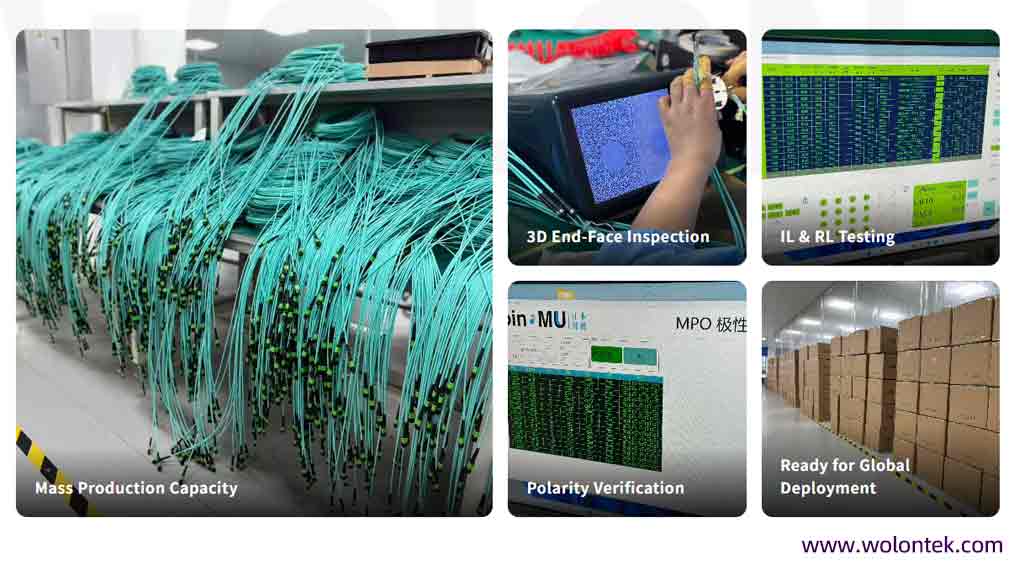
WolonFiber provides full-series MPO-8/MPO-12 pre-terminated cabling solutions. All trunk cables, breakout harnesses, and conversion cassettes undergo 100% 3D interferometer testing to ensure ultra-low-loss performance. Our professional engineering team offers customized layout design and upgrade consulting services to future-proof your optical network infrastructure.