

Custom 100G QSFP28 Single Lambda Transceiver (DR/FR/LR)
-
4-to-1 Lane Conversion: Integrates an advanced Digital Signal Processor (DSP) to translate four 25Gbps NRZ electrical host lanes into a solitary 100Gbps PAM4 optical signal.
-
Forward Interoperability: Optically maps directly to 400GBASE-DR4, XDR4, and PLR4 switch architectures via MPO-to-4xLC breakout cabling.
-
Component Reduction: Utilizing a single EML laser drastically lowers the hardware failure rate and improves the Mean Time Between Failures (MTBF).
-
Span Configurations: Firmware and optical outputs are factory-calibrated for exact IEEE 802.3cu specifications: DR (500m), FR (2km), and LR (10km).
Product Description
Transitioning to 400G infrastructures necessitates backward-compatible 100G edge optics. Standard 100GBASE-LR4 modules multiplex four separate wavelengths, rendering them optically incompatible with 400G ports. The Single Lambda QSFP28 resolves this by utilizing PAM4 encoding over a single 1310nm wavelength. Procured directly from WolonFiber's manufacturing base, this transceiver enables network engineers to patch 100G leaf switches directly into next-generation 400G spine routers without signal mismatches.
Key Features
-
Host FEC Dependency: Decoding complex PAM4 signals requires the host switch port to actively support and enforce KP4 Forward Error Correction (FEC).
-
Thermal Footprint: Eliminating three localized lasers drops the aggregate power dissipation below 3.5W, well within standard QSFP28 thermal thresholds.
-
MSA Memory Flashing: EEPROM data is custom-written prior to dispatch, preventing proprietary operating systems (such as Cisco NX-OS or Juniper Junos) from disabling the port.
Application Scenarios
-
Leaf-to-Spine uplinks funneling 100GbE traffic into centralized 400G PAM4 core routers.
-
High-density single-mode data halls requiring reduced power consumption per 100G port.
Technical Specifications
| Specification | Details | Specification | Details |
| Form Factor | QSFP28 | Vendor Name | WolonFiber |
| Data Rate | 106.25Gbps | Modulation | PAM4 |
| Wavelength | 1310nm (Single Lambda) | Reach Options | 500m (DR), 2km (FR), 10km (LR) |
| Connector | Duplex LC | Cable Type | Single-Mode Fiber (SMF) |
| Transmitter | Single EML | Receiver | PIN |
| TX Power | -2.9 to 4.0dBm (DR spec) | RX Sensitivity | < -5.9dBm |
| Power Draw | ≤ 3.5W | Operating Temp | 0 to 70°C (32 to 158°F) |
| Host FEC | KP4 FEC (Mandatory) | Protocols | 100G Lambda MSA, IEEE 802.3cu |
Engineering FAQs
-
Q: Can this transceiver establish a link with a standard 100GBASE-LR4?
A: No. A 100GBASE-LR4 transmits four distinct 25G NRZ wavelengths. This module uses one 100G PAM4 wavelength. The optical formats cannot handshake.
-
Q: How is the physical connection made to a 400G switch?
A: A 400GBASE-DR4 module is placed in the core switch. An MPO-to-4xLC single-mode breakout cable separates the 400G signal. The four LC ends connect to four individual 100G Single Lambda modules.
-
Q: Does the DSP chip introduce latency?
A: Yes. The mathematical PAM4 encoding/decoding process inside the DSP adds approximately 100-150 nanoseconds of latency compared to analog NRZ transceivers.
-
Q: Is optical attenuation required for bench testing?
A: For the DR (500m) variant, the maximum transmit power usually sits below the receiver overload limit, but technicians must verify exact optical metering before back-to-back patching.
Related products
-
Sale!
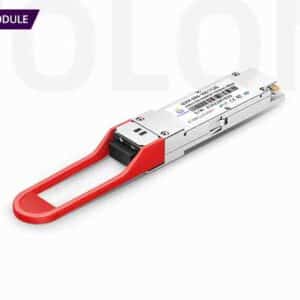
Custom 100GBASE-ER4 QSFP28 Transceiver (ER4 & ER4L)
Original price was: $1,749.00.$593.75Current price is: $593.75. -
Sale!
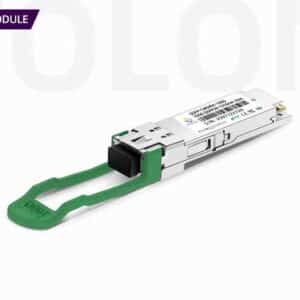
Custom 100G QSFP28 CWDM4 Optical Transceiver
Original price was: $161.00.$93.75Current price is: $93.75. -
Sale!
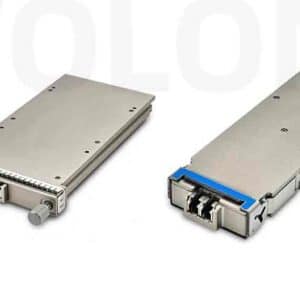
Custom 100G CFP & CFP2 Optical Transceivers (Carrier-Grade)
Original price was: $3,869.00.$1,187.50Current price is: $1,187.50. -
Sale!
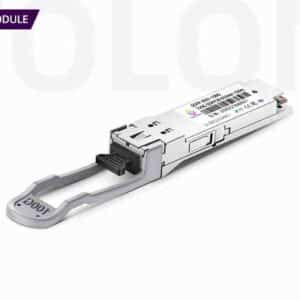
Custom 100G QSFP28 BiDi Optical Transceiver
Original price was: $419.00.$226.00Current price is: $226.00.


Reviews
There are no reviews yet.